South East Asia
Thailand, Cambodia, Vietnam and Hong Kong
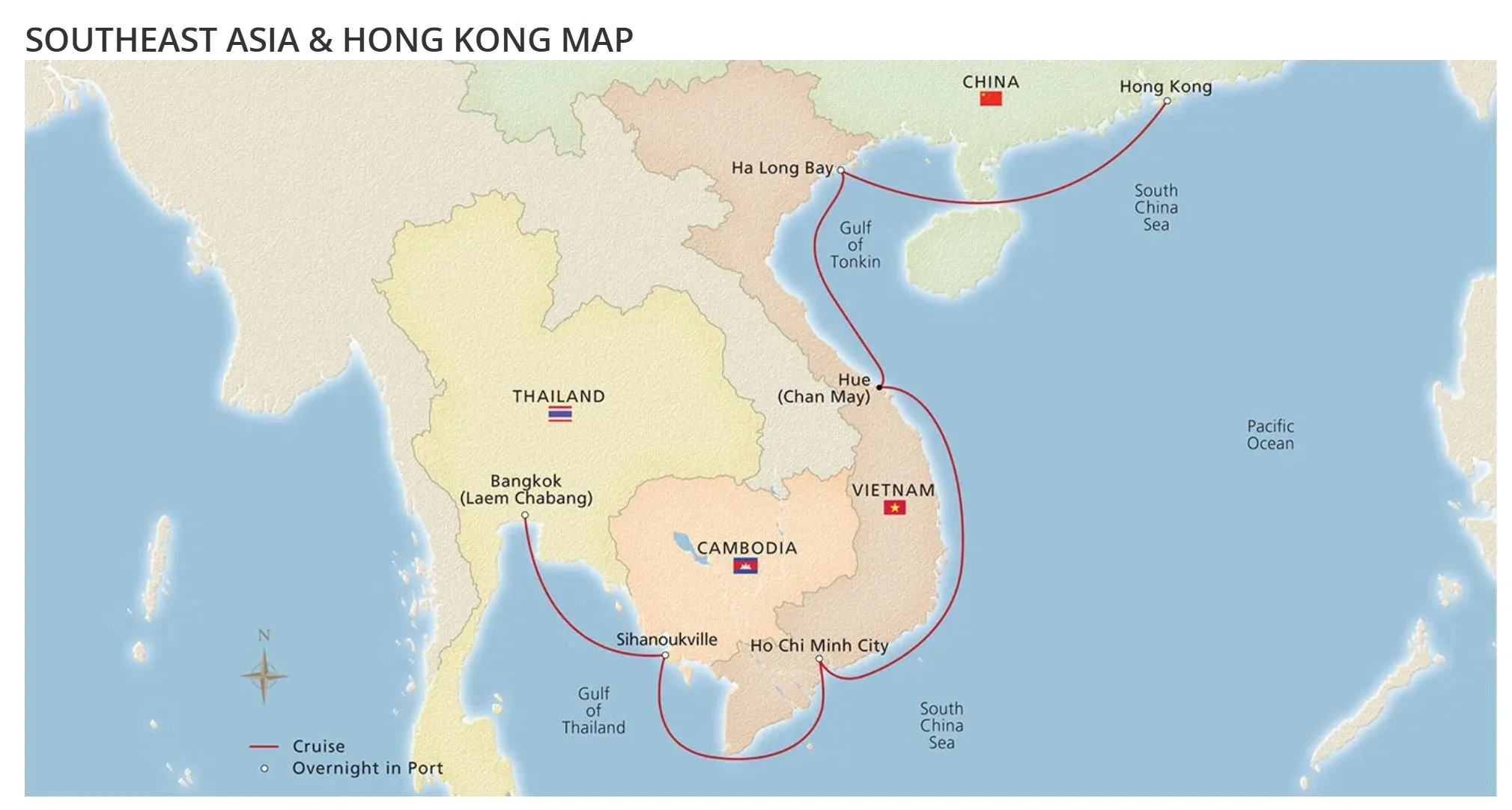
We embarked on another Viking Cruise Lines trip to South East Asia. We spent a few days in Bangkok prior to boarding our ship, Viking Orion. Then we sailed to ports in Cambodia, Vietnam and Hong Kong. We were able to go on extensive excursions at each port. Here’s an account of the voyage.
Note: None of my images include AI generated content.
Bangkok Thailand
Travel to Bangkok from Phoenix involved 22 hours of time in the air and, with layovers, a total of 28 hours of actual travel.
We had arranged our flights to arrive in Bangkok early in the afternoon with the intent that we’d have some time to get out in the evening and explore. When we landed however, we were so exhausted that we just collapsed into bed at the hotel.
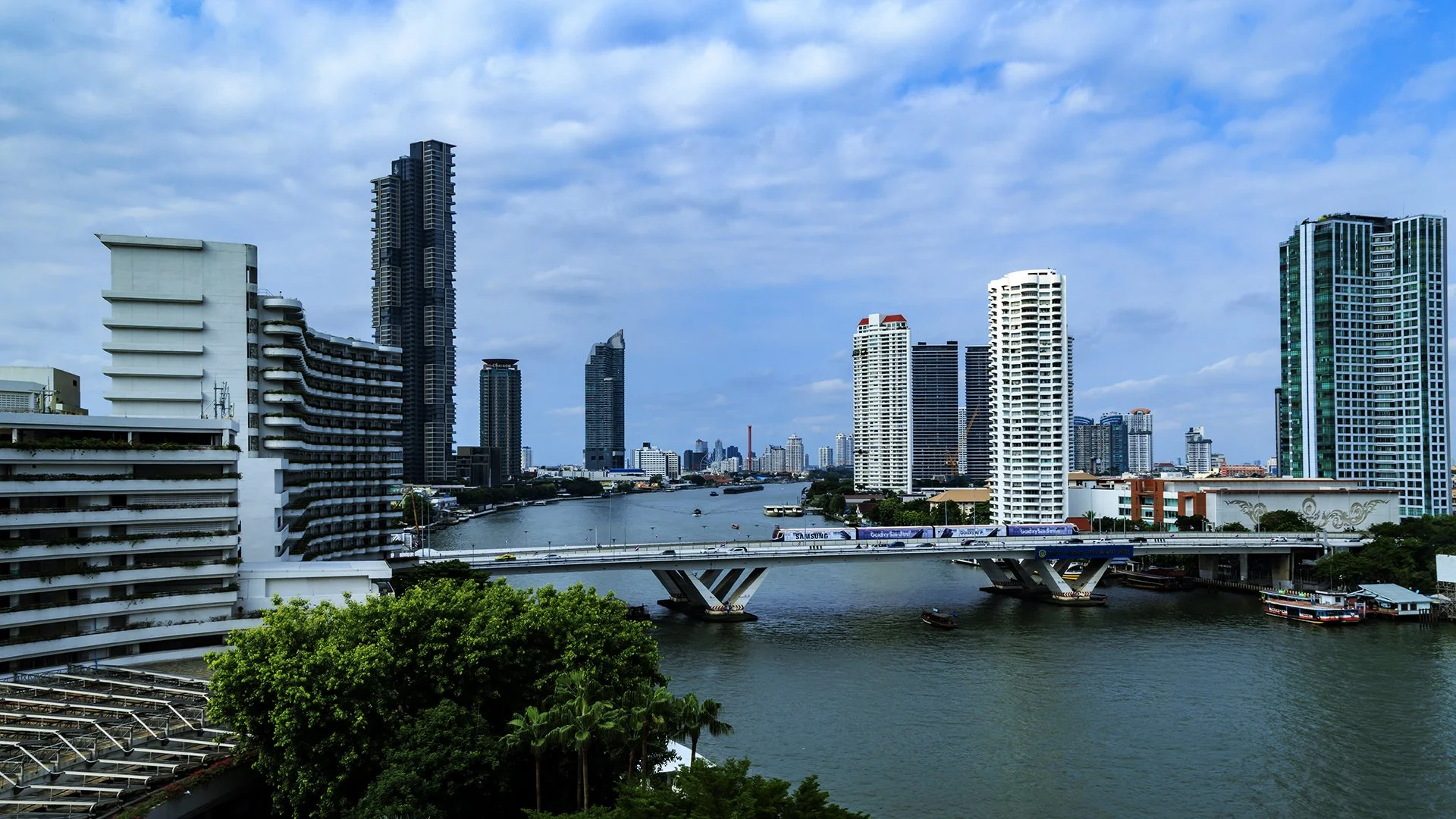
I managed to take only one photograph that day. This image is of the Chao Phraya River from our hotel room at the Shangri-La in Bangkok.
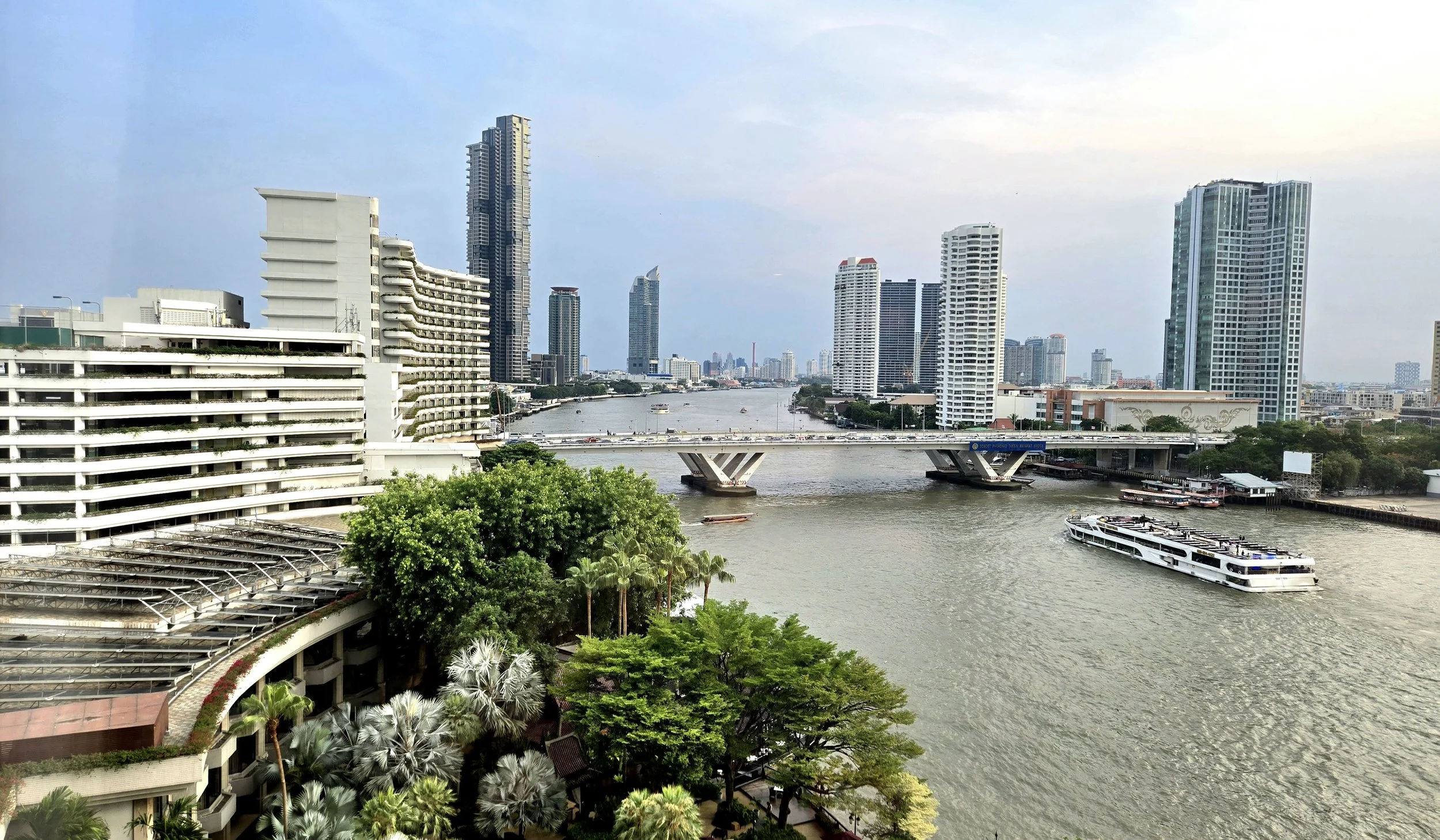
The following day we had tours planned but before they started, we took a few minutes to walk around the streets near our hotel. We only had an hour or so but had a nice walk and then breakfast back at the hotel. I took this cell phone snapshot from the breakfast terrace.
Later, after a nice breakfast at the hotel, we boarded buses for our first tour: the compound containing the Royal Palace and the temple of the Emerald Buddha (called Wat Phro Kaeo - “Wat” means “temple”).
Since it was a large group tour, we had to keep moving along. As a result, it was difficult finding shots without a bunch of people in them or that captured a wide perspective of the complex.
This first shot is the skyline of the entire complex as we arrived. The roofs of the various buildings are largely covered in porcelain tiles that reflect the sun.
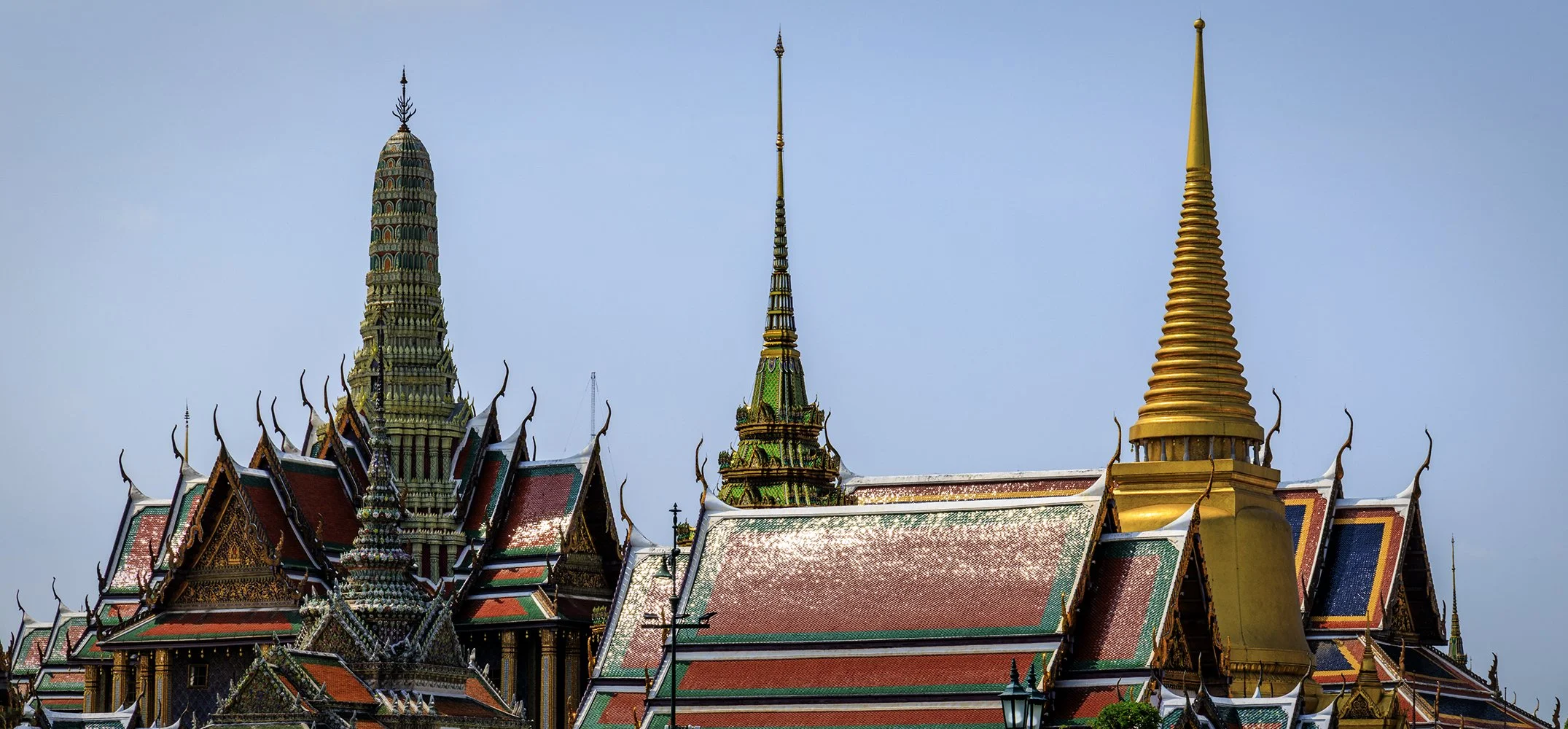
I used a polarizing filter for the shot to reduce the glare on the roof tiles. I wanted to show detail but since my orientation to the buildings did not put me at right angles to the sun, the filter didn't eliminate all of the reflected glare.
I think that's OK because although I wanted to keep some detail in the roofs I do think that the sparkle of the roof tiles is important to the story of the place. The balance I achieved in this photograph seems right to me.
Entering the Royal Palace and temple complex in Bangkok is not simple. There is a massive underground entrance foyer where people line up and show tickets. Fortunately we moved through quickly because there was special arrangements for the group tour.
Once we entered the compound I took the following photograph showing the front of Wat Phro Kaeo (or Wat Phra Kaew — I’ve seen it spelled both ways). Since the wall of the compound was close to the temple on the right I didn't have the option to photograph it from directly in front but I think the angled shot in the first image works fine.
It shows the front of the temple (with the red roof) and one of the three white Prangs (also called pagodas or stupas) arranged around the temple. These represent Brahma, Vishnu and Shiva from Hinduism (which has largely merged into Theravada Buddhism).
You can also see the stone guardian warriors arranged around the temple grounds. These are called "Chinese Attendants" or Jin Siang. They guard the temple as symbols of protection and stability.
These statues came to Thailand as ballast in Chinese trading ships in the 18th and 19th centuries. Thus the statues also represent foreign trade and cultural exchange.
They are human figures as opposed to demons and are often represented as general, scholars or court officials.
Subsequent images give more details from around the temple.
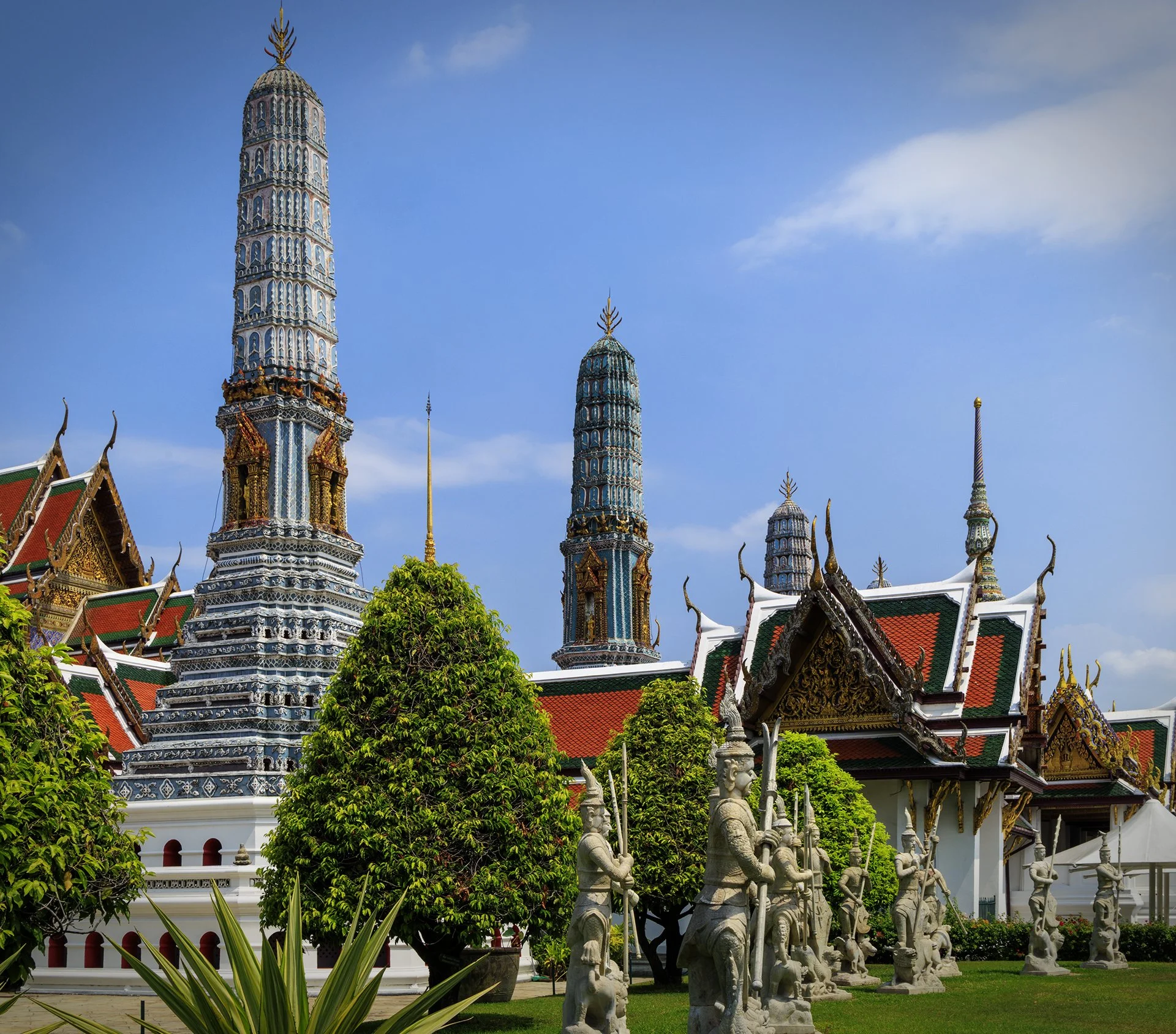
Front of the temple of the Emerald Buddha showing the stupas and the guardian statues.
After that we wandered the area around the temple. It was very impressive. I took a lot of photos even though the conditions where challenging. Here are samples…
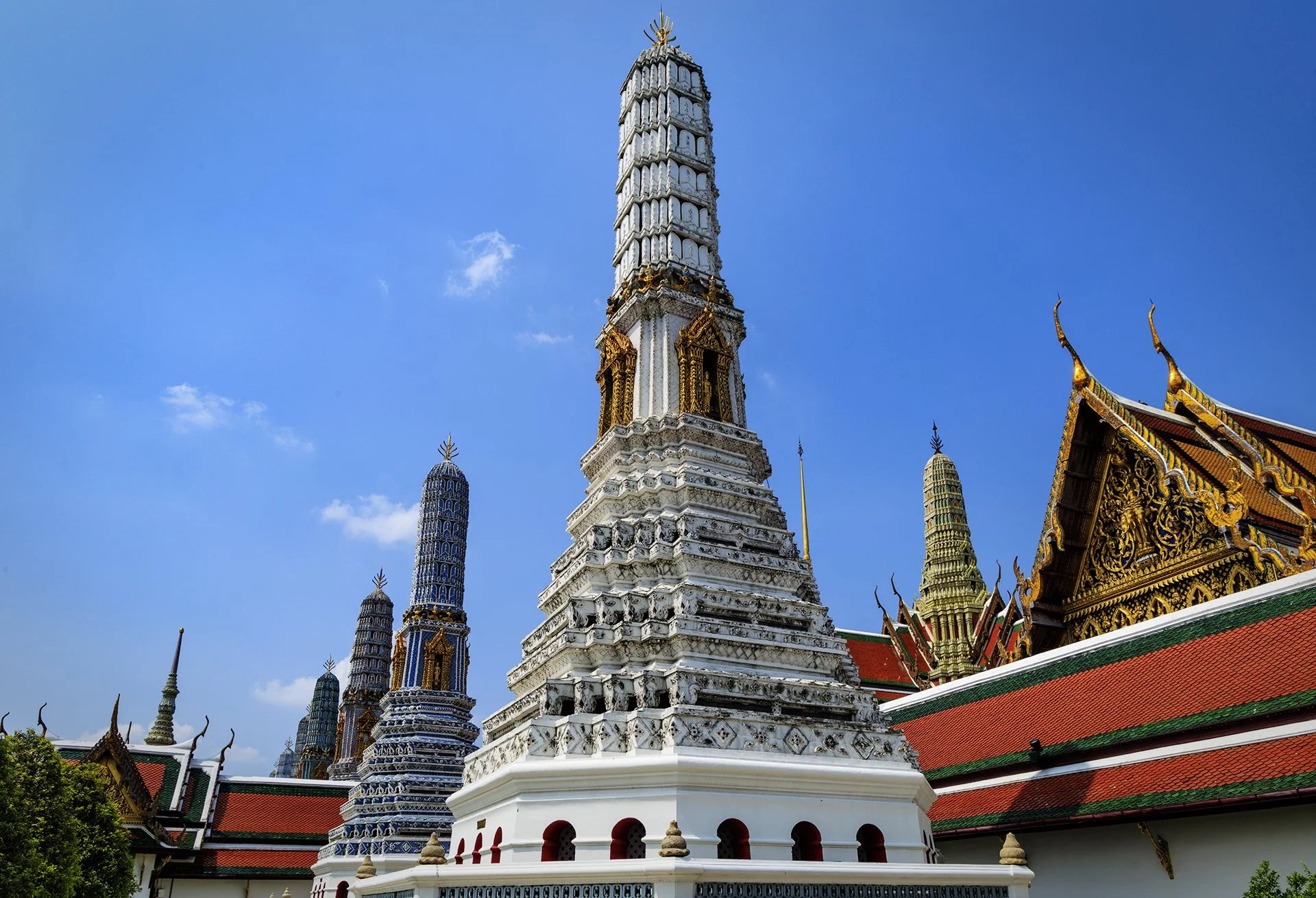
One of the three white stupas around the temple.
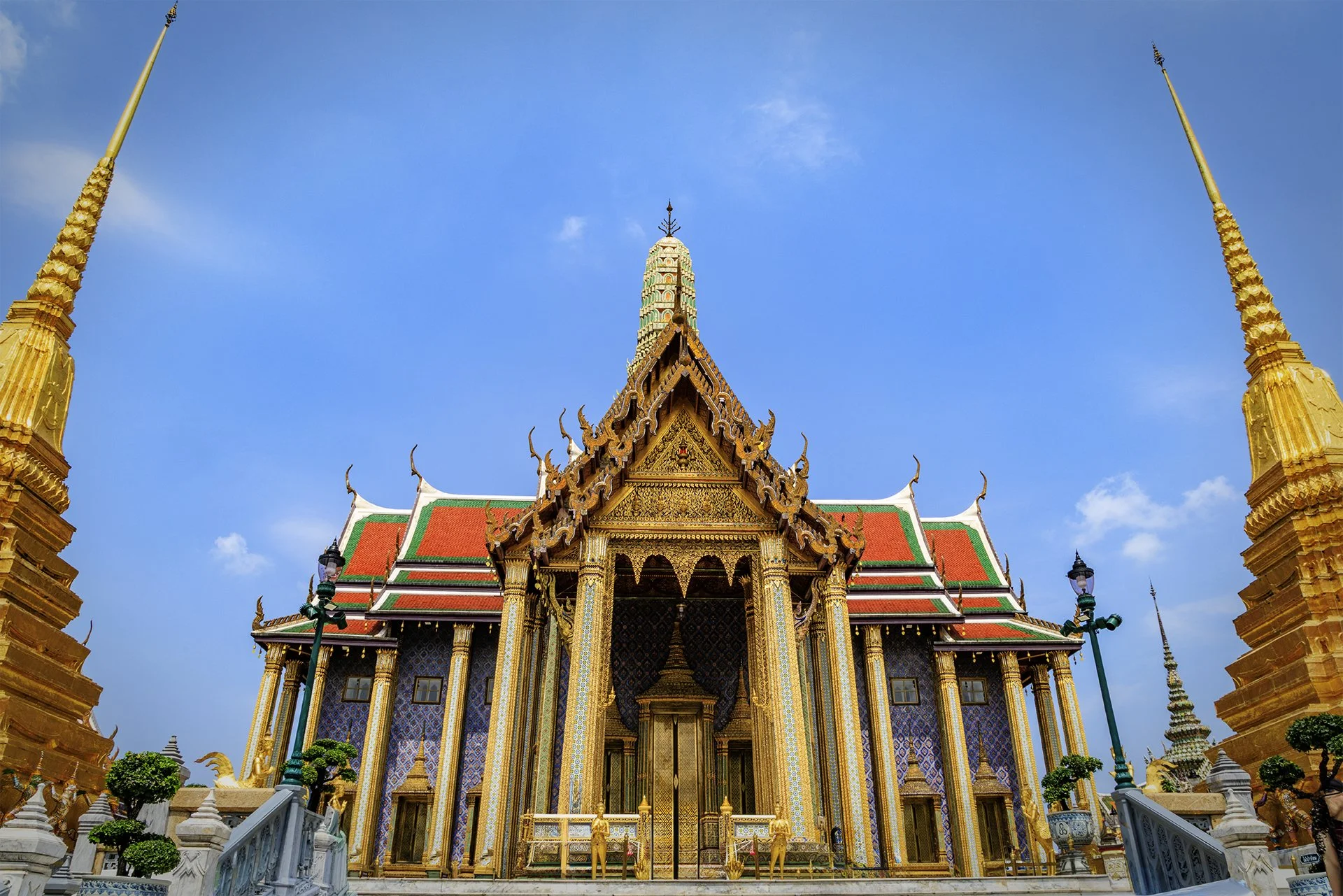
Main entrance flanked by stupas.
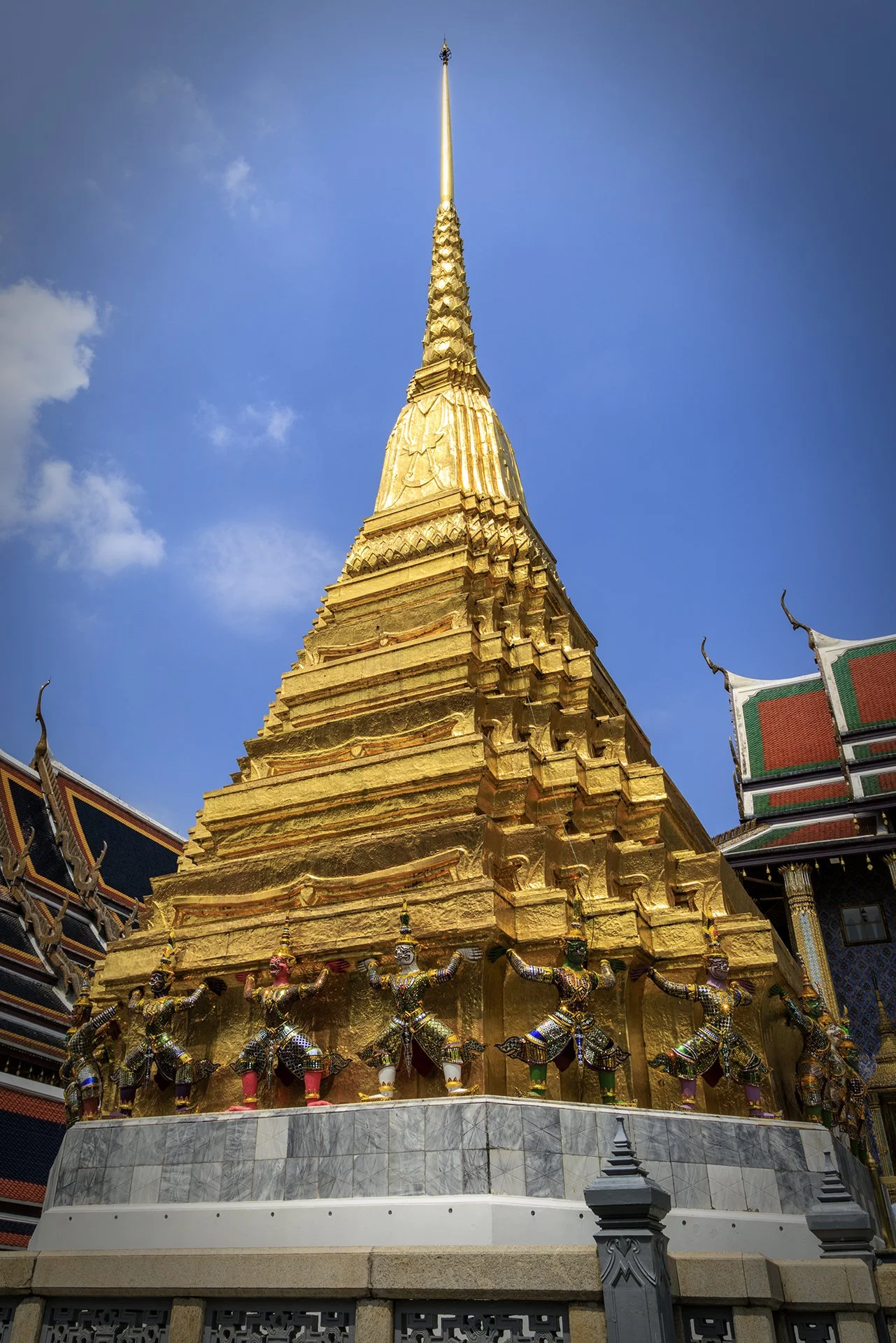
Another pagoda (or stupa) on the temple grounds.
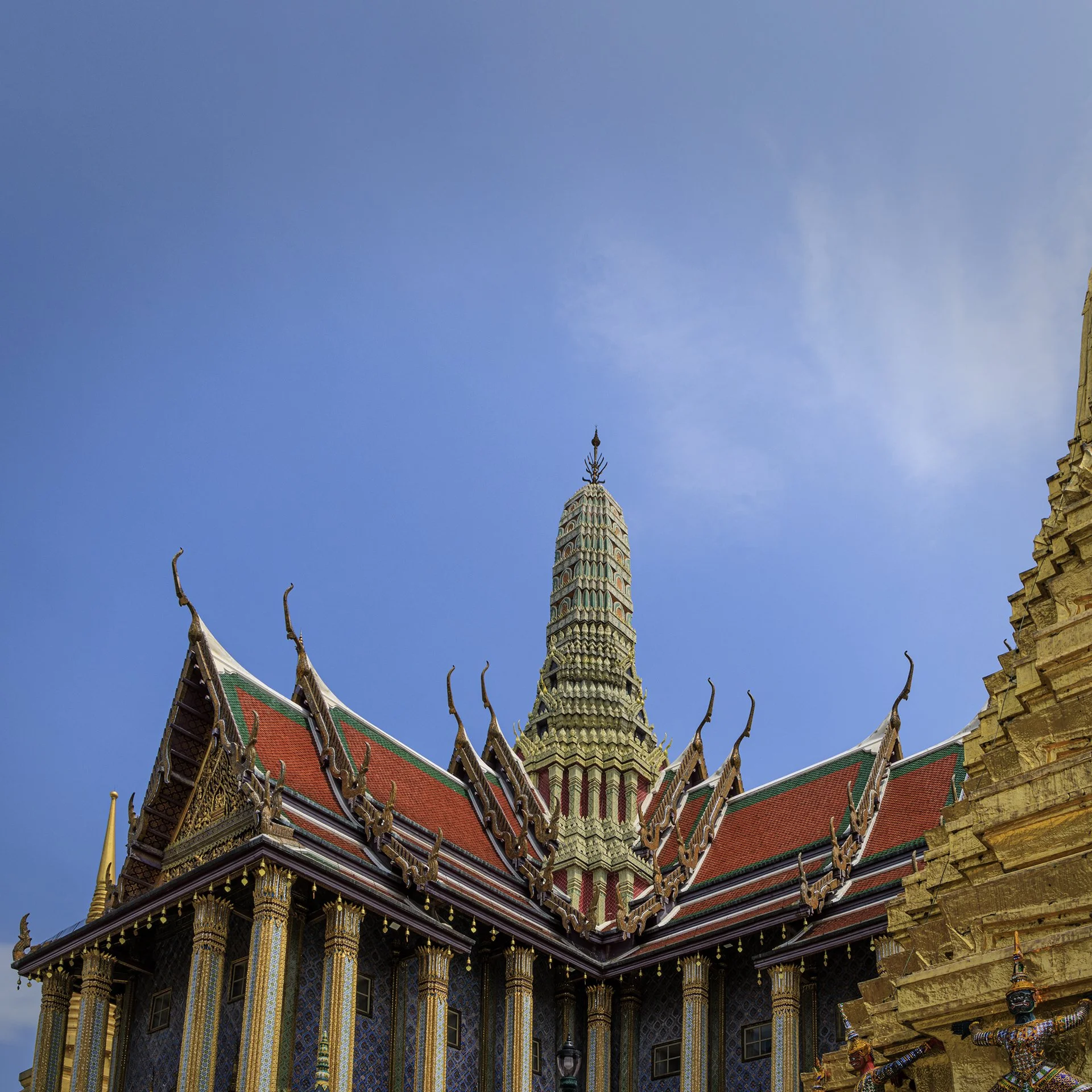
Another view of the temple with the central stupa.
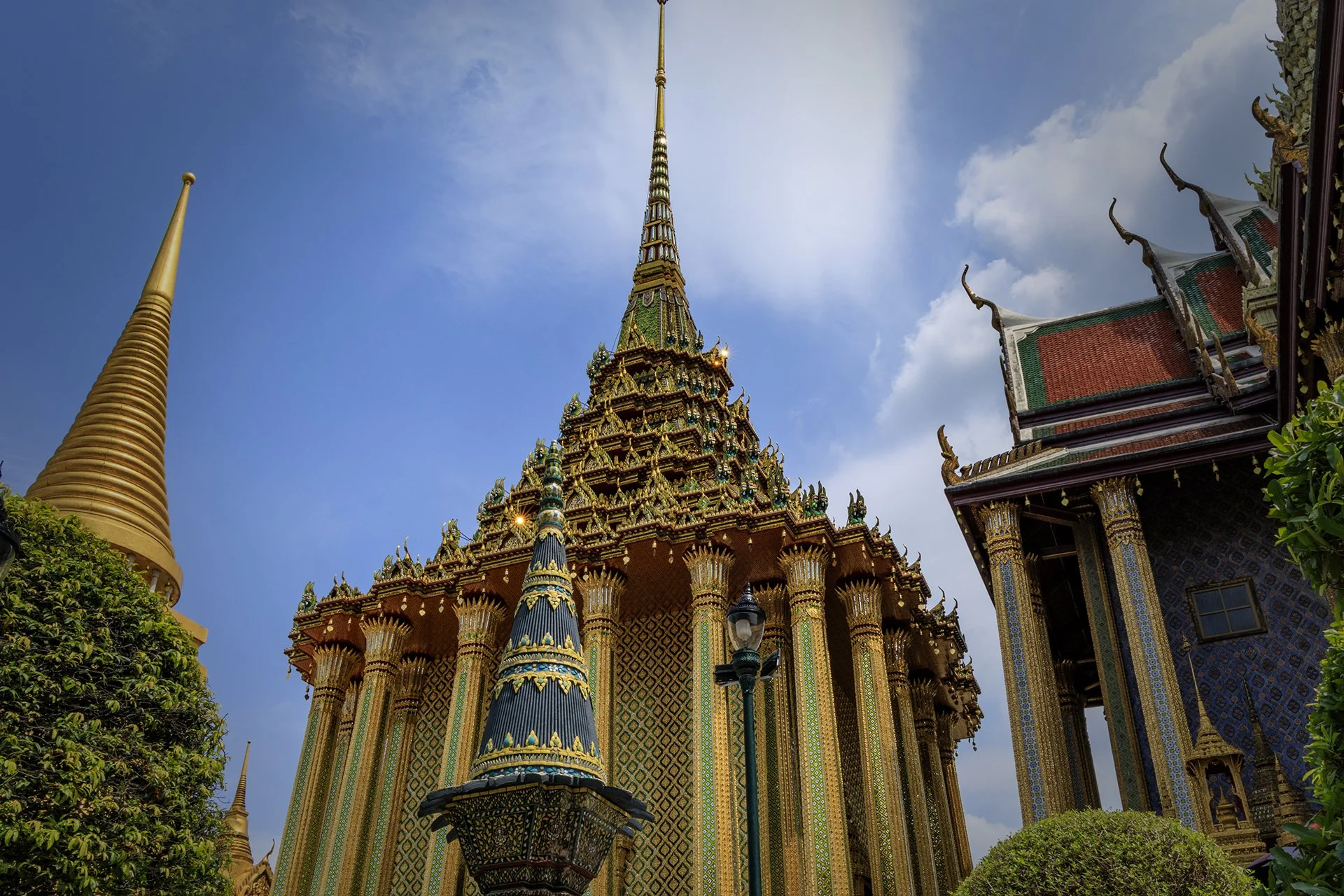
Phra Mondop Library at the temple.
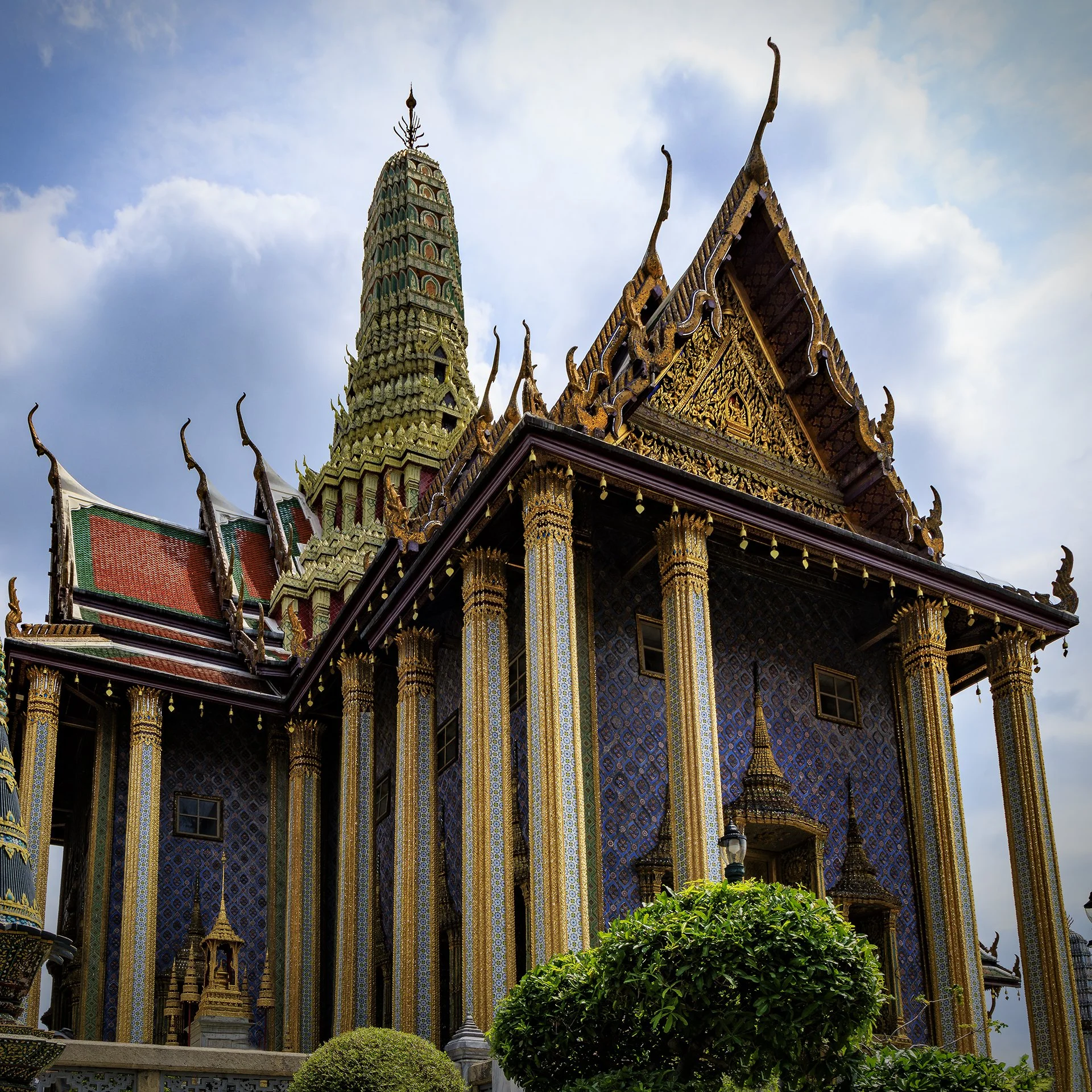
Another view of the temple.
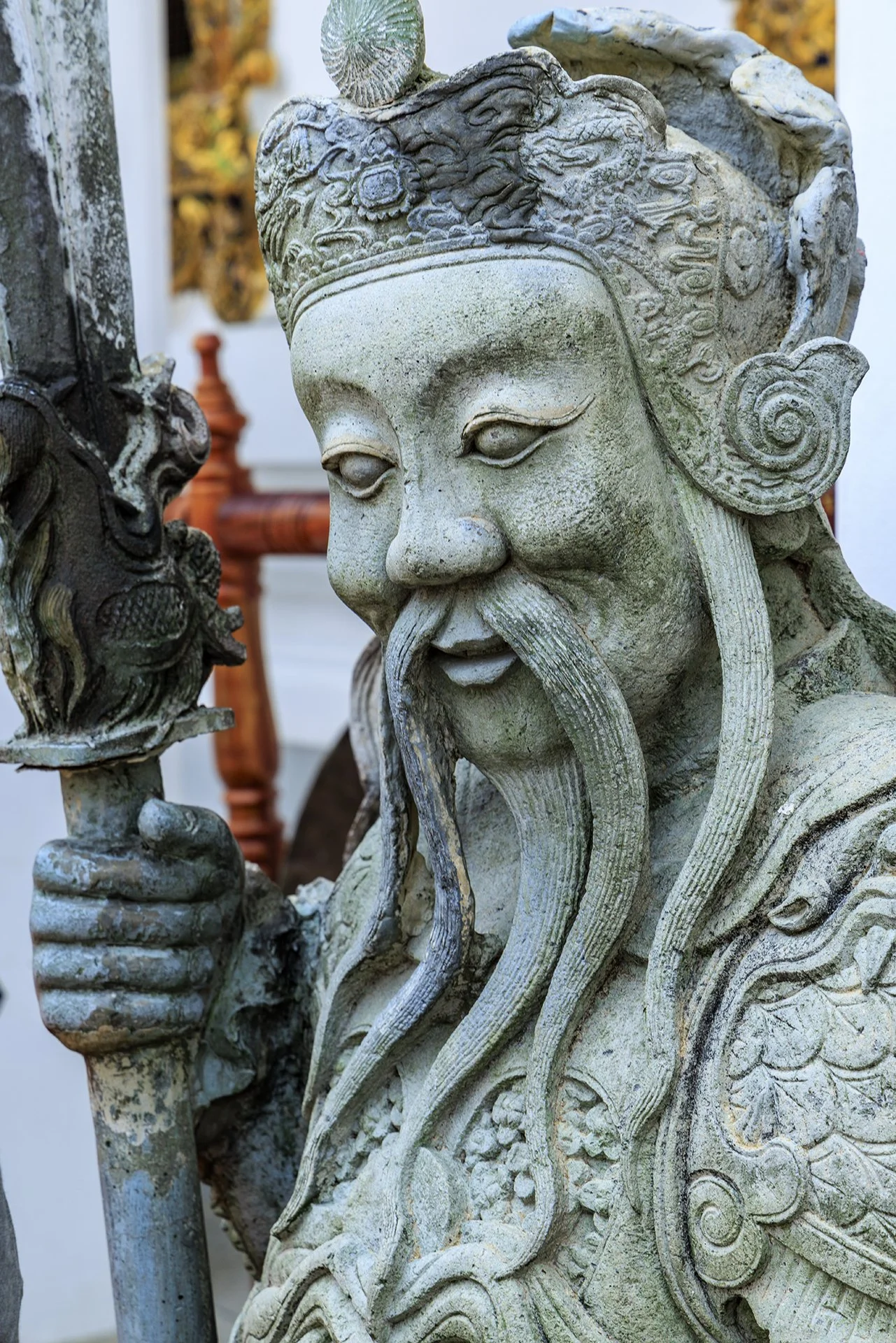
Closeup of one of the Chinese Guardian statues. Each one is different and has very expressive features.
Continuing our tour of the Royal Palace and Emerald Buddha temple complex we entered the temple of the Emerald Buddha (Wat Phra Kaew).
When you enter the temple, you have to remove your shoes. There are also modesty requirements as well-- no shorts, women must cover their shoulders and wear long pants or a long dress.
Photography is also forbidden within the temple. However you can shoot photos of the Emerald Buddha from outside the temple through the open doors.
Since the Buddha statue is only 18 inches tall and you are shooting from 30 feet or more away there are limits to what you can get as an image. I did some AI noise reduction and cropped the image and also adjusted exposure, color and contrast. The result is a pretty faithful reproduction of what I saw in person captured under challenging photographic conditions:
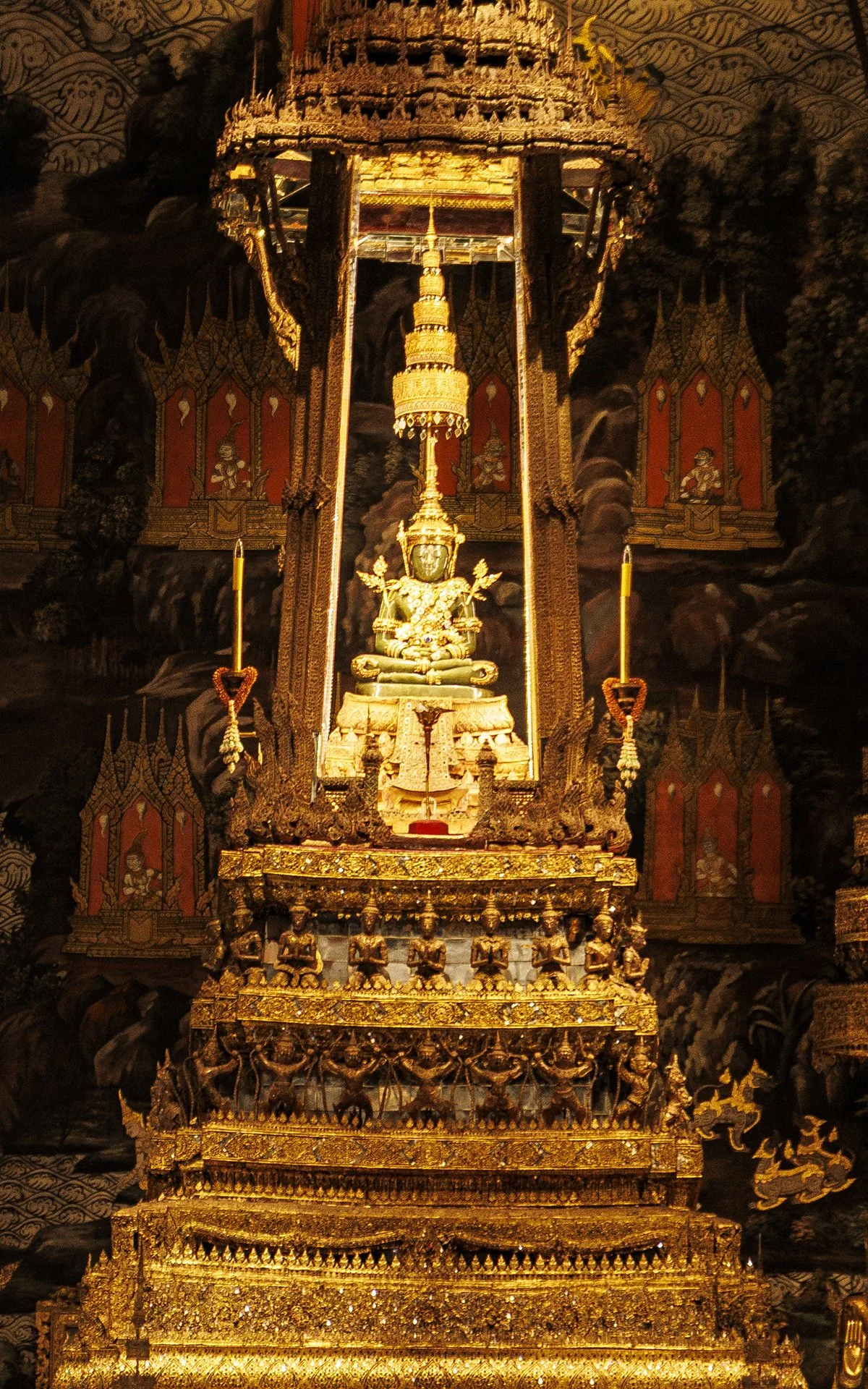
The Emerald Buddha
The next image is of the Phra Si Rattana Chedi. It's special because it holds "physical relics of the Buddha". What those relics are is apparently secret but it is known that they came from Sri Lanka and the Chedi was built in 1855 by King Mongkut (who is the King Yul Brynner played in the King and I).
This pagoda is designed so that it's base represents the earthly realm, the dome represents the world mountain (Mount Meru) and the spire represents the ascent to nirvana. It's covered in gold to represent purity, merit, spiritual illumination and the radiance of enlightenment.
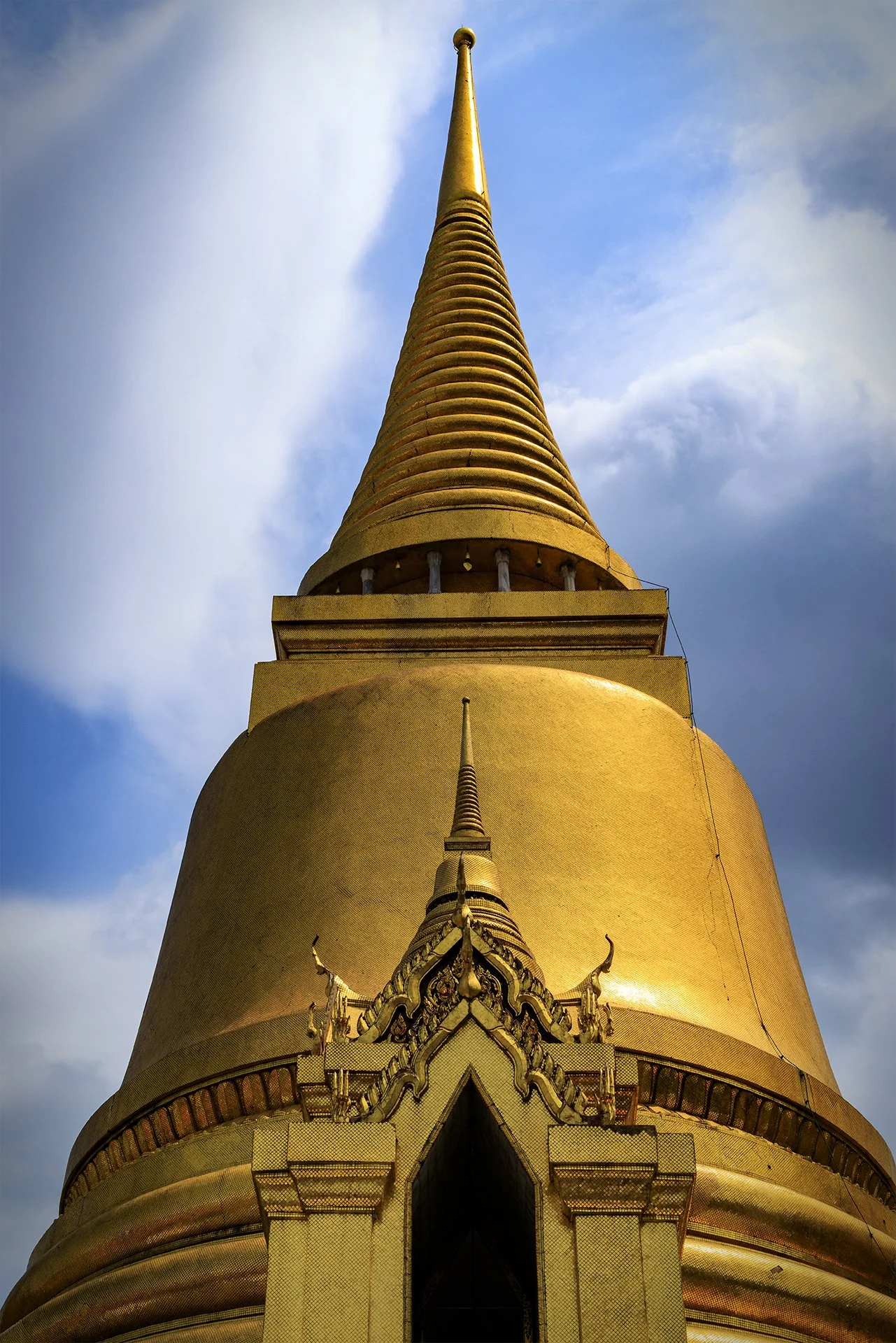
Phra Si Rattana Chedi
These remaining images are of the Royal Palace itself and various shots from around the courtyard at the front of the palace.
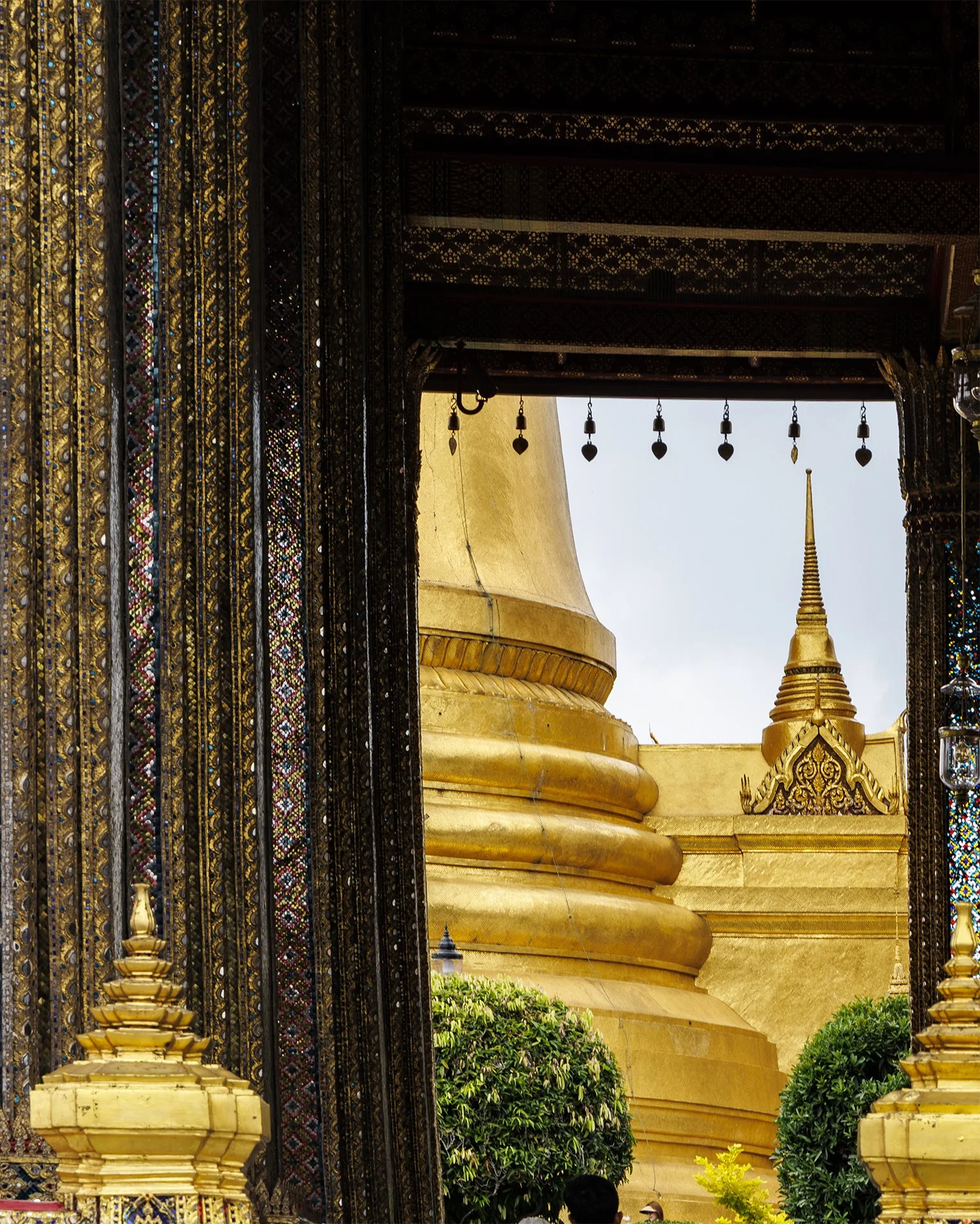
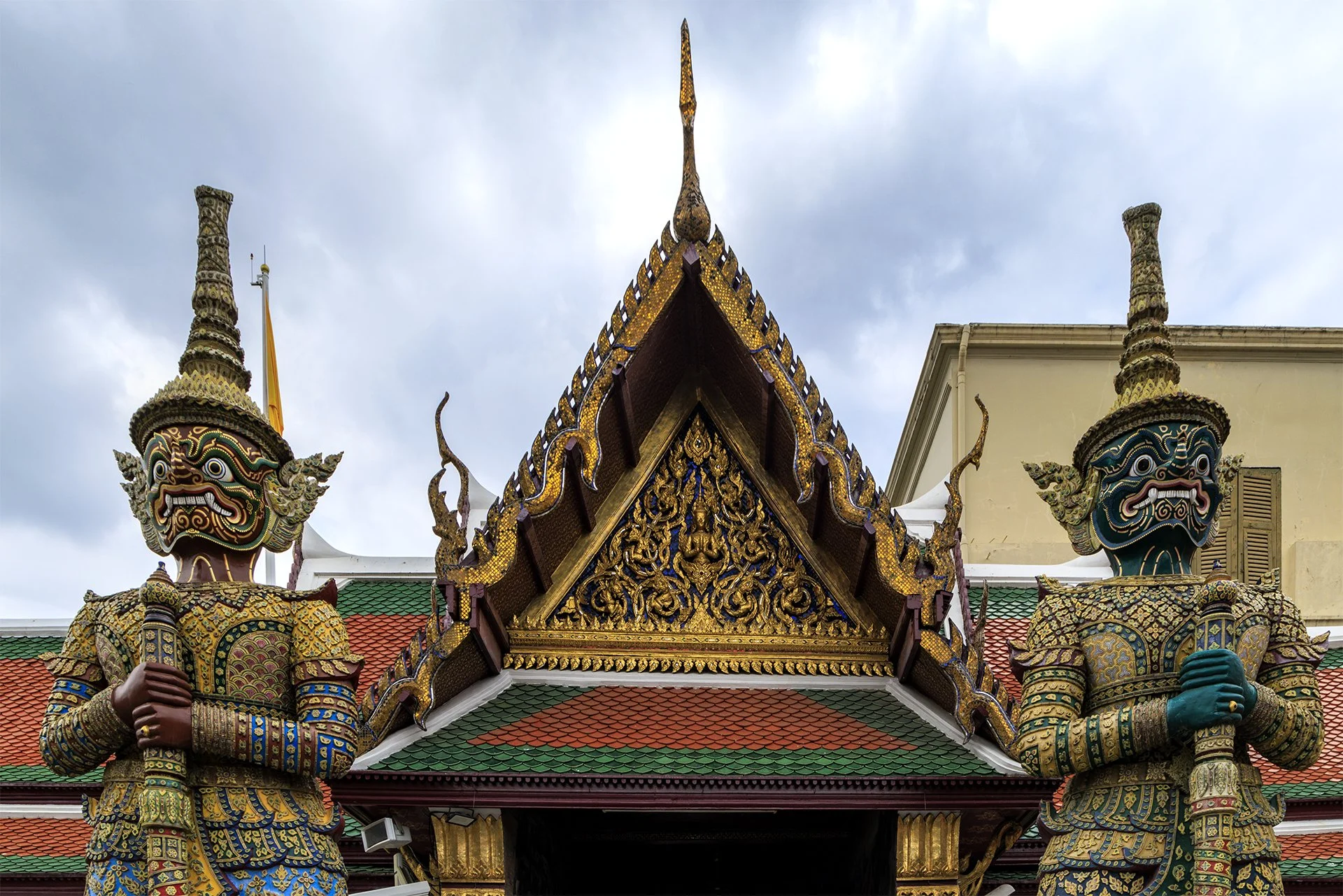
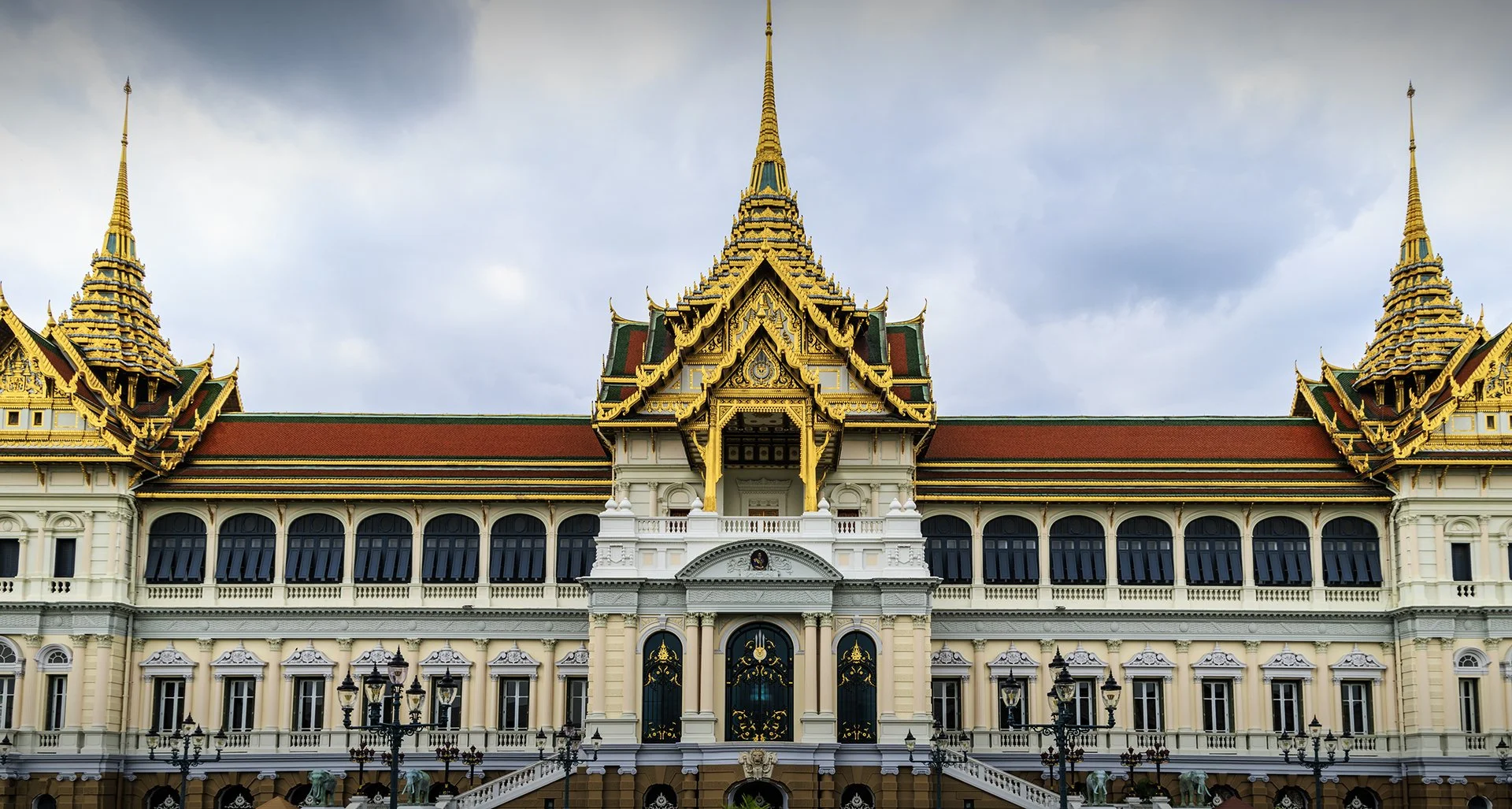
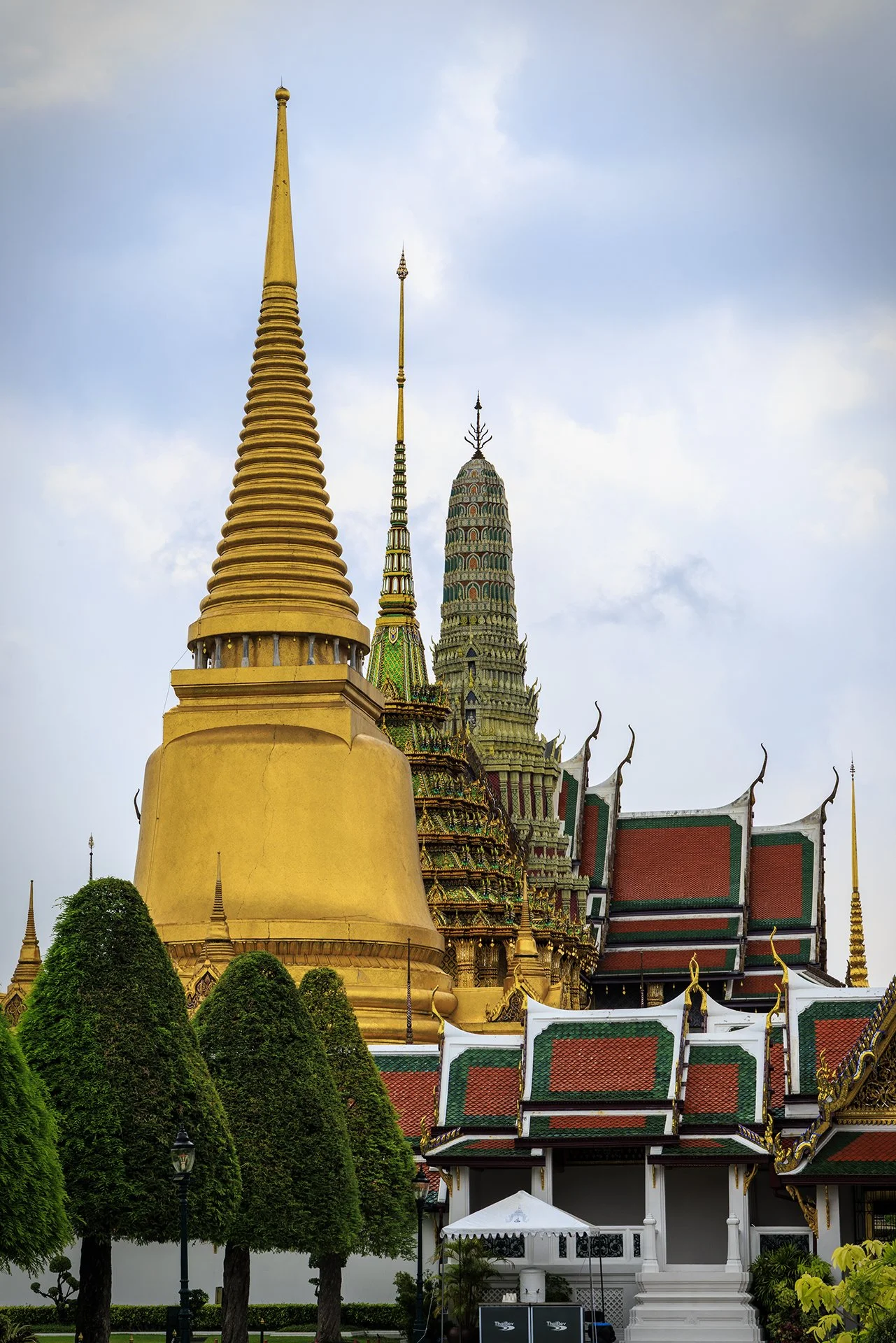
Next up is the famous reclining Buddha. Buddha statues are generally represented in one of about a dozen specific poses, each of which represents a specific meaning.
The famous reclining Buddha in Bangkok represents Buddha during his final illness as he enters the final state of spiritual enlightenment (Parinirvana). This was Buddha's liberation from the endless cycle of death and rebirth -- the goal of Buddhisim.
Photographically, it was a challenge to get any kind of a photo of the reclining Buddha. First, the Buddha is very long but your only viewing point is along a long corridor in front of the Buddha. You are never more than a few feet from the Buddha yet it is 44 feet long. The positions from which you can shoot the entire length of the Buddha are very limited.
Also, it's dark so you have to shoot wide open with very high ISO settings. Your resulting images are likely to be grainy and full of luminance noise. I used a combination of careful settings and AI noise reduction in Photoshop to get these images. Without these precautions and the AI tools the images would be so noisy and grainy that they would not be useable. Fortunately we have very advanced tools in photography these days.
Finally, it's crowded. Getting a shot without tourists in it is likewise a challenge. With patience I was able to get into positions to shoot the statue without anyone in front of me. Most people were cooperative and took turns. I suppose the solemn atmosphere you expect at such a site helps encourage people to be polite and cooperative.
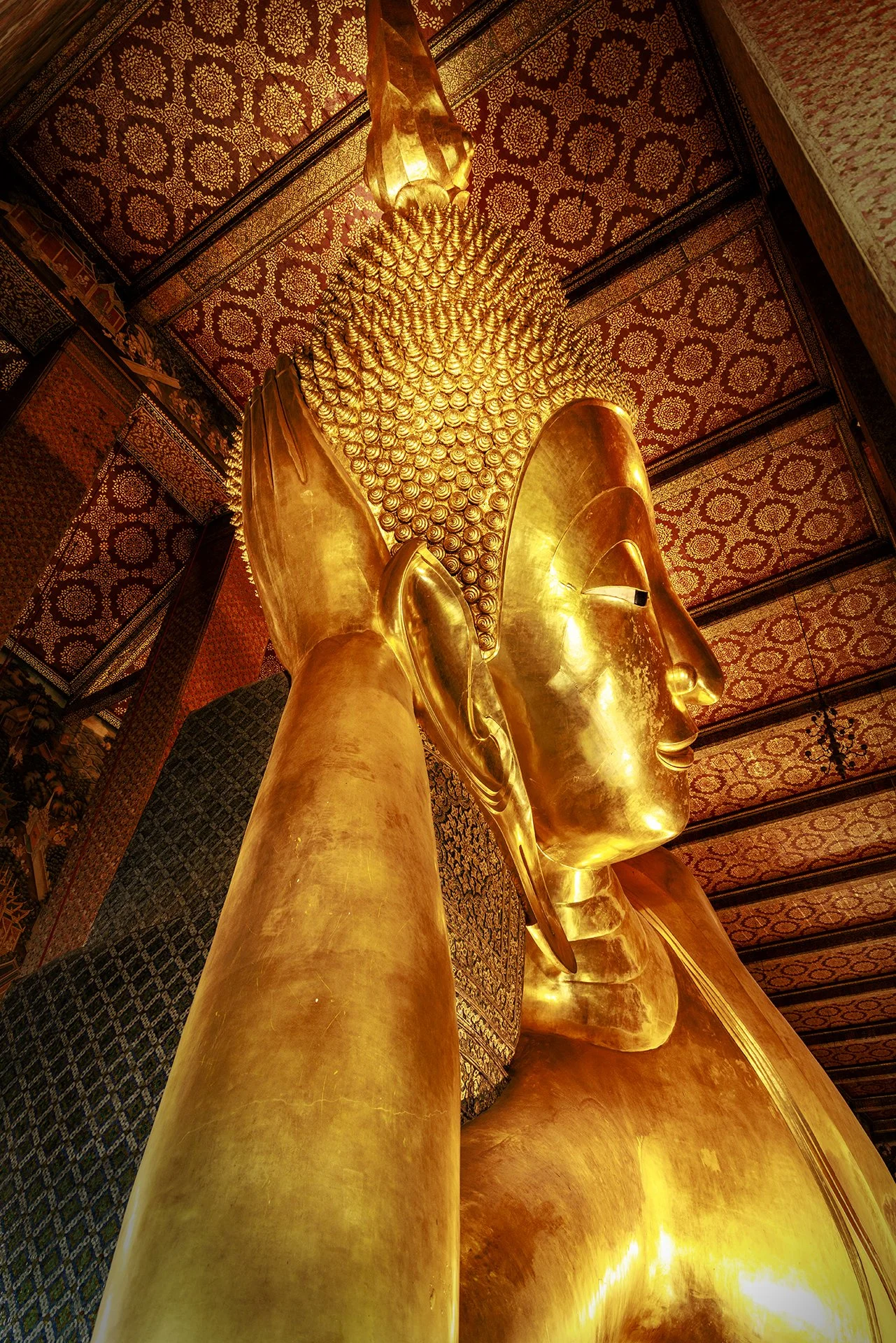
From the head of the reclining Buddha.
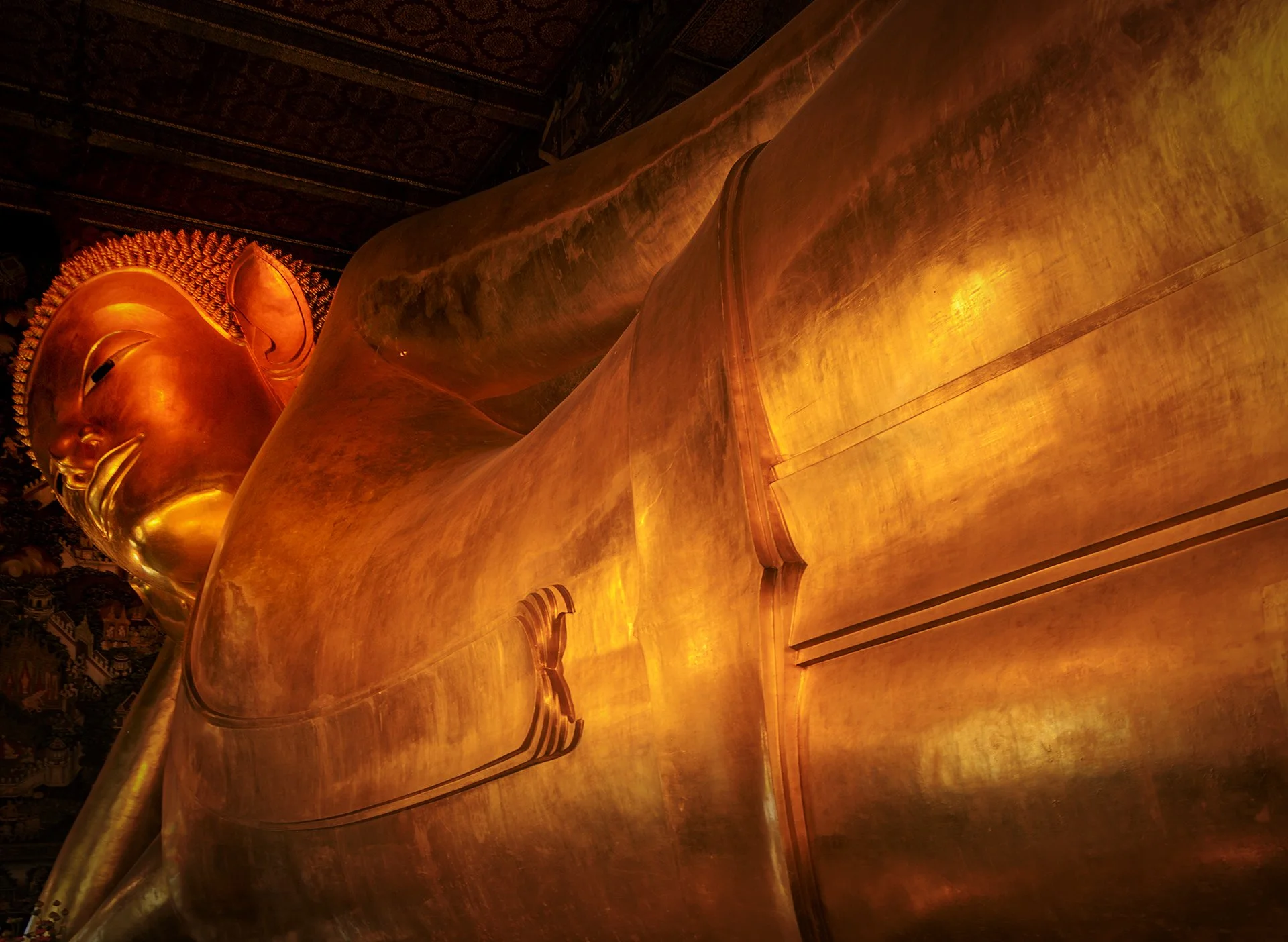
Looking back from near the end of the statue.
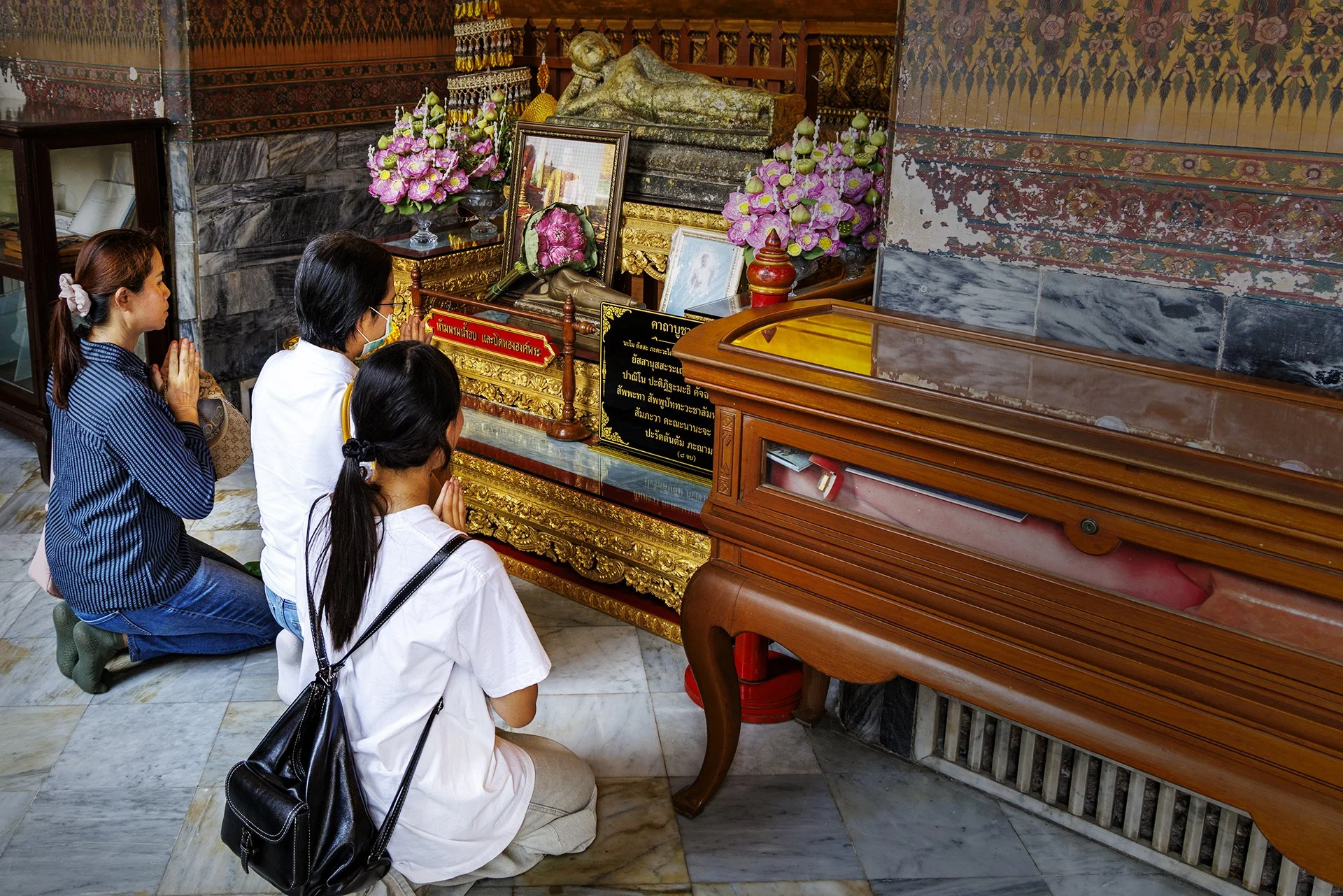
It's not just a tourist spot -- people come to meditate and pray.
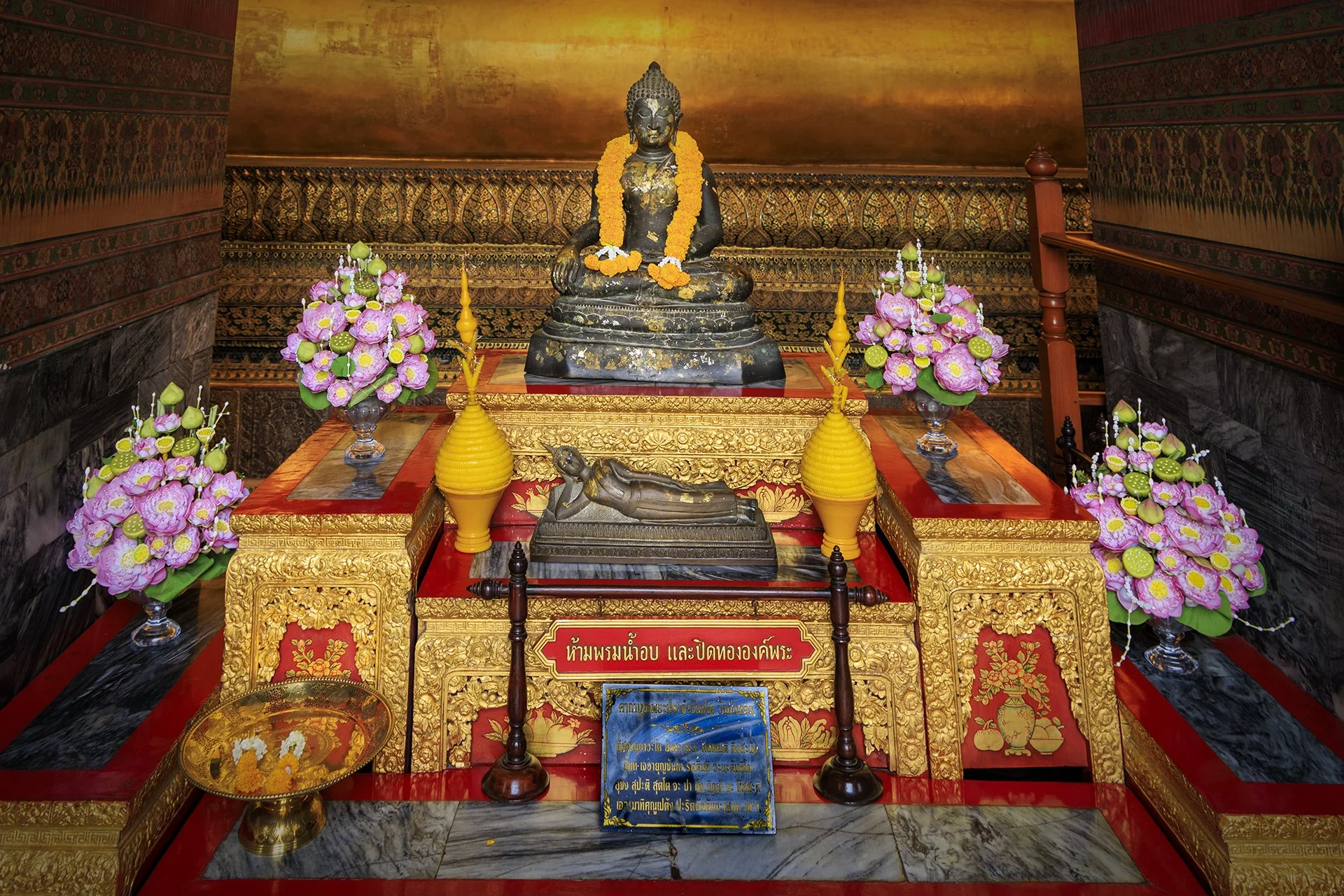
One of the many little shrines in the temple.
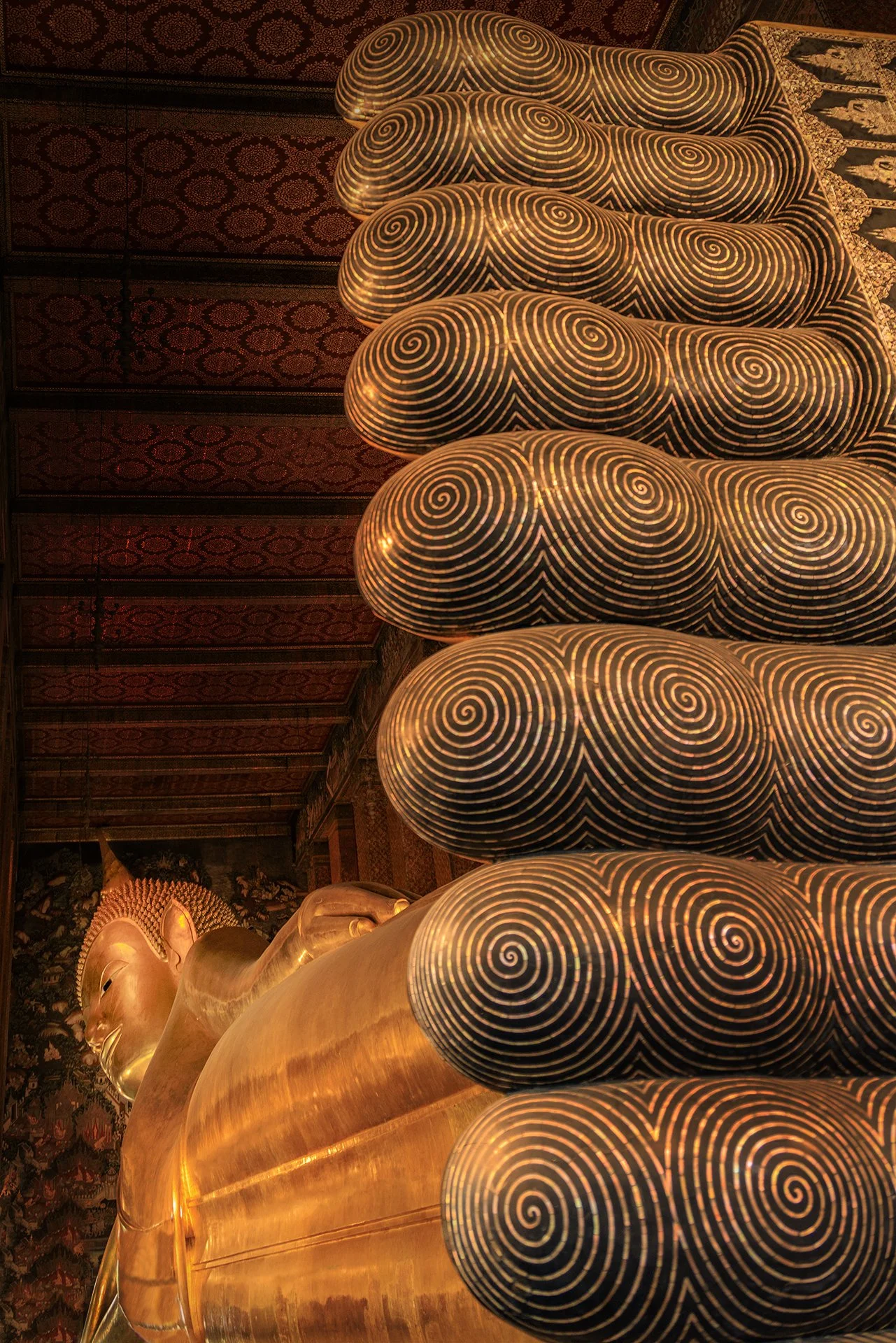
I couldn't get the entire bottom of the feet in the image. Supposedly there are several meaningful patterns included in the soles of the Buddha's feet.
After a day of exploring temples and palaces we signed up for a street food excursion by Tuk Tuk.
We thought it'd be a leisurely drive around Bangkok's China Town to try random street food. Wow, were we wrong.
When we boarded our Tuk Tuks, the drivers all sped away from our hotel at top speed. I think they were racing each other to see who would arrive at a food cart first.
We raced through Bangkok, dodging in and out of traffic to the sound of squealing tires and brakes, inches from collision with a variety of cars, trucks, scooters and other Tuk Tuks.
When we slammed to a stop at our first street food cart -- just a little cart in the street gutter -- we saw five years worth of Michelin Guide emblems proudly displayed on their sign. Turned out all the street venders and hole-in-the-wall cafes we visited that night were in the Michelin Guide. Hardly random street food.
What an adventure -- racing through the night on the streets of Bangkok to sample the world's best street food. It was to be the highlight of our trip.
Photographically this was kind of like being a war correspondent. Everything moved fast and I had to work to find ways to tell the story of what was happening. Of course, no one was shooting at us but with the tuk tuks racing through the streets it felt a little like we were in a war zone.
I took a lot of general shots at the food stalls trying to capture the cooks and the food they made us as they worked. While racing around the streets I was shooting high shutter speeds at high ISOs to capture the action. At the end of the evening I started trying to drag the shutter with panning to emphasize movement. That was hard because we were being thrown all around in the tuk tuk and it just wasn’t possible to get sharp images but that wasn’t the point. I wish I had started the the shutter drag earlier — some of the images I got told the story of the outing in dramatic fashion and it’s too bad I don’t have more of them.
Here’s a sampling of photos from the outing:
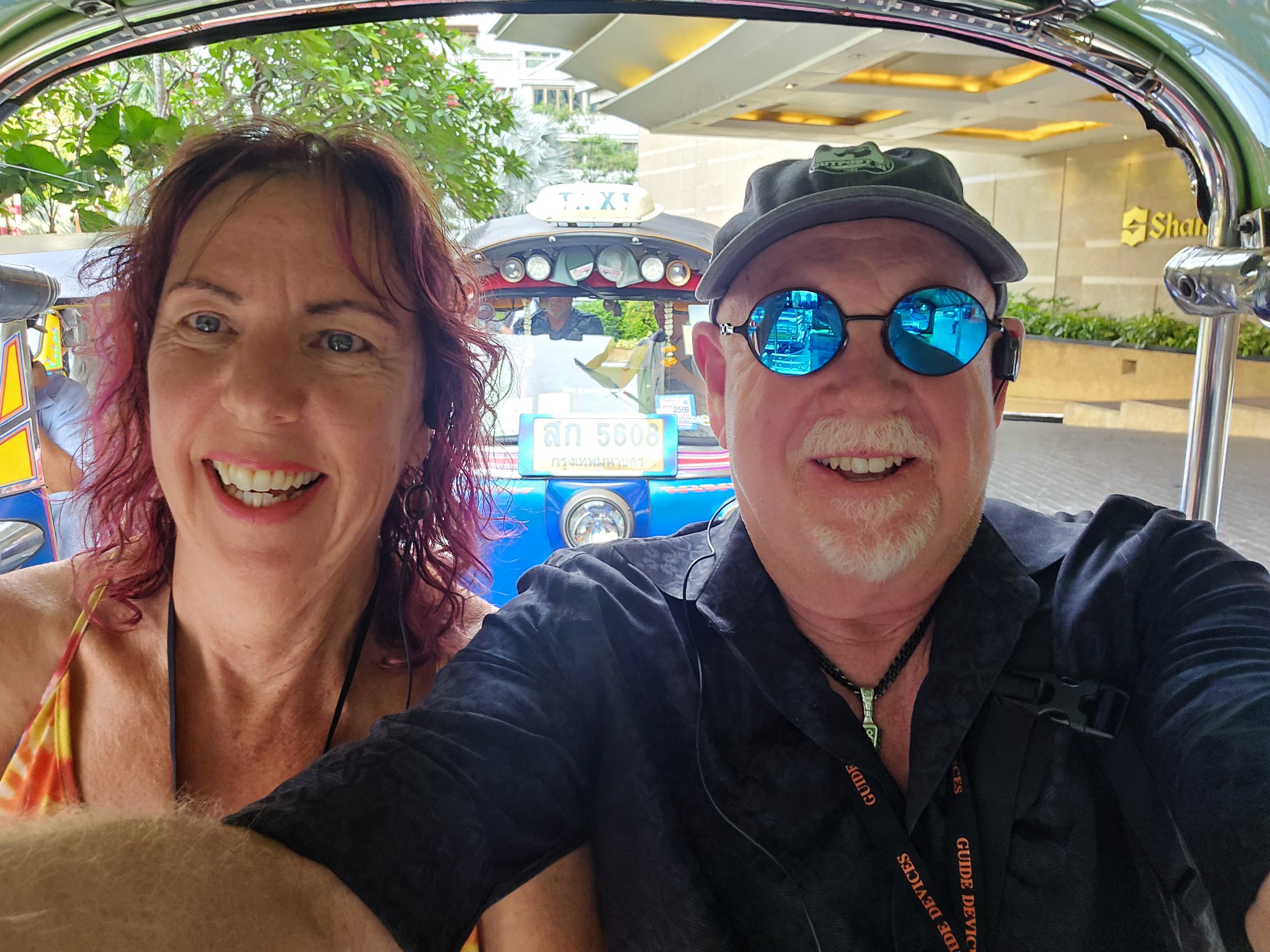
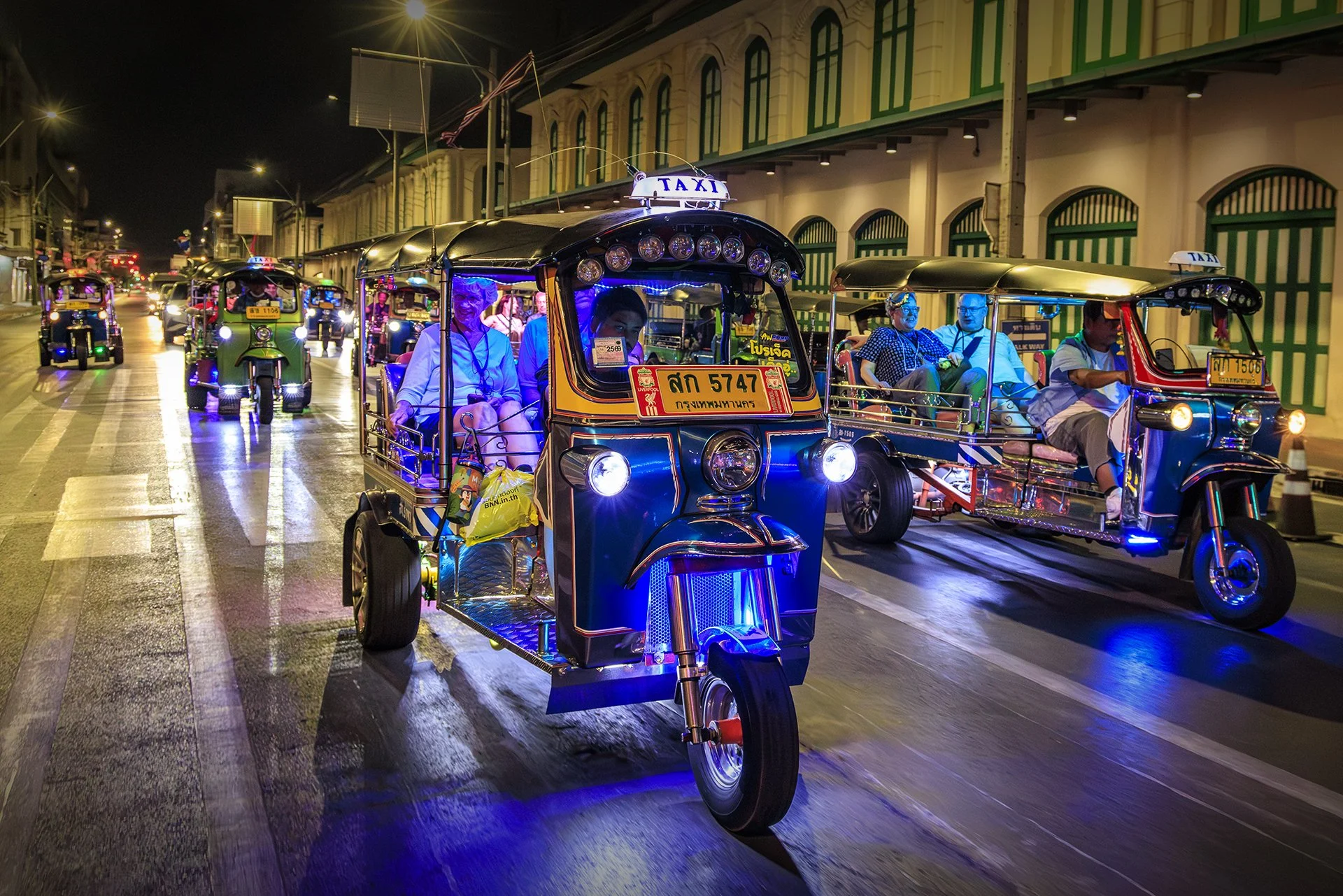
All aboard
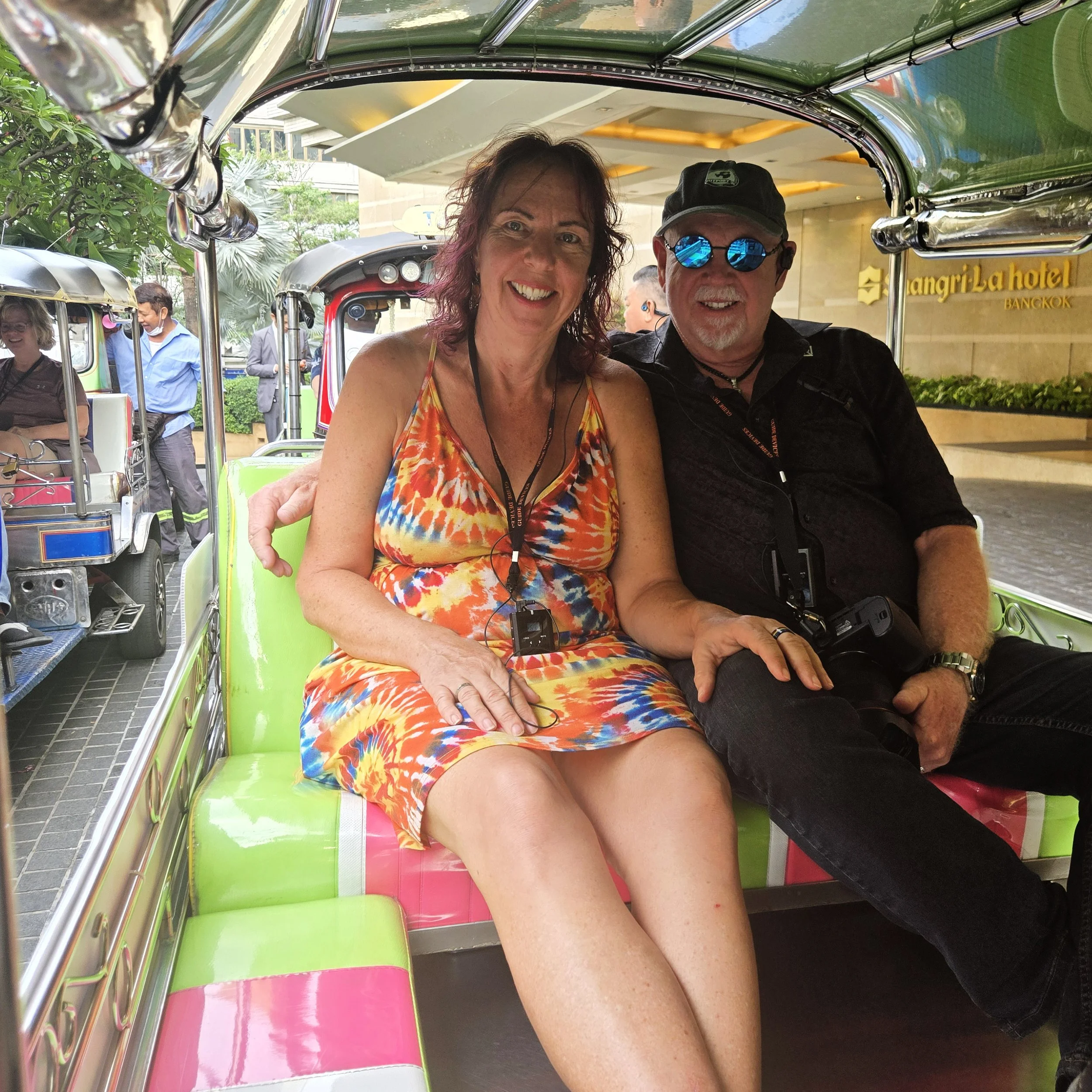
Look at us — we had no idea what we were getting into at this point...
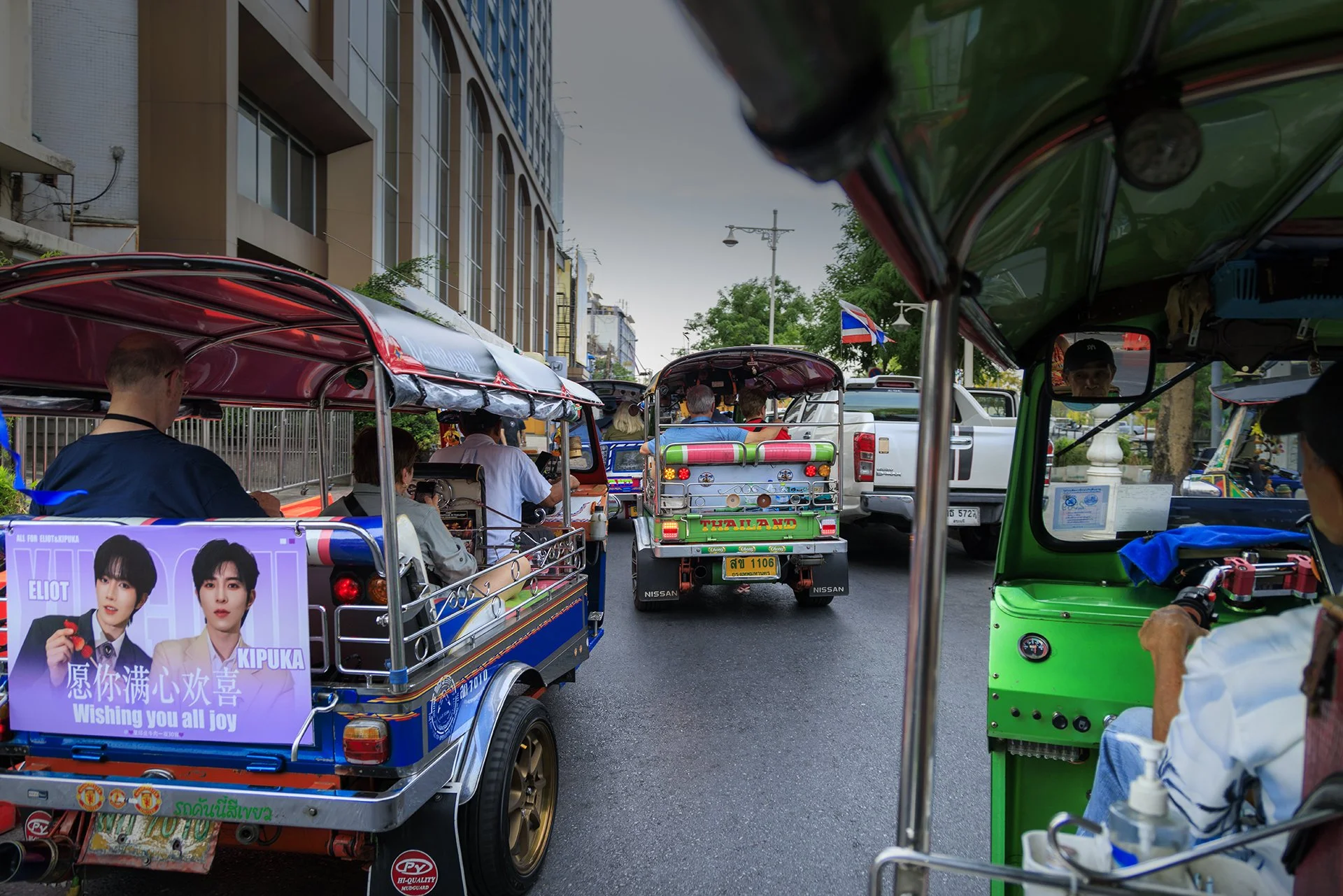
On to China Town!
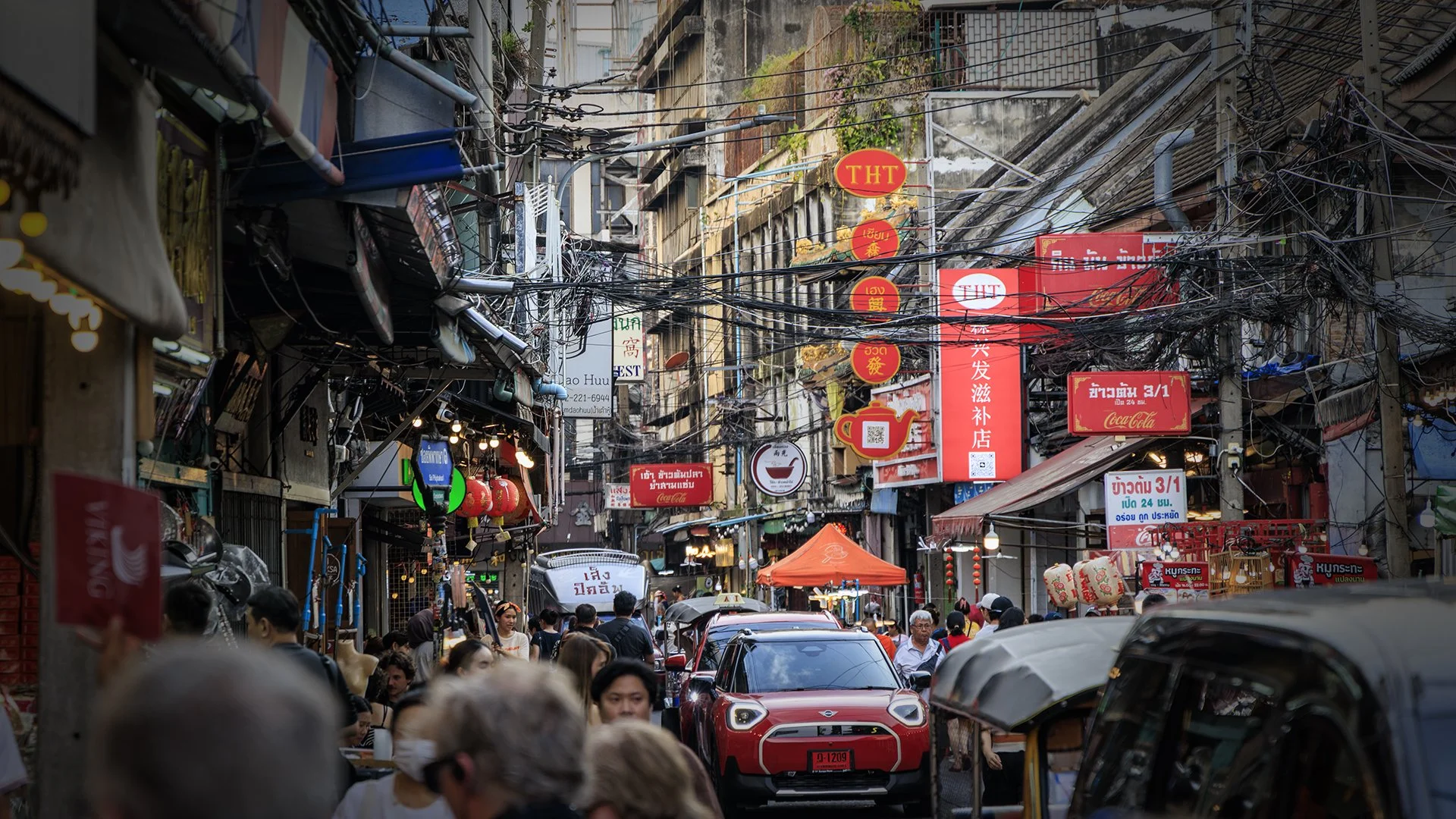
Bangkok China Town
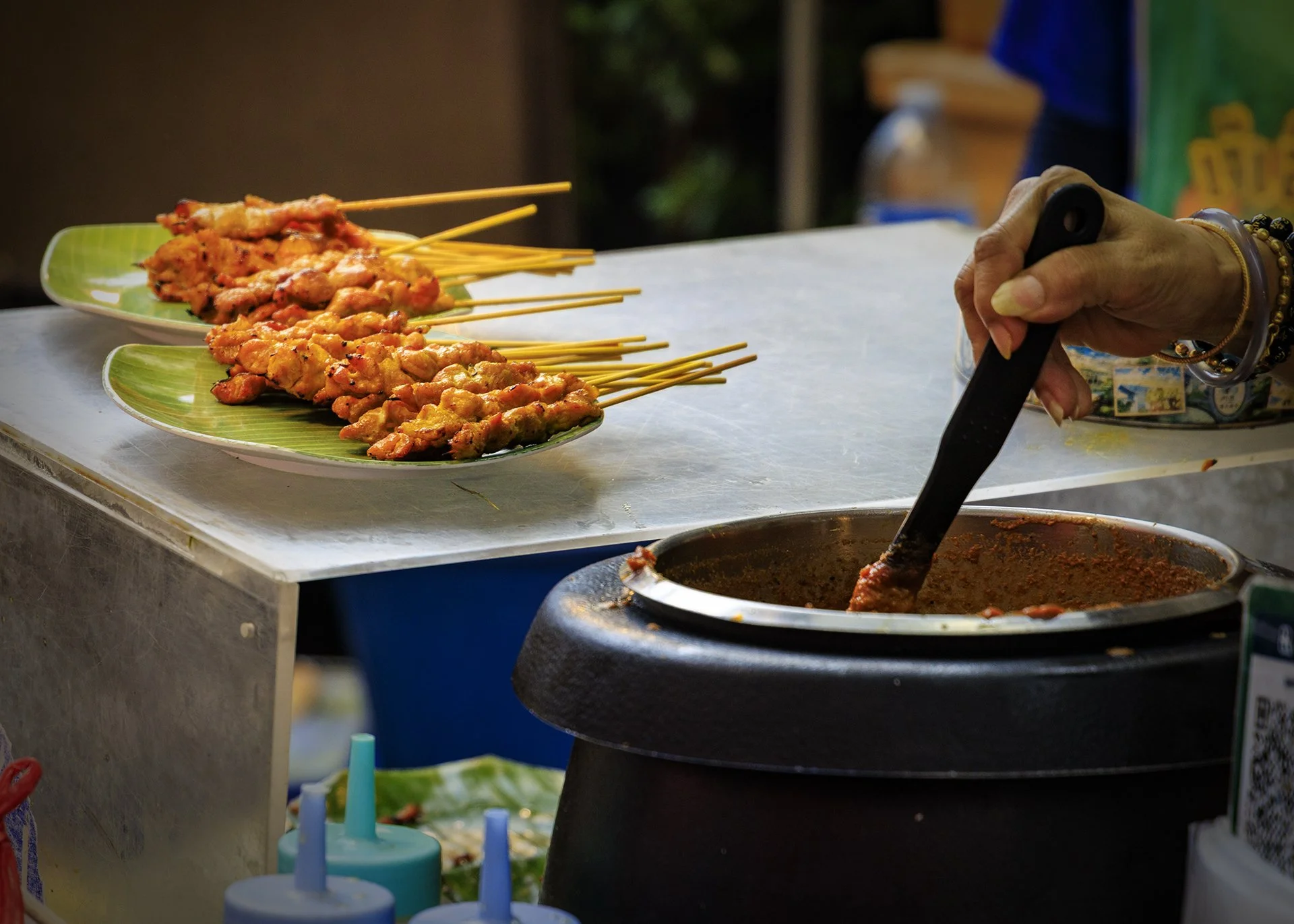
Mmmm Satay.
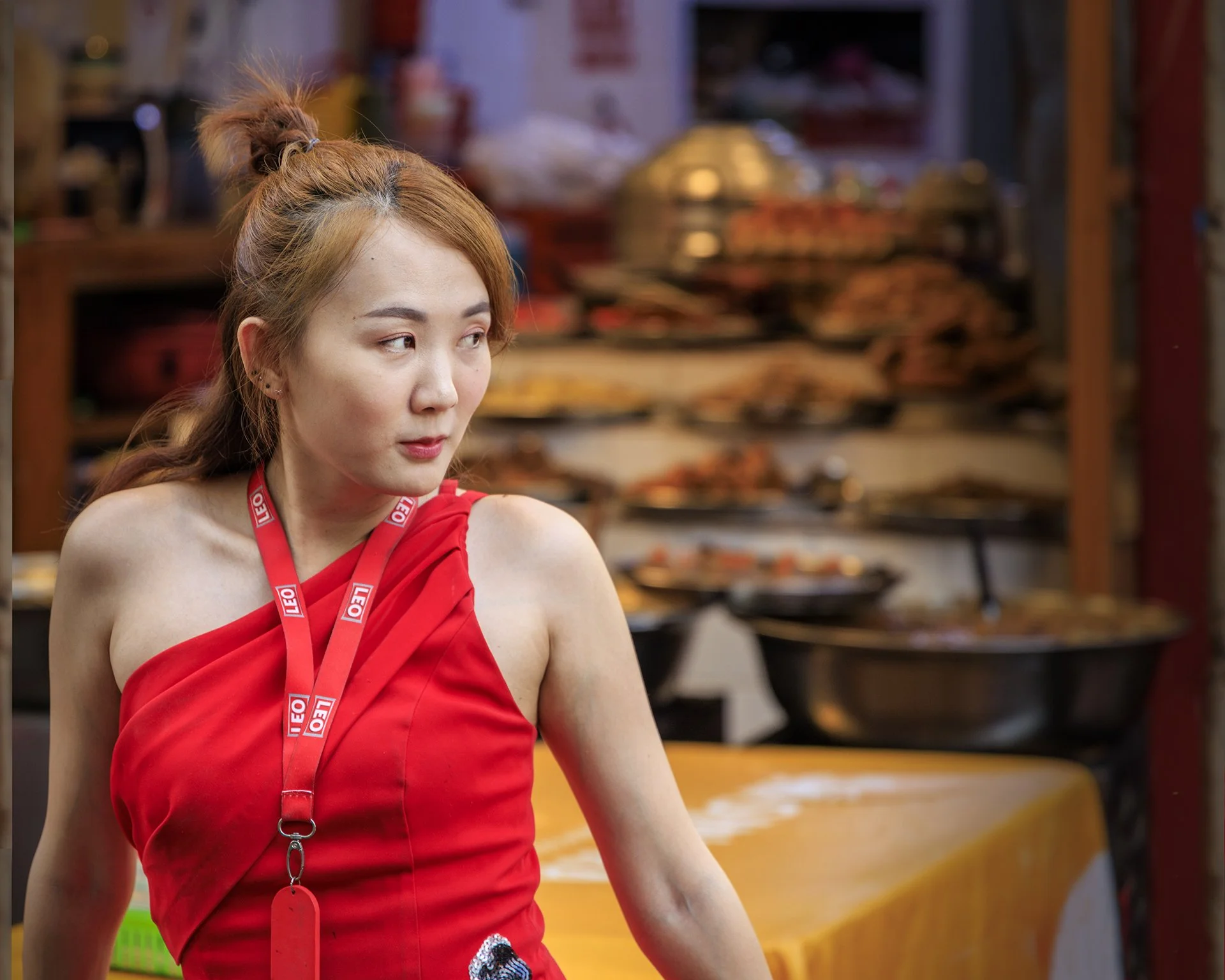
Yes, she knew I was taking her picture.
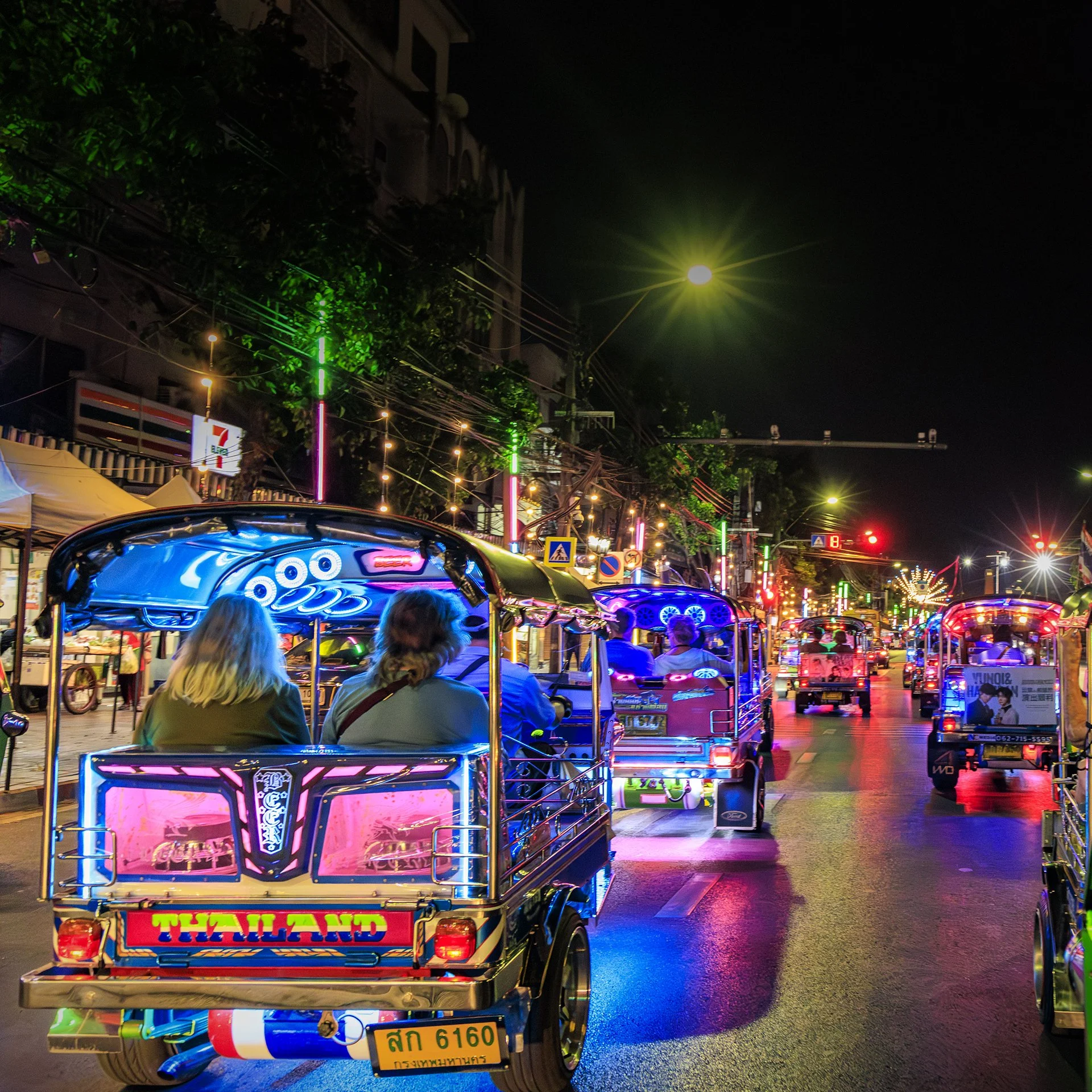
On to the next food vendor…
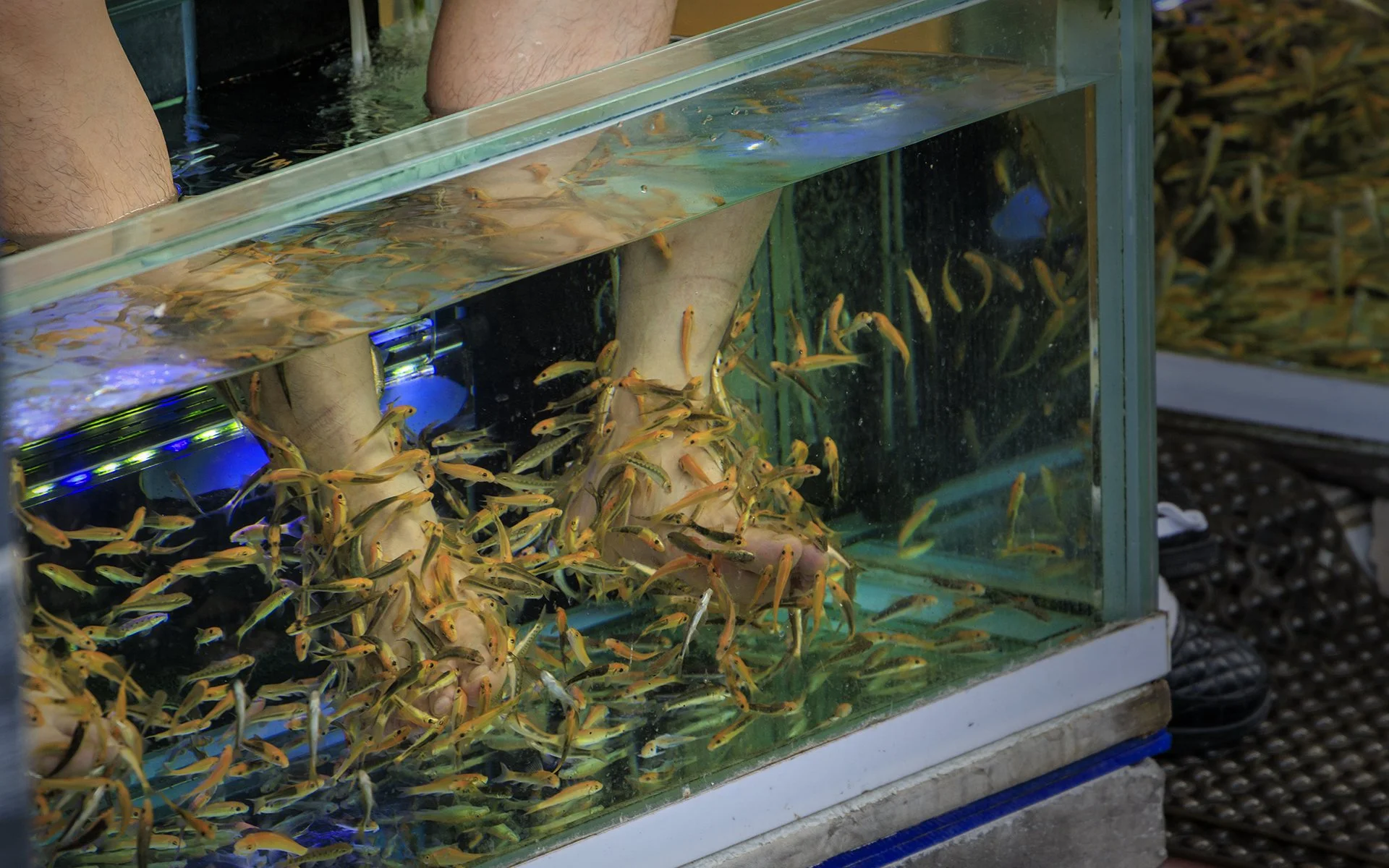
That pedicure place seemed a little fishy.
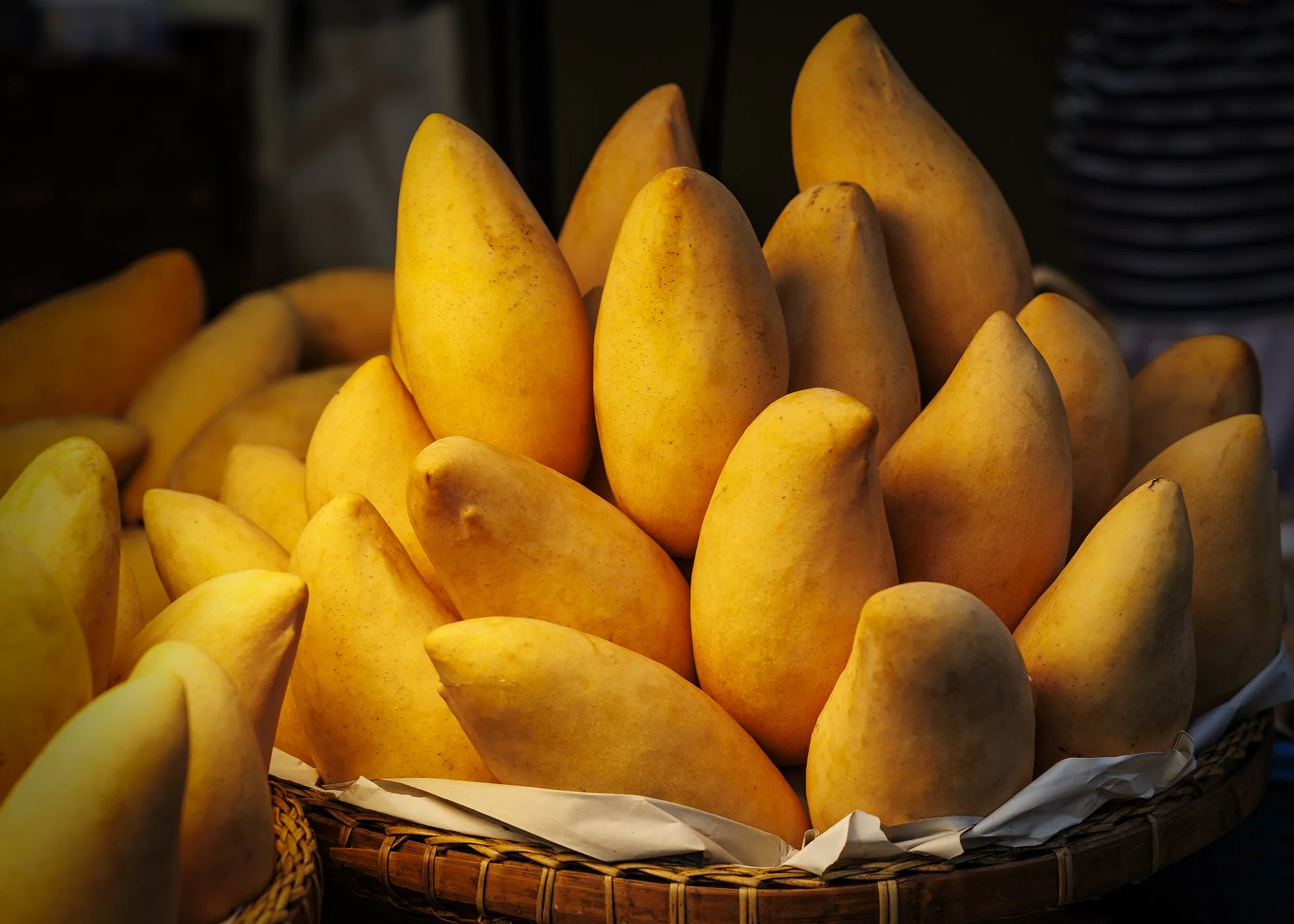
Best mangos I’ve ever eaten.
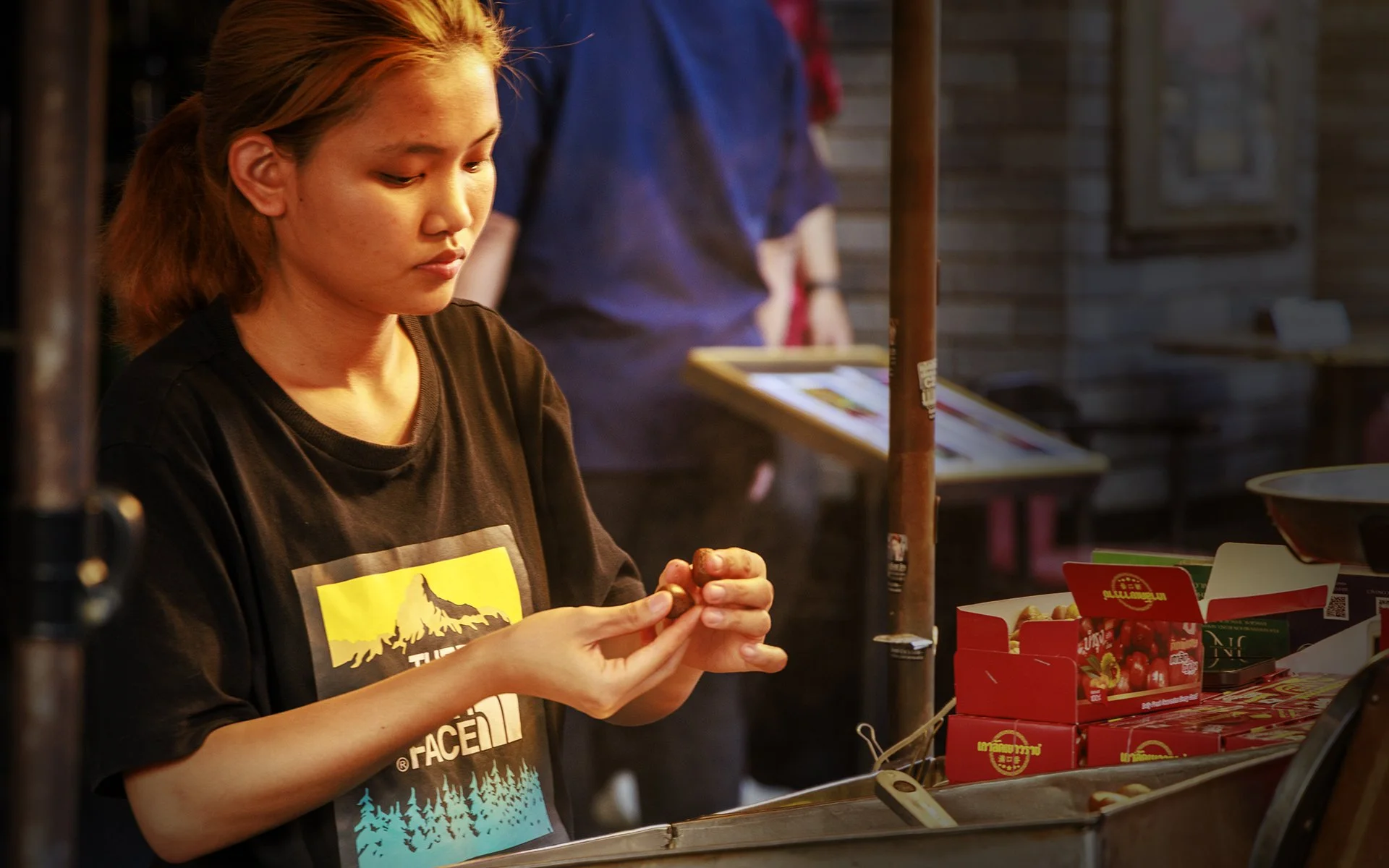
These little food carts were obviously family businesses.
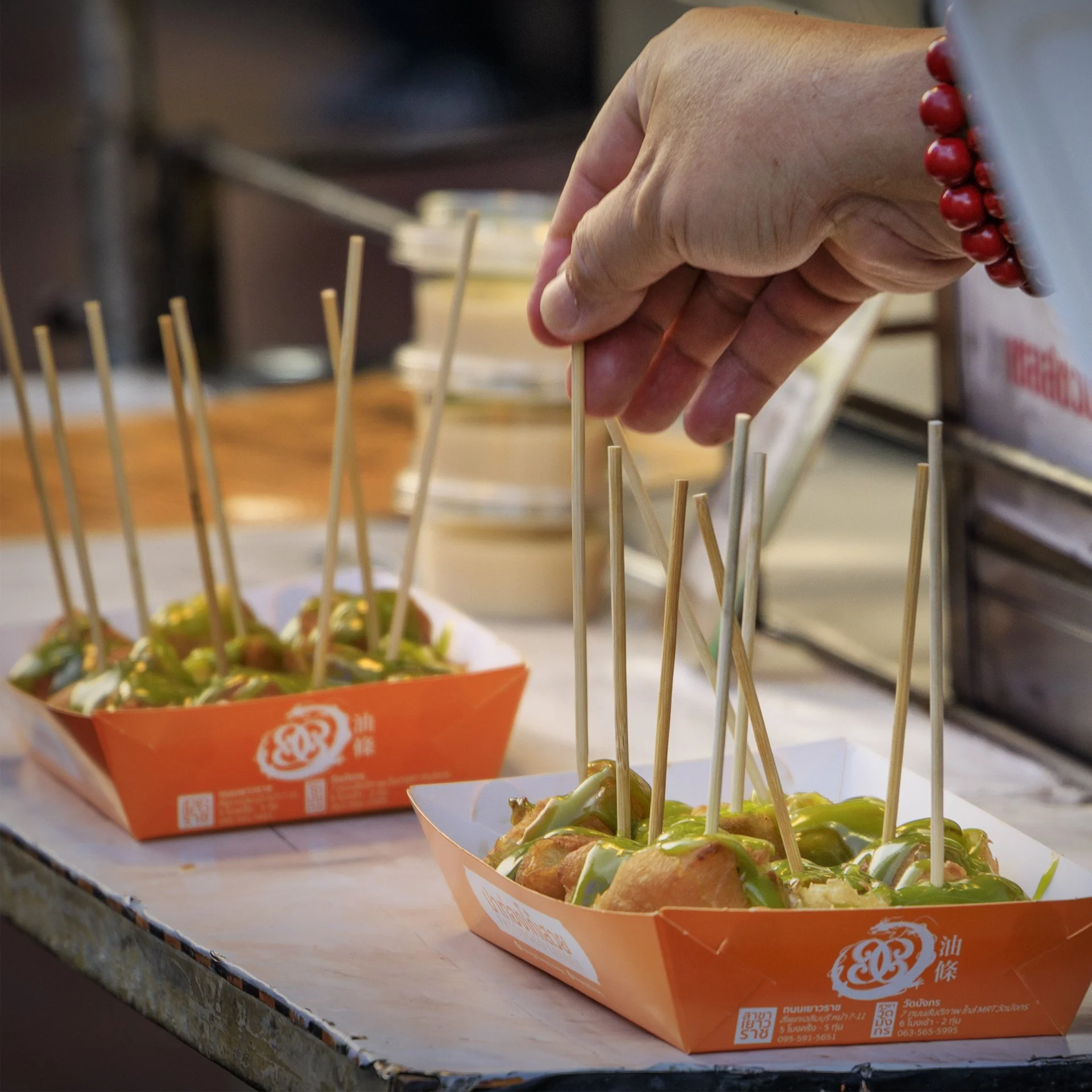
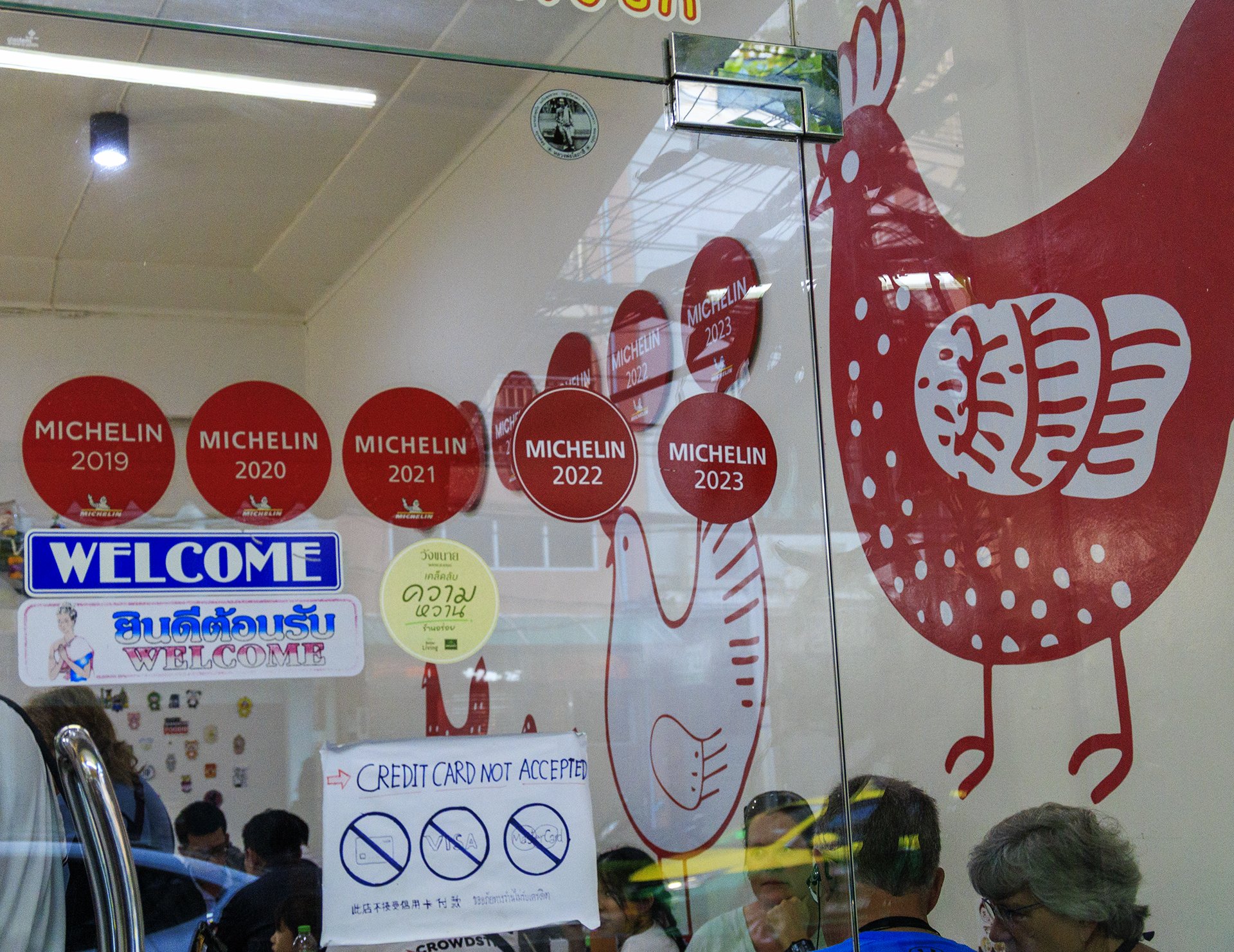
Seriously, pretty much all the places we went were Michelin Guide listed…
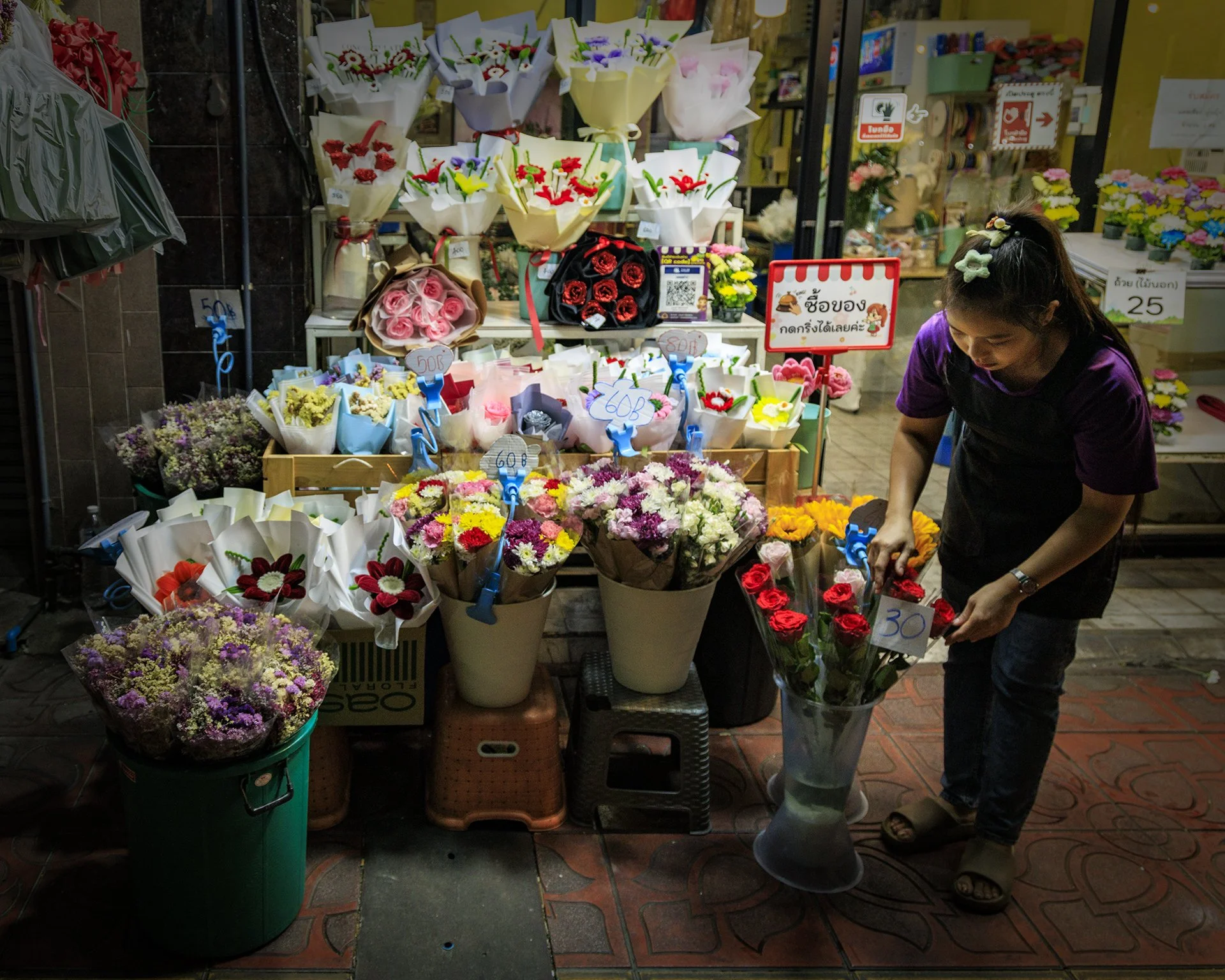
Bangkok Chinatown is also a huge flower market.
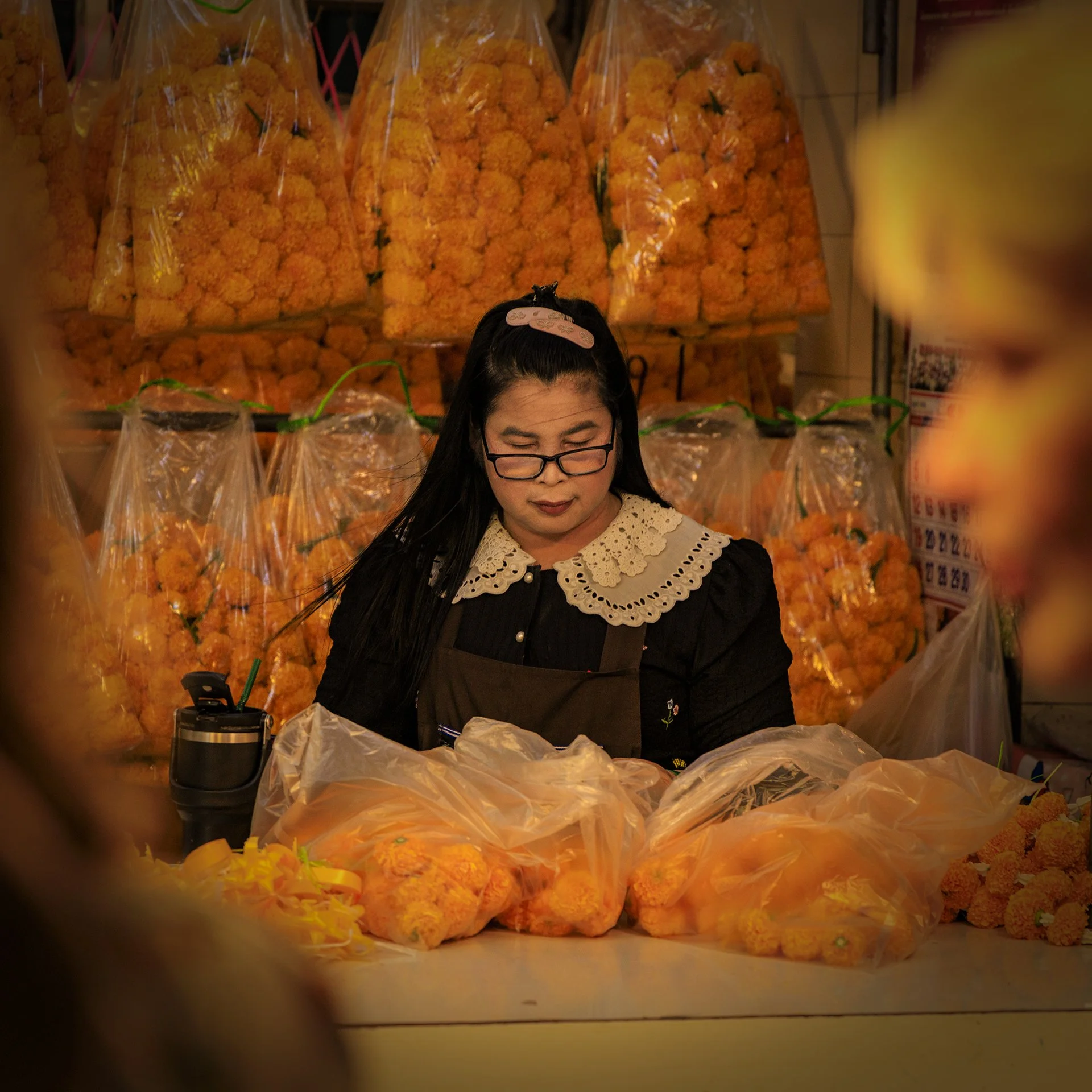
Marigolds are very important in South East Asia. They are used at all the temples and also for any celebrations like weddings, etc.
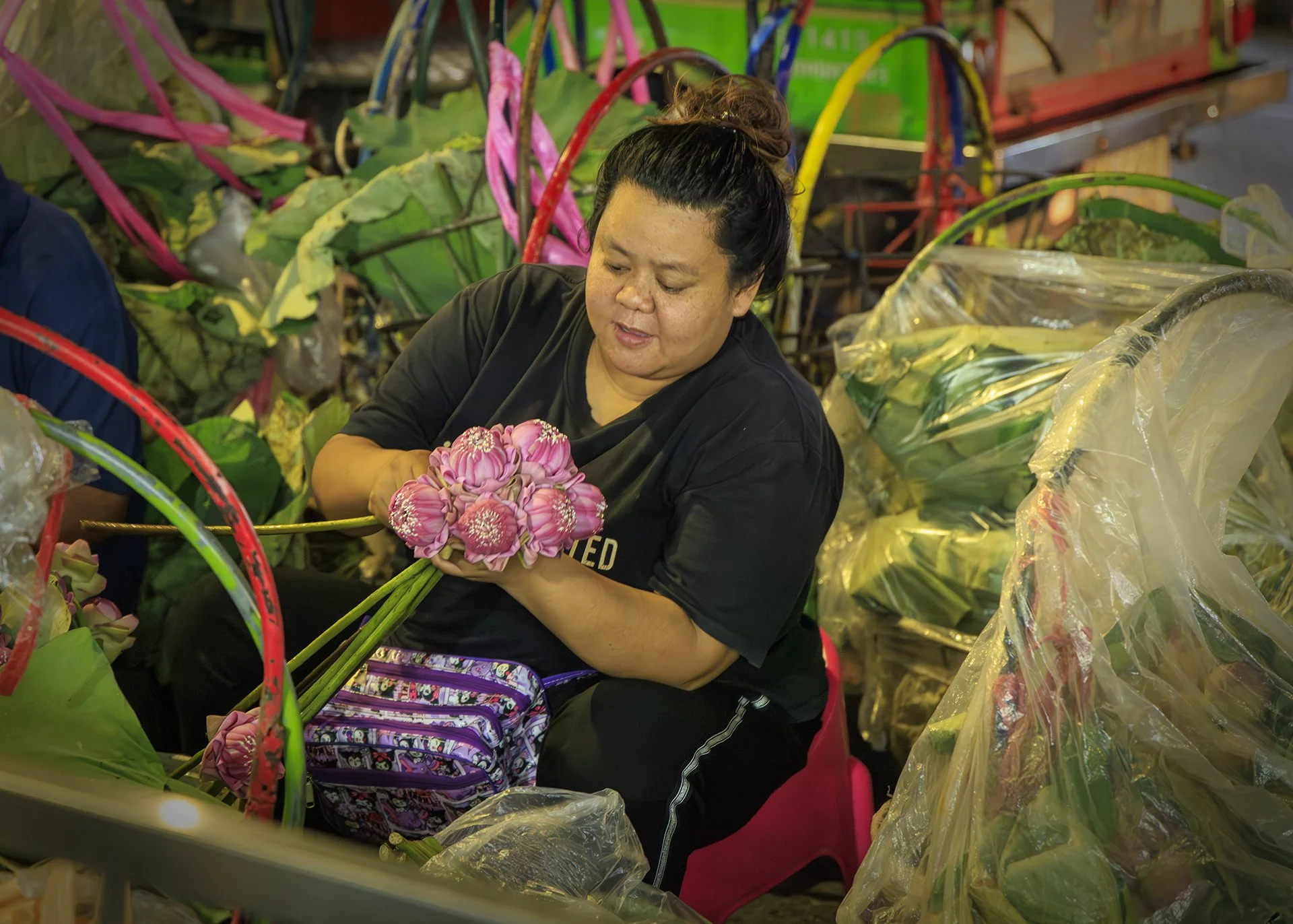
I never knew what Lotus Blossoms where until we saw them here. They are everywhere because they are also used in the temples and for all kinds of Buddhist spiritual practices.
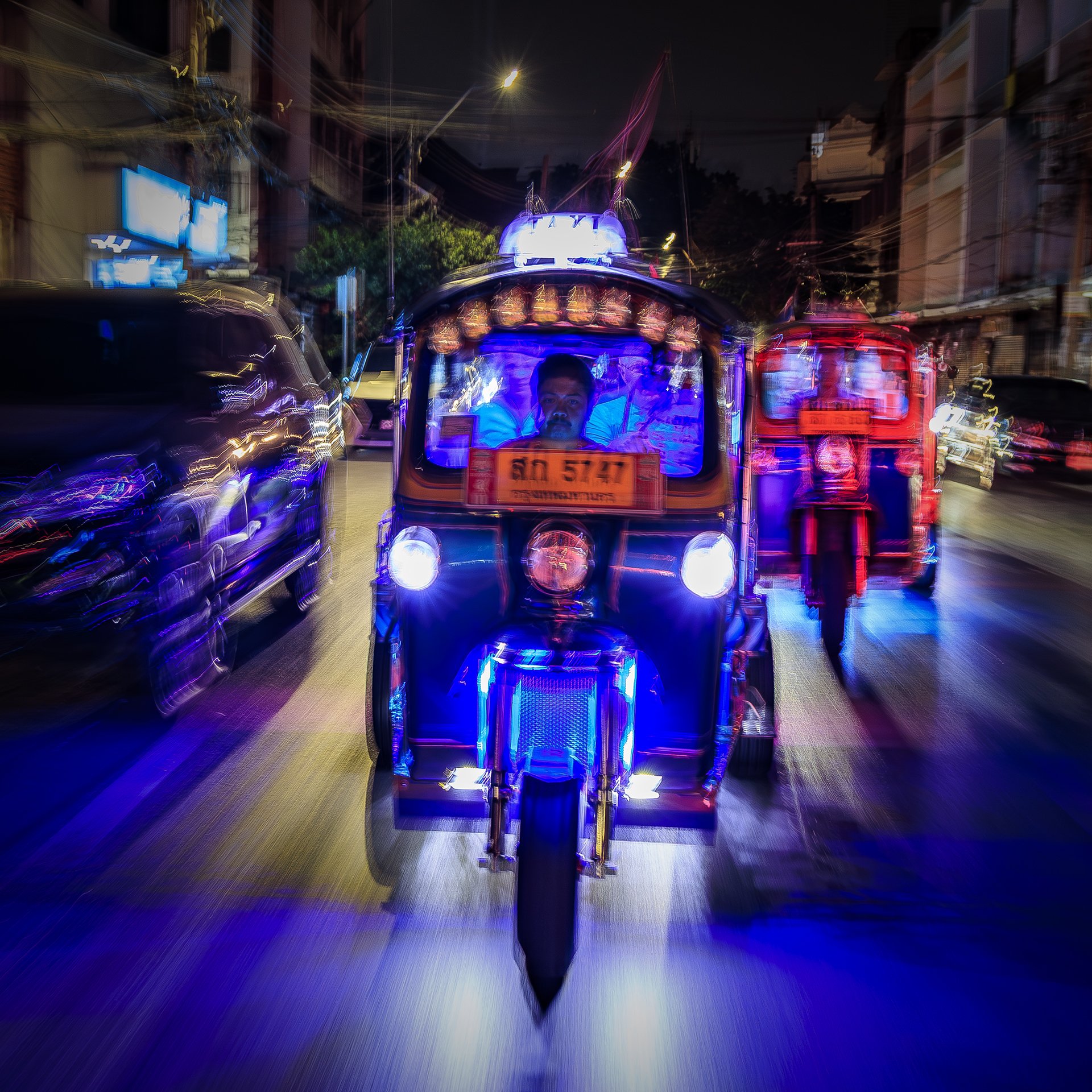
Warp speed back to the hotel.
After a long day in Bangkok touring temples and racing through the city in tuk tuks, I was exhausted. Even so, I couldn't resist trying to get some more serious photography done since this would be our last night in the city.
However, I was only able to summon up the energy to take my photos from my hotel's river patio. So here are a couple images of the city on the Chao Phraya River.
Photographically, I followed my usual process for such photos. Tripod mounted long exposures (15 to 30 seconds) with aperatures of f9 or smaller (to get the star bursts on the lights which I prefer).
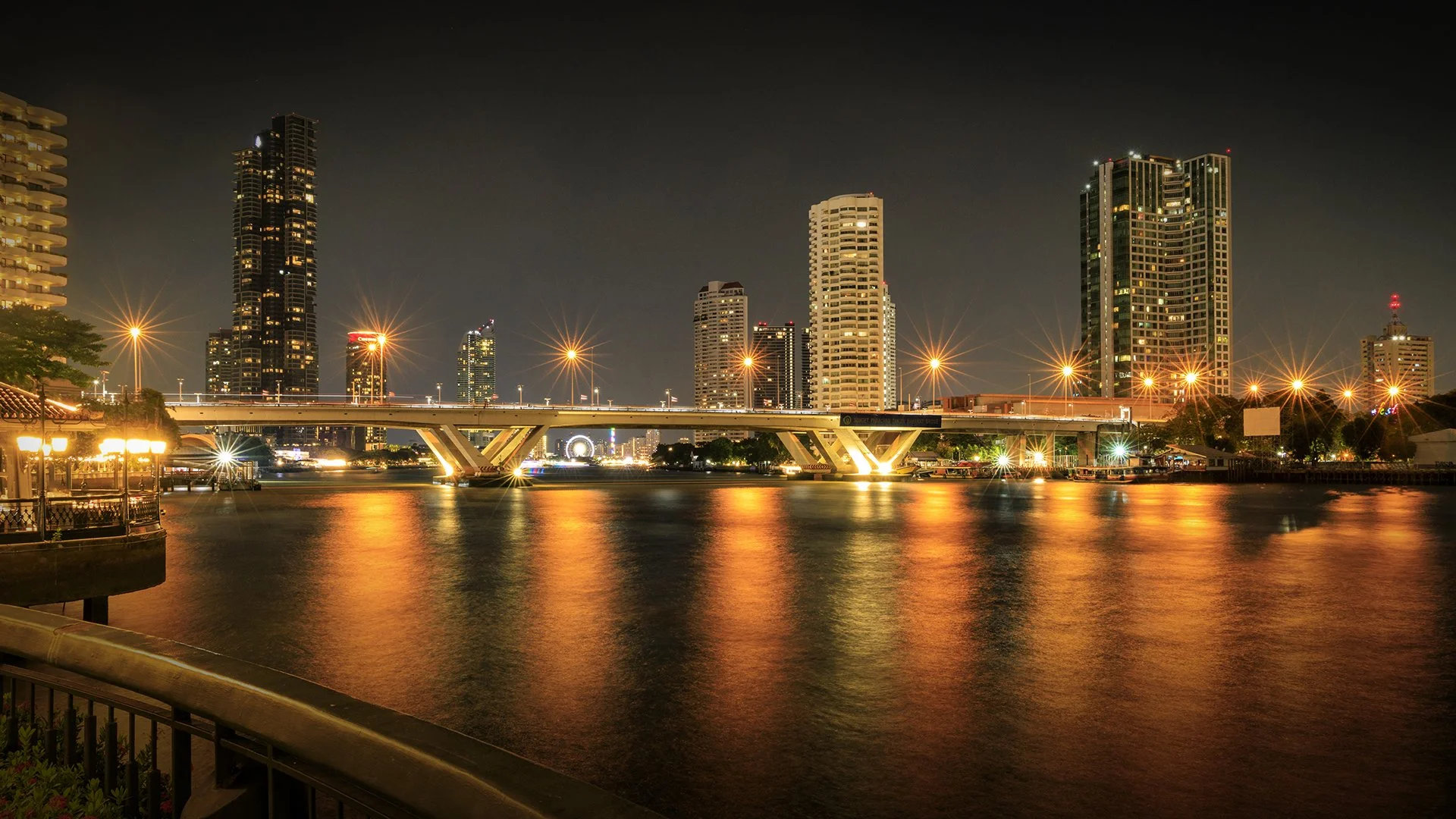
Kung Thon Buri bridge.
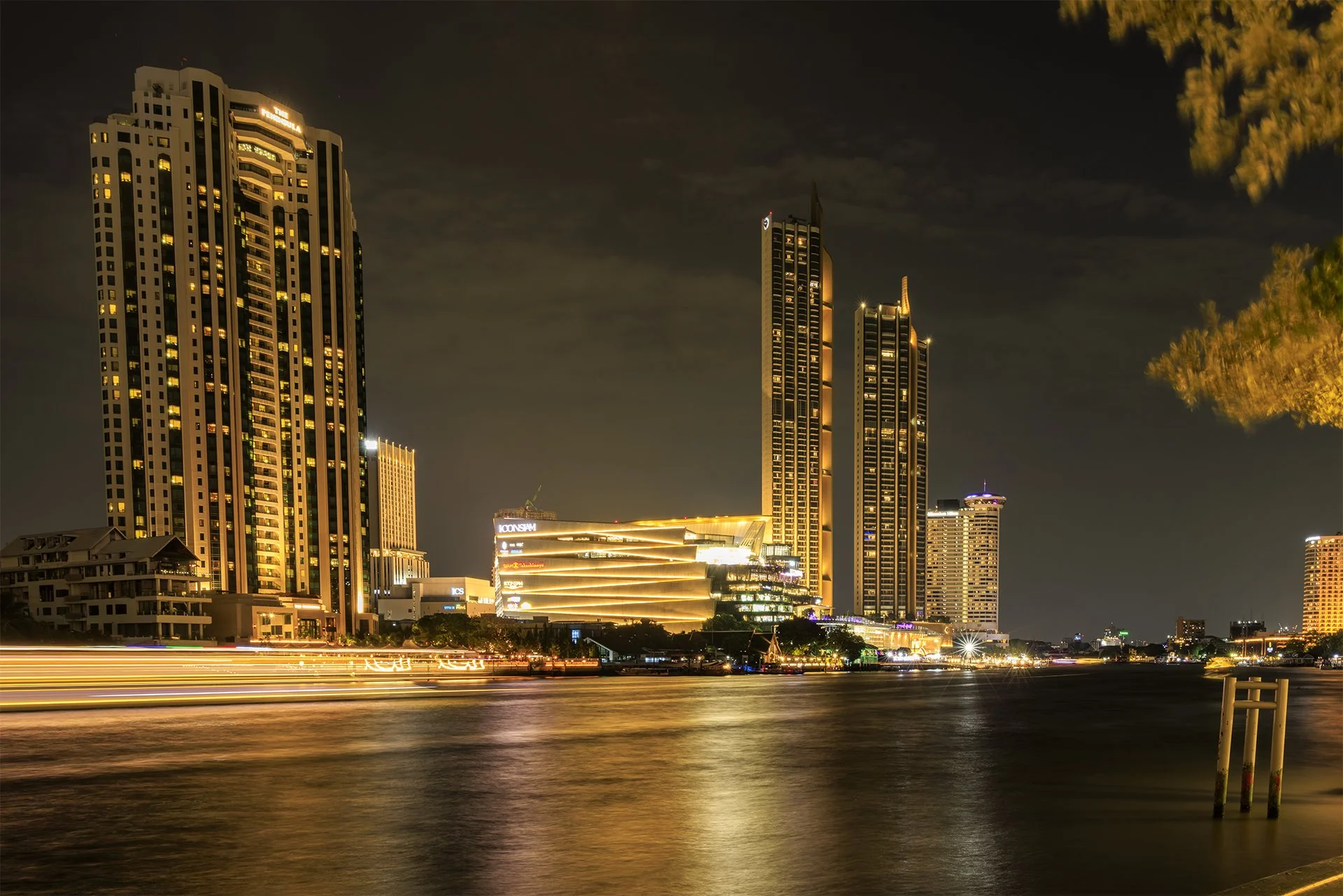
ICONSIAM shopping center.
Early the next morning we embarked our ship, Viking Orion. It was a little like coming home since this was the same ship we sailed on for our Australia/New Zealand trip. Later that day we had one more tour in Bangkok. This time we visited the flower market again and one more temple -- Wat Ratchanatdaram.
Here's a selection of photos from that tour. After that, we were happy to get back to our ship, have a nice meal, get some spa time and some rest.
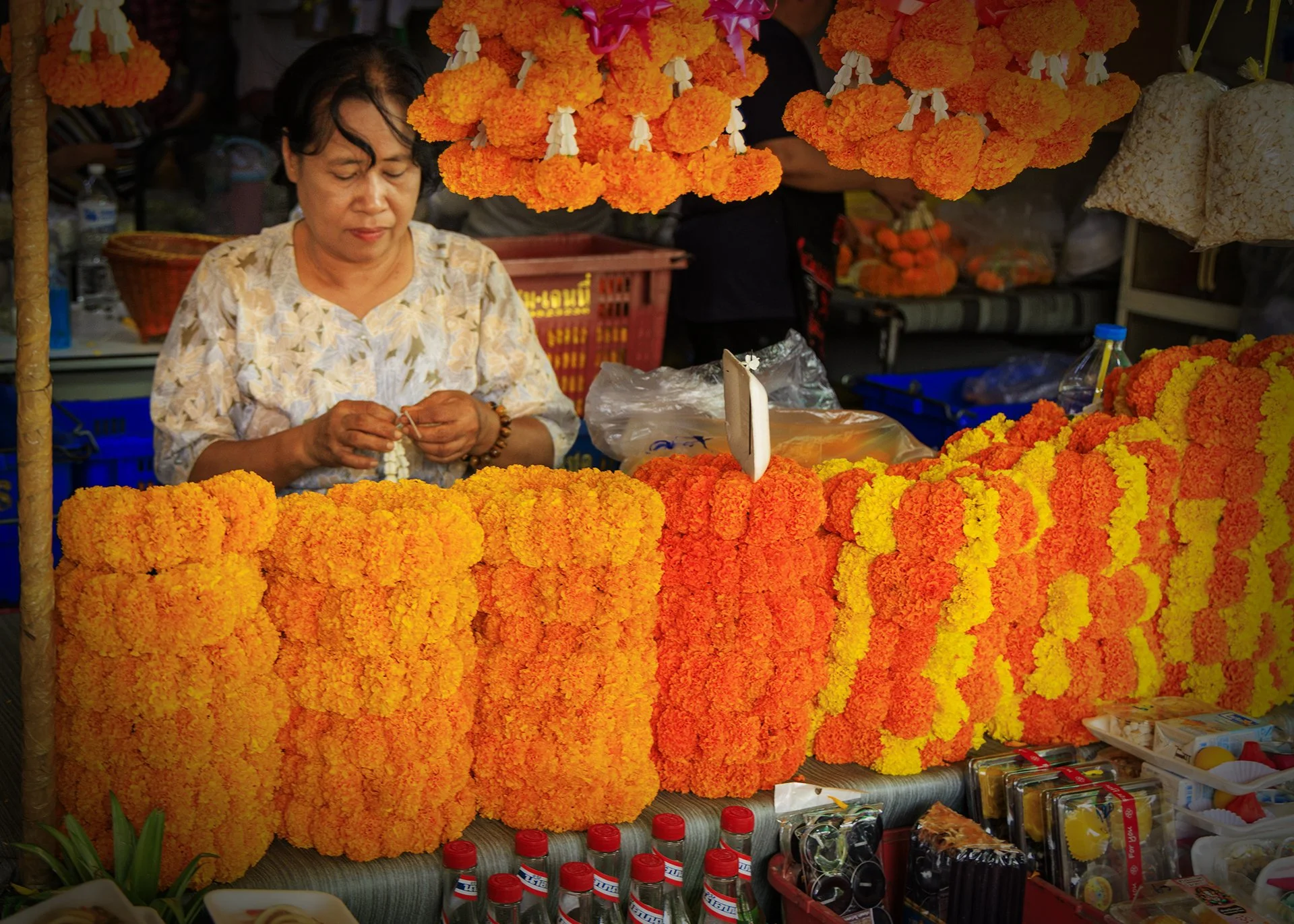
Marigold stall in the flower market.
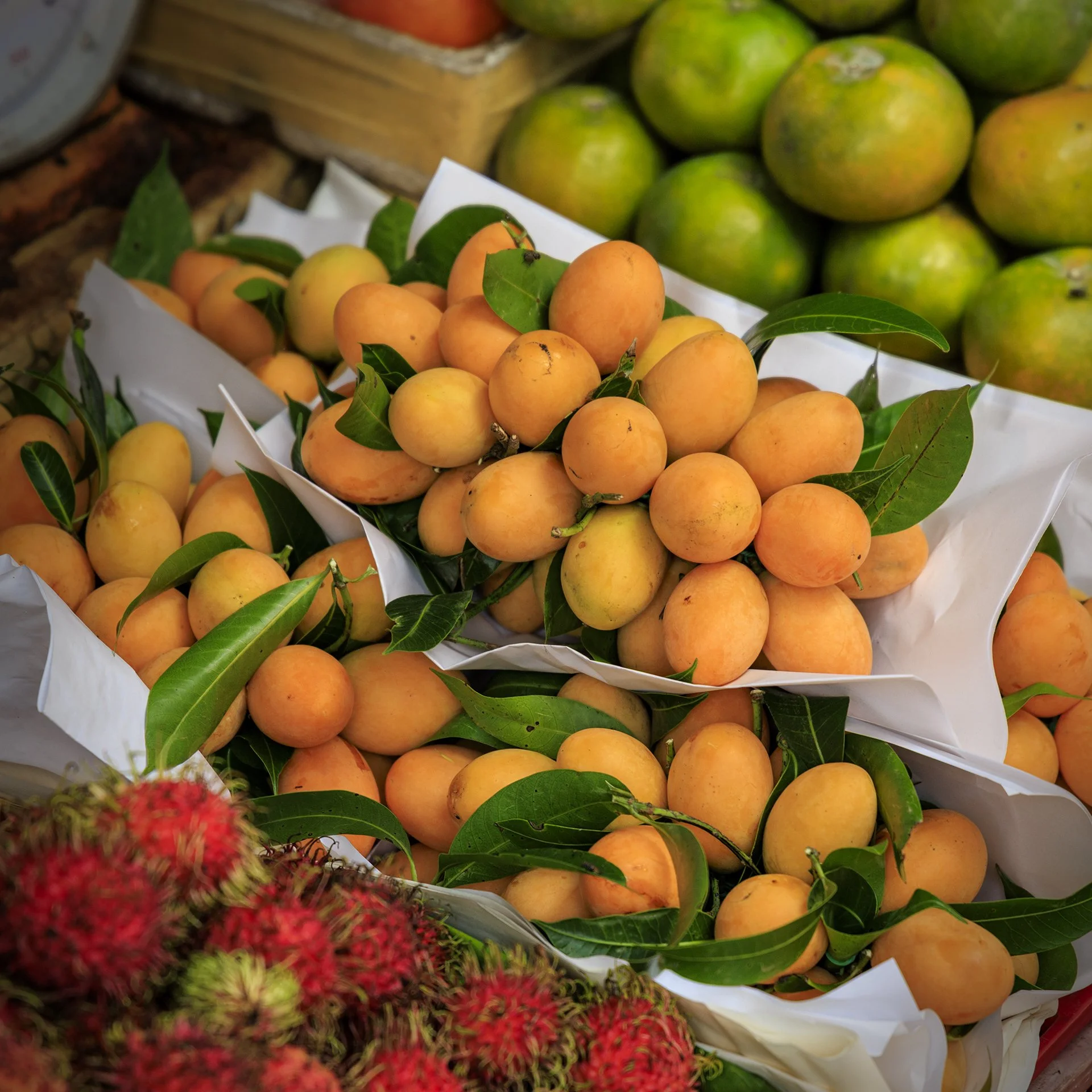
Fruit in the market.
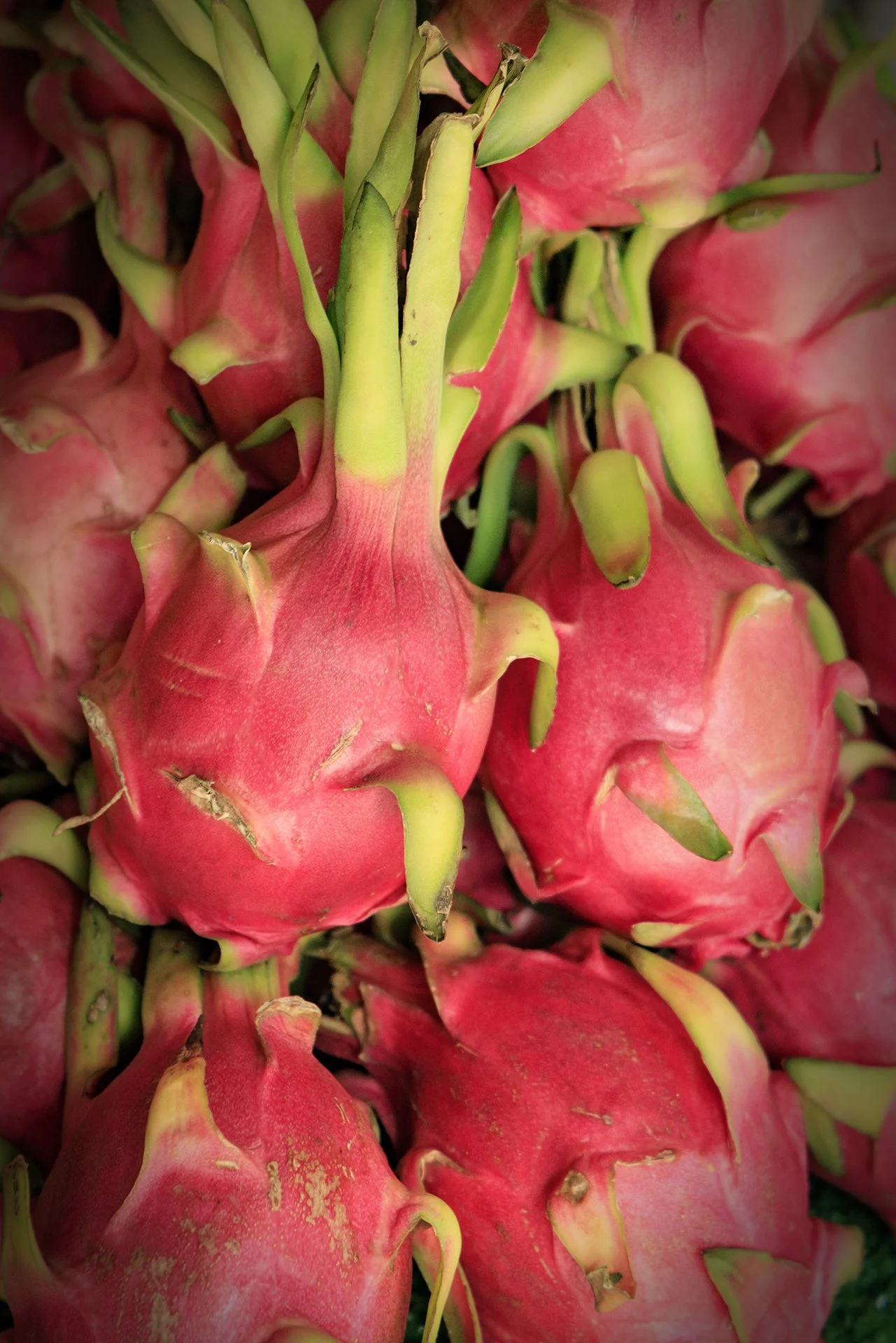
Dragon fruit.
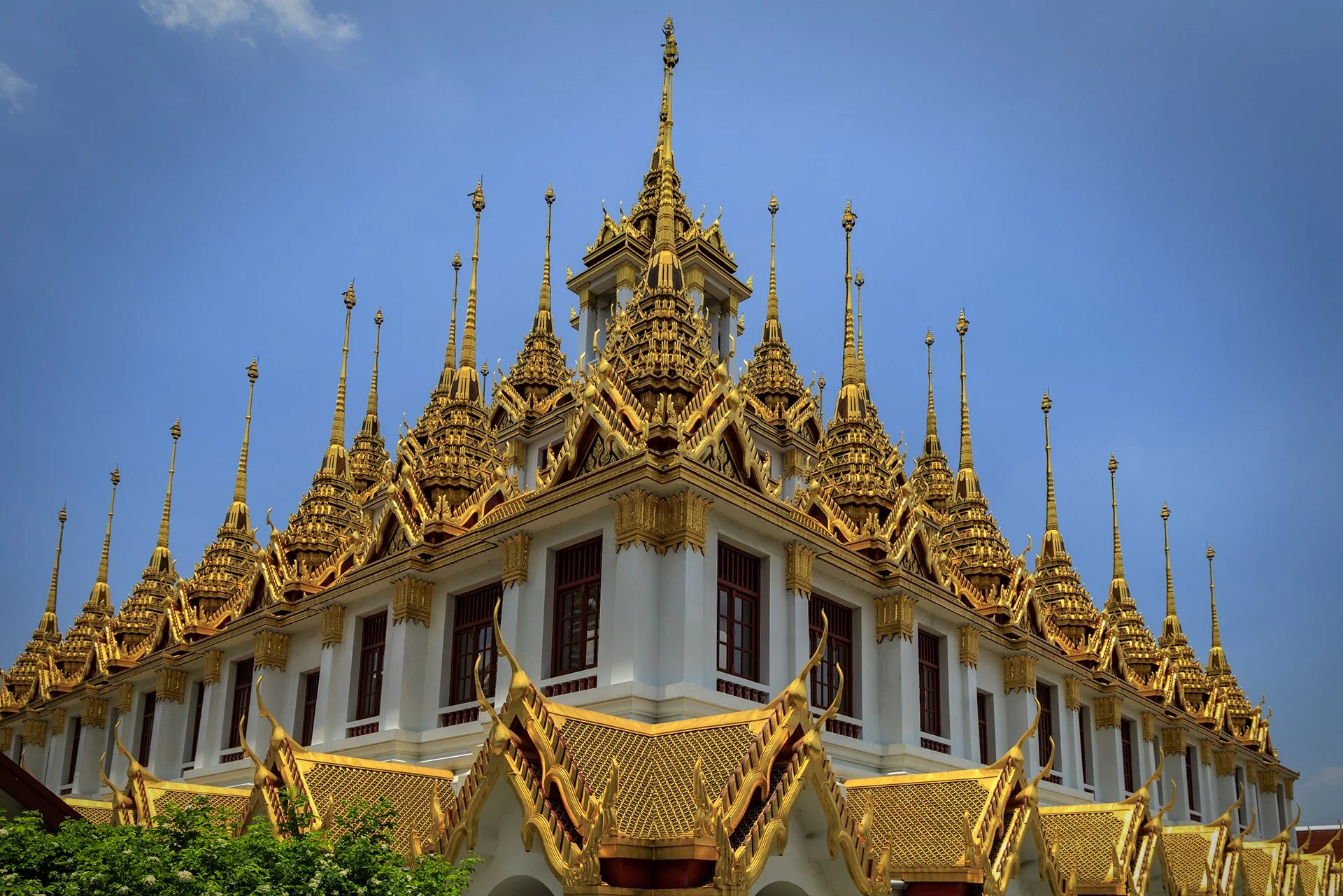
Loha Prasat (the Iron Temple) built by King Rama III for his niece.
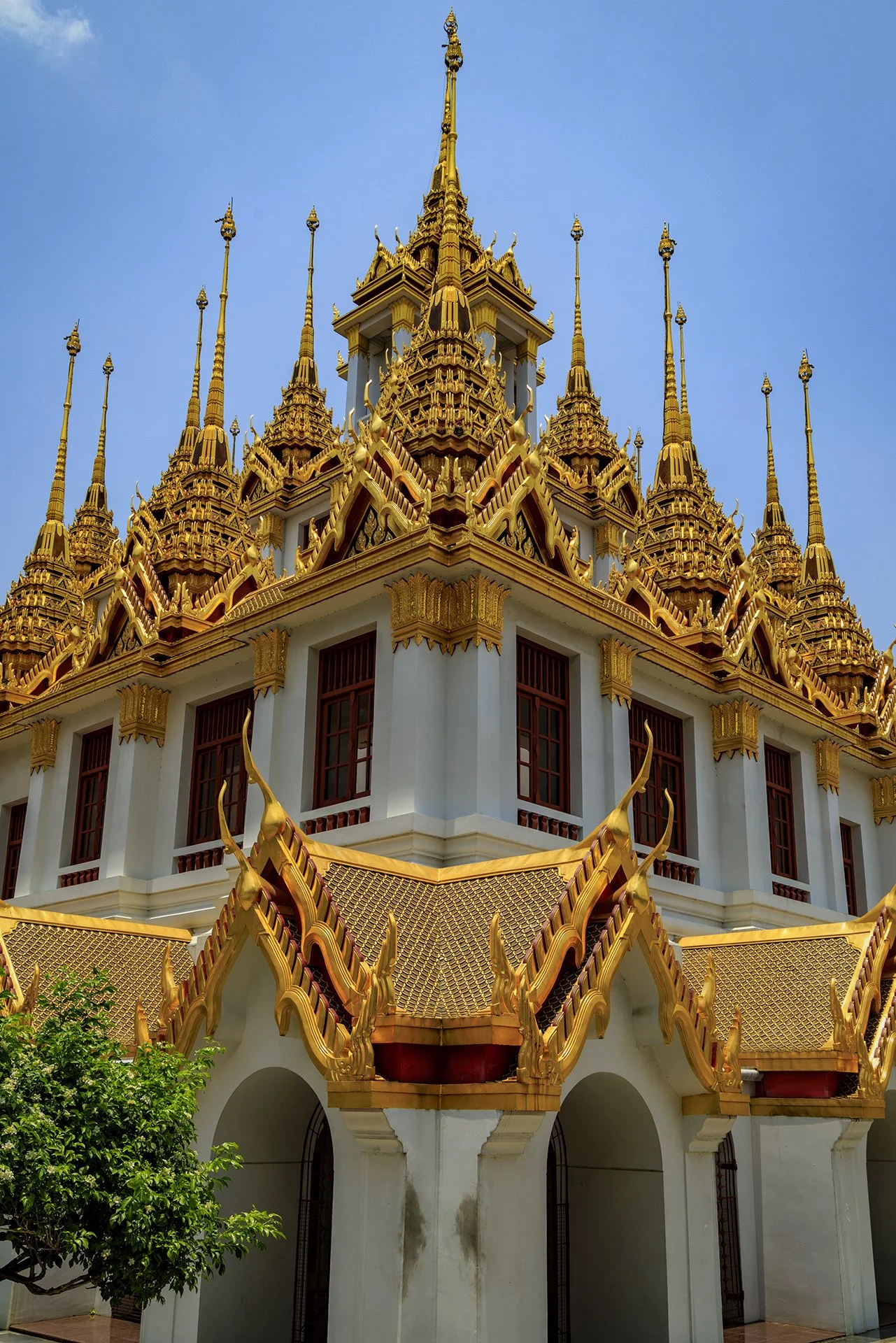
Another view.
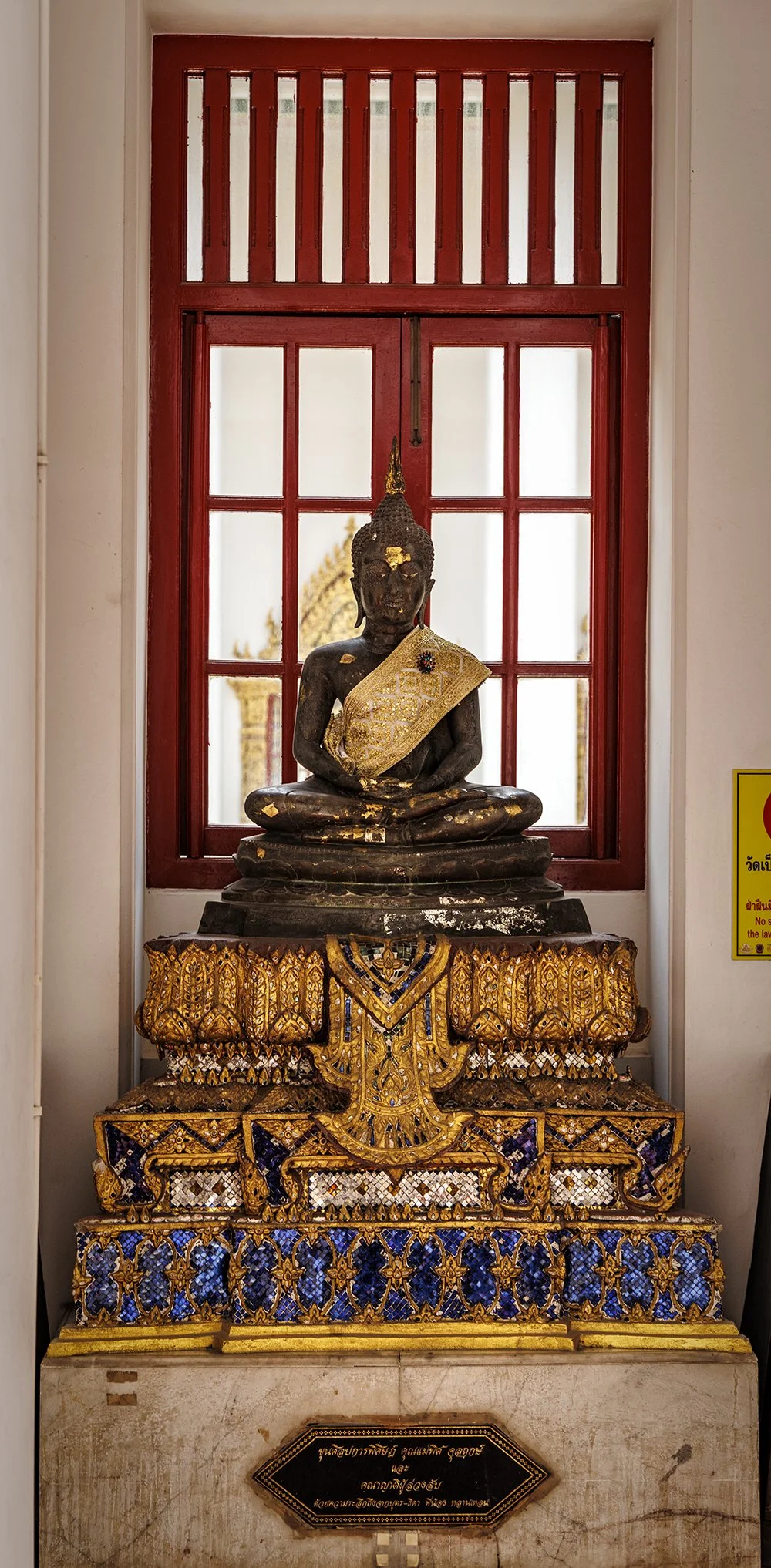
There is literally a shrine around every corner at this temple.
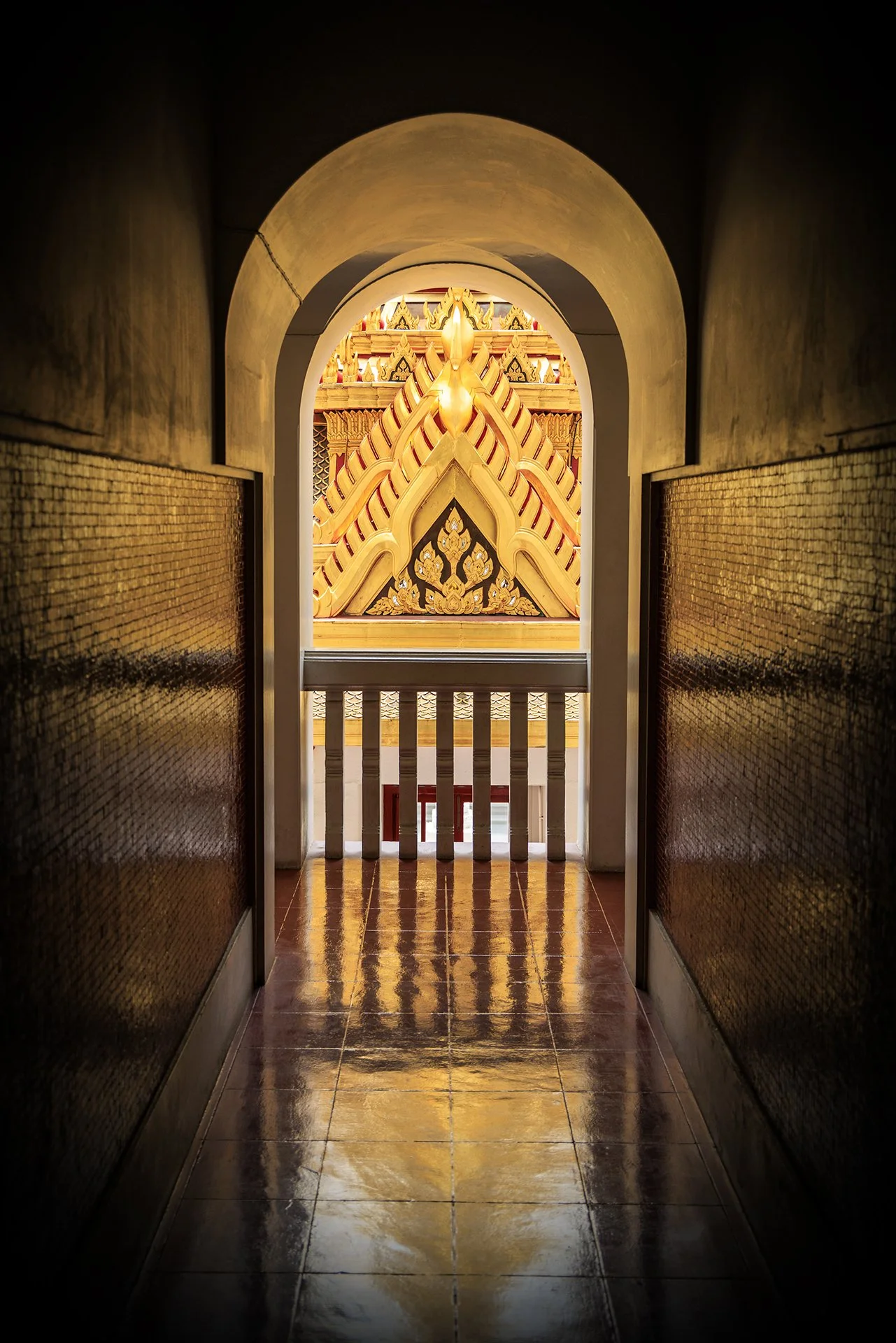
A corridor inside Loha Prasat.

Very large panoramic of the Bangkok skyline from Loha Prasat.
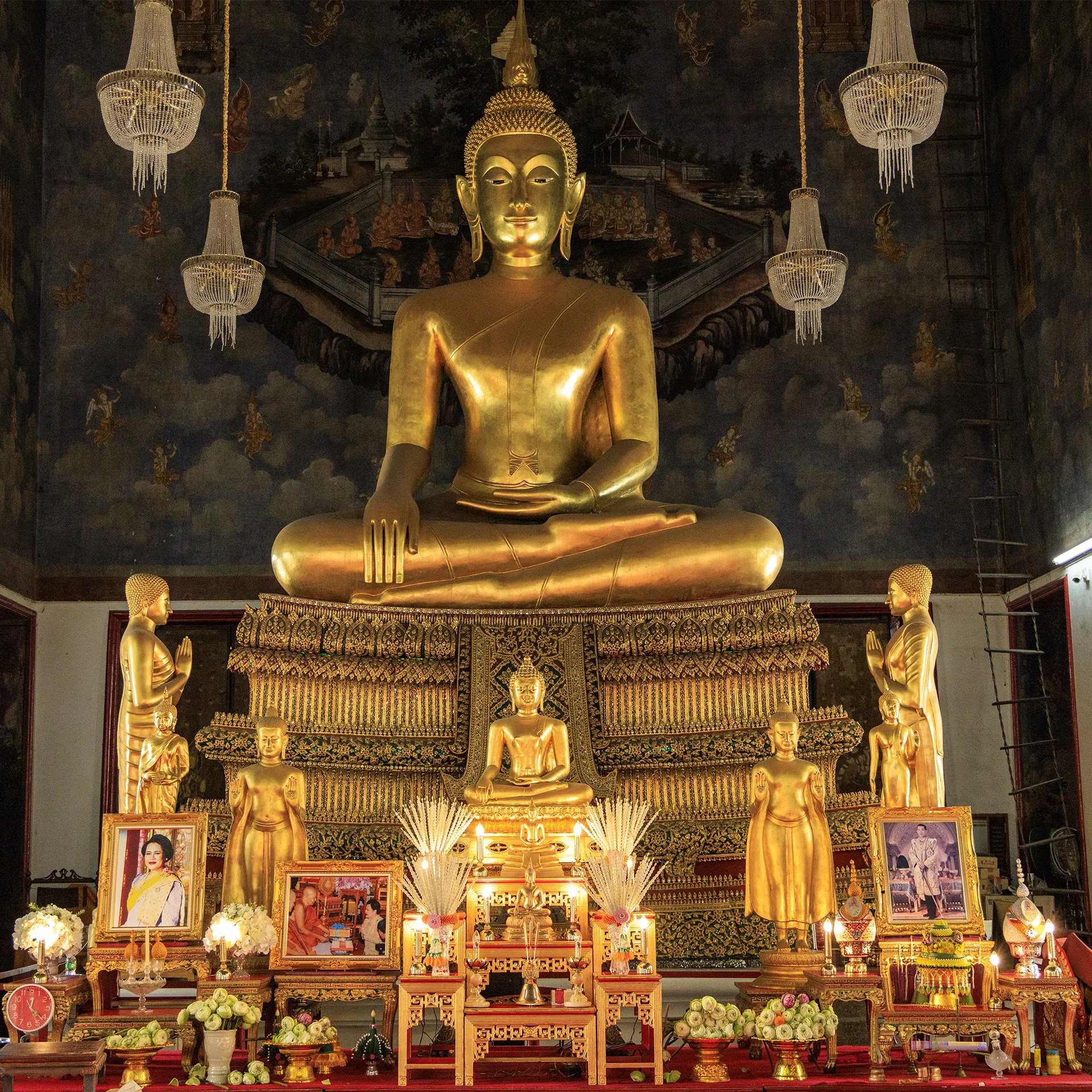
The main Buddha statue at Rat Ratchanatdaram.
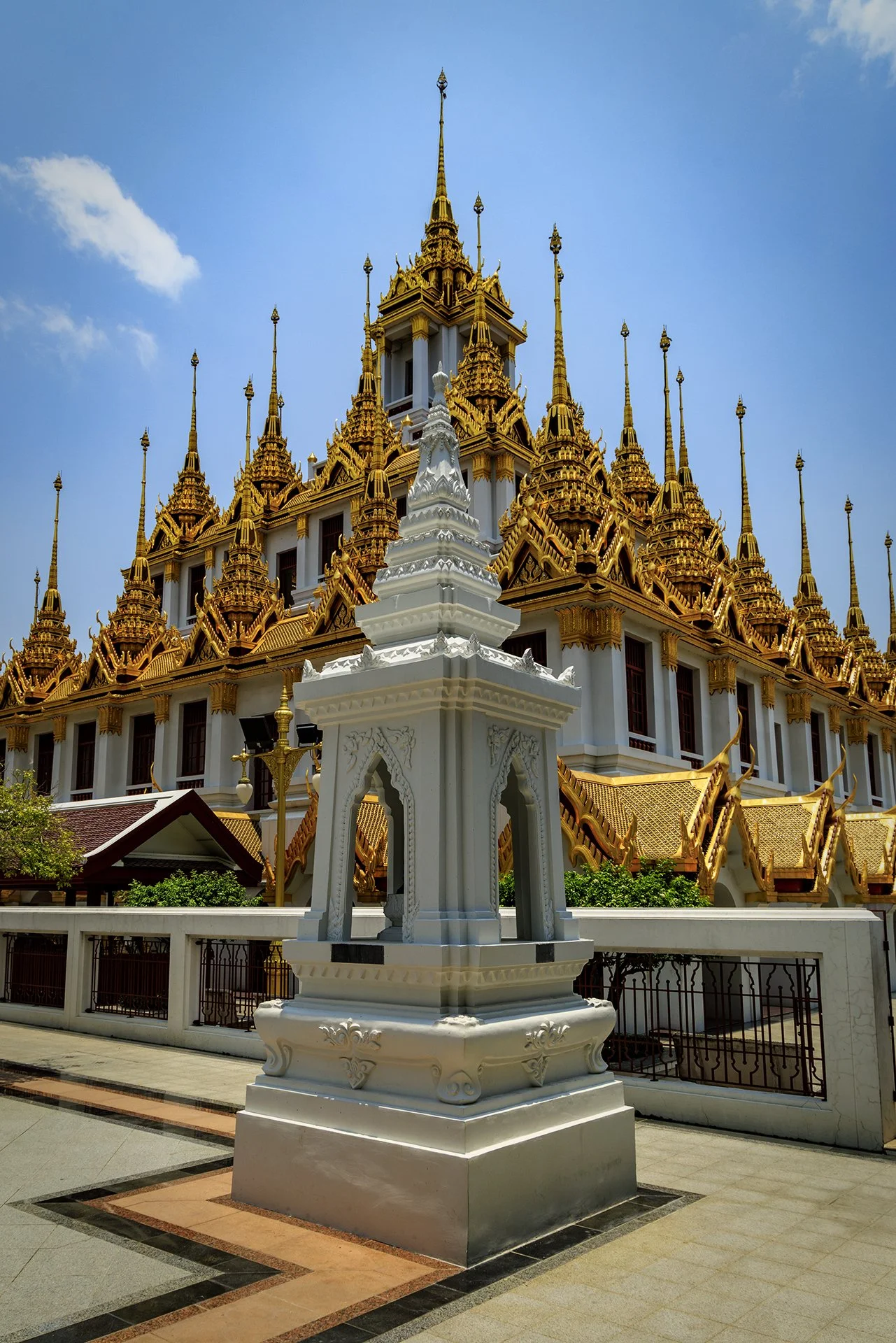
Another view of Loha Prasat.
Sihanoukville in Cambodia
After setting sail from Bangkok we spent one relaxing day at sea. Early the following morning we docked at Sihanoukville in Cambodia.
The shadow of the civil war of the late 70s in Cambodia still hangs over the country. It seemed that everyone we talked to wanted to tell us of family members lost to the "killing fields". At the same time Everyone was dedicated to building a stable democracy and capitalist system in their country after the chaos following the civil war and in spite of the almost universal poverty. As one guide put it, "We are just a baby democracy but we are going to make it". As dedicated as they are to it, I believe they will.
Maybe we could learn something from them.
In the morning we visited a small fishing village and had an opportunity to see how the people lived there. I took some street photos even though I didn't have the leisure to spend and record the street life as I would have I liked.
Later in the day we visited yet another Buddhist temple. In Bangkok the Buddhist religion influenced everything that happened in the country. In Cambodia, it was similar but somewhat different. I felt that the Buddhists in Cambodia didn't have as much influence in people's lives as they did in Bangkok.
For example, in Bangkok, traffic was crazy but people didn't blow their horns or cut one another off. It seemed a very Buddhist attitude dominated the way people drove. In Cambodia it was each person for themselves and horns blared frequently (but not in an angry way as you would see in the US, more just a "hey I'm here so please don't hit" me kind of a way).
Then it was back to our ship where we enjoyed a nice sunset and views of the city. We followed that with dinner at Manfredi's -- the Italian fine dining premium restaurant on our ship.
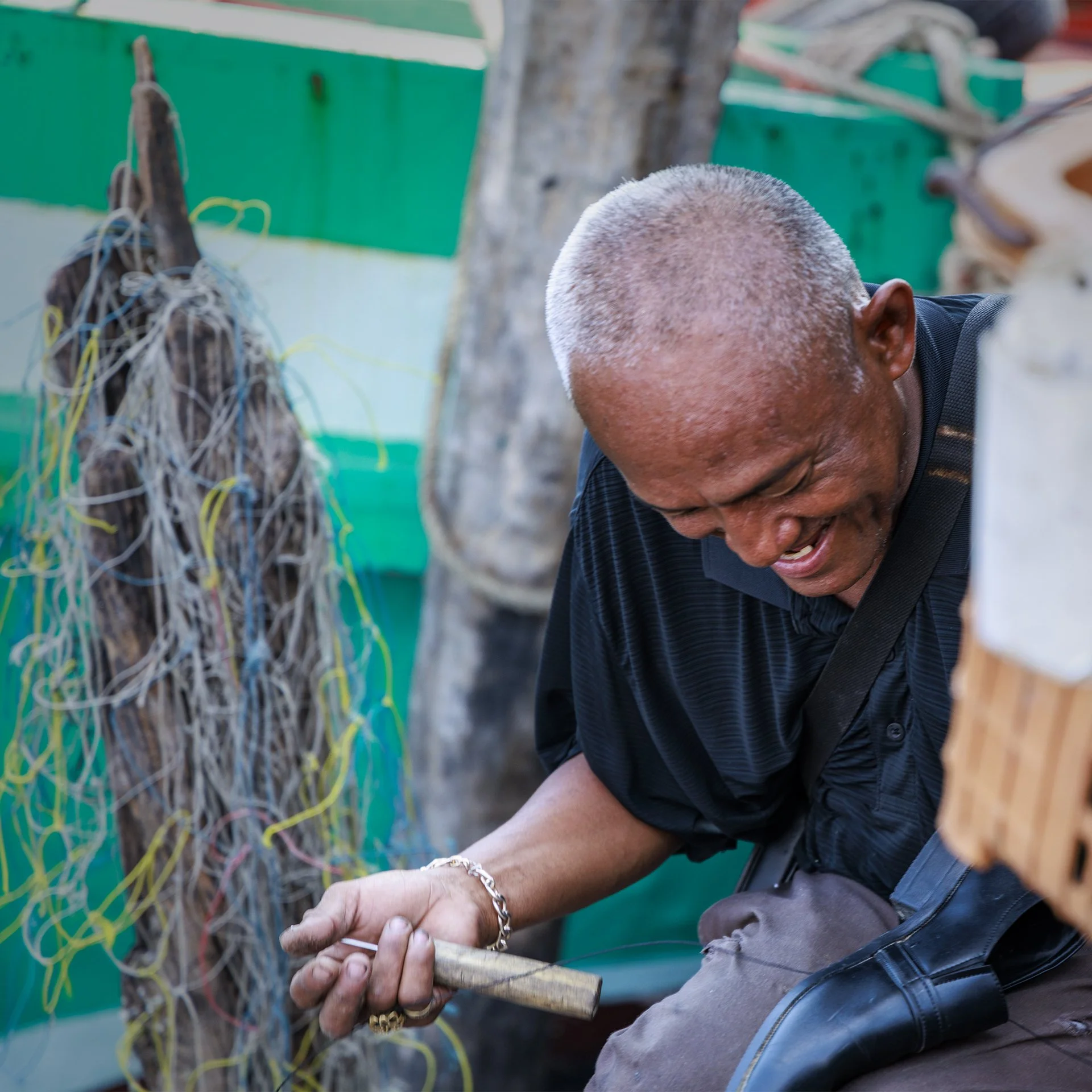
A shoe maker working on the dock.
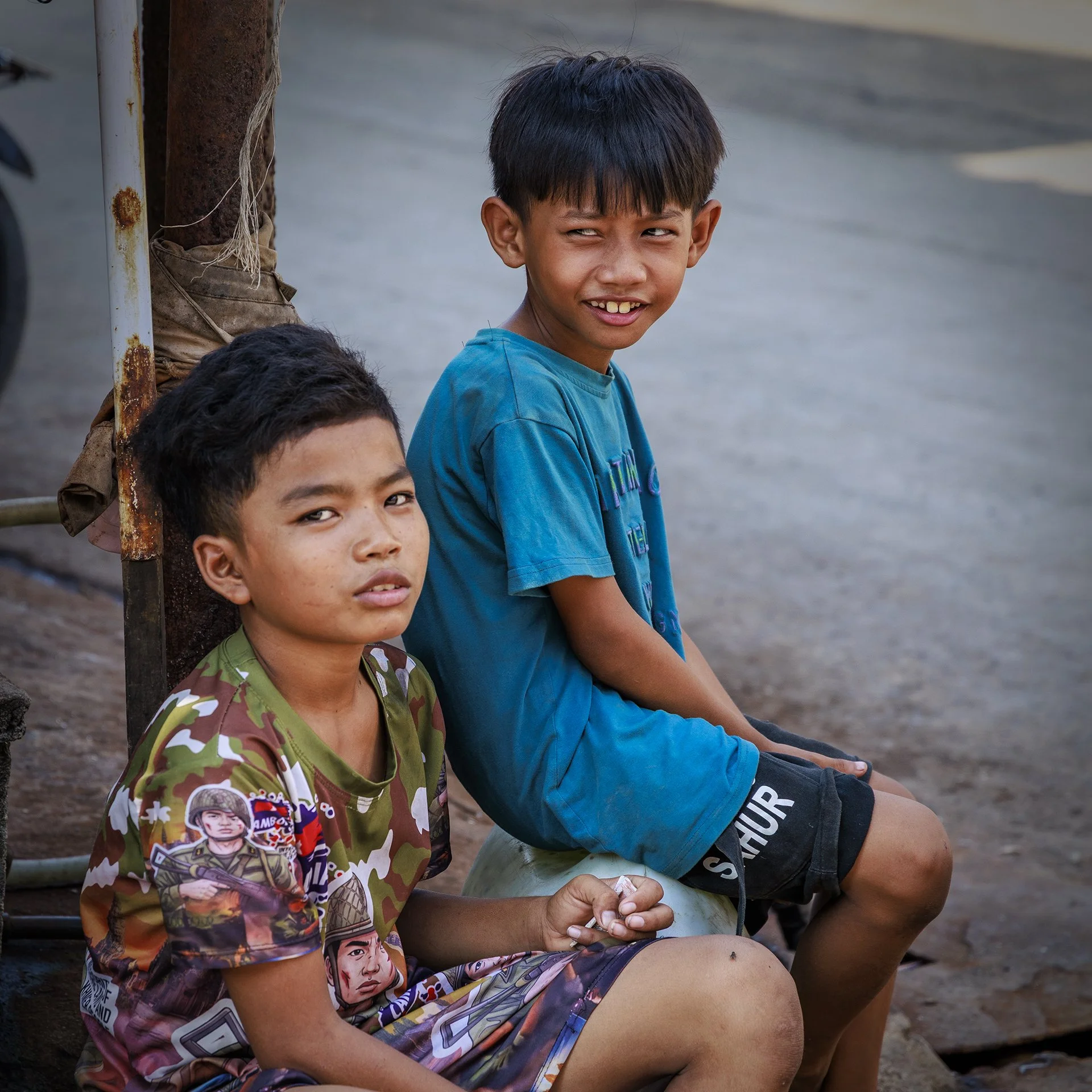
Boys in the fishing villiage.
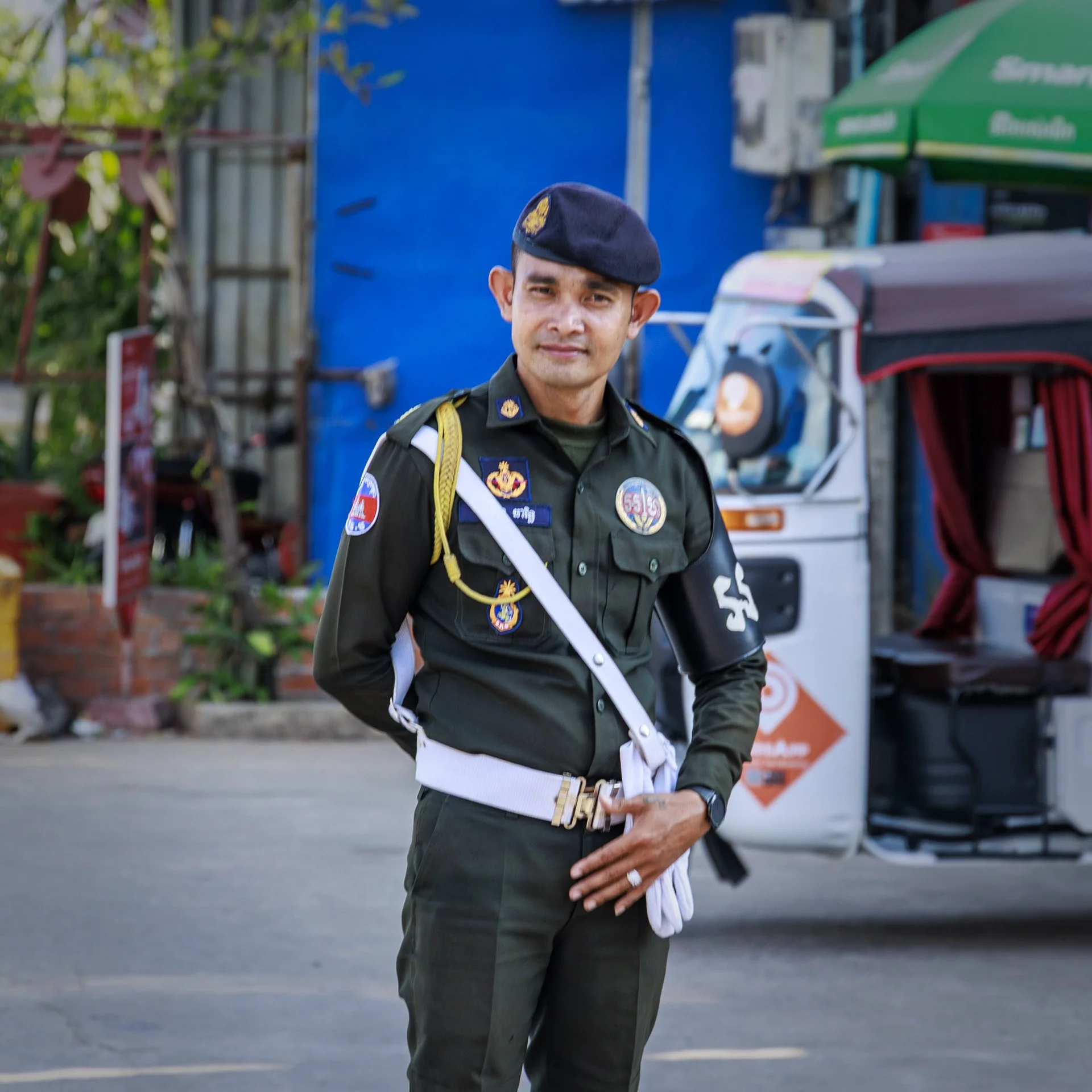
Police officer walking a beat in the villiage.
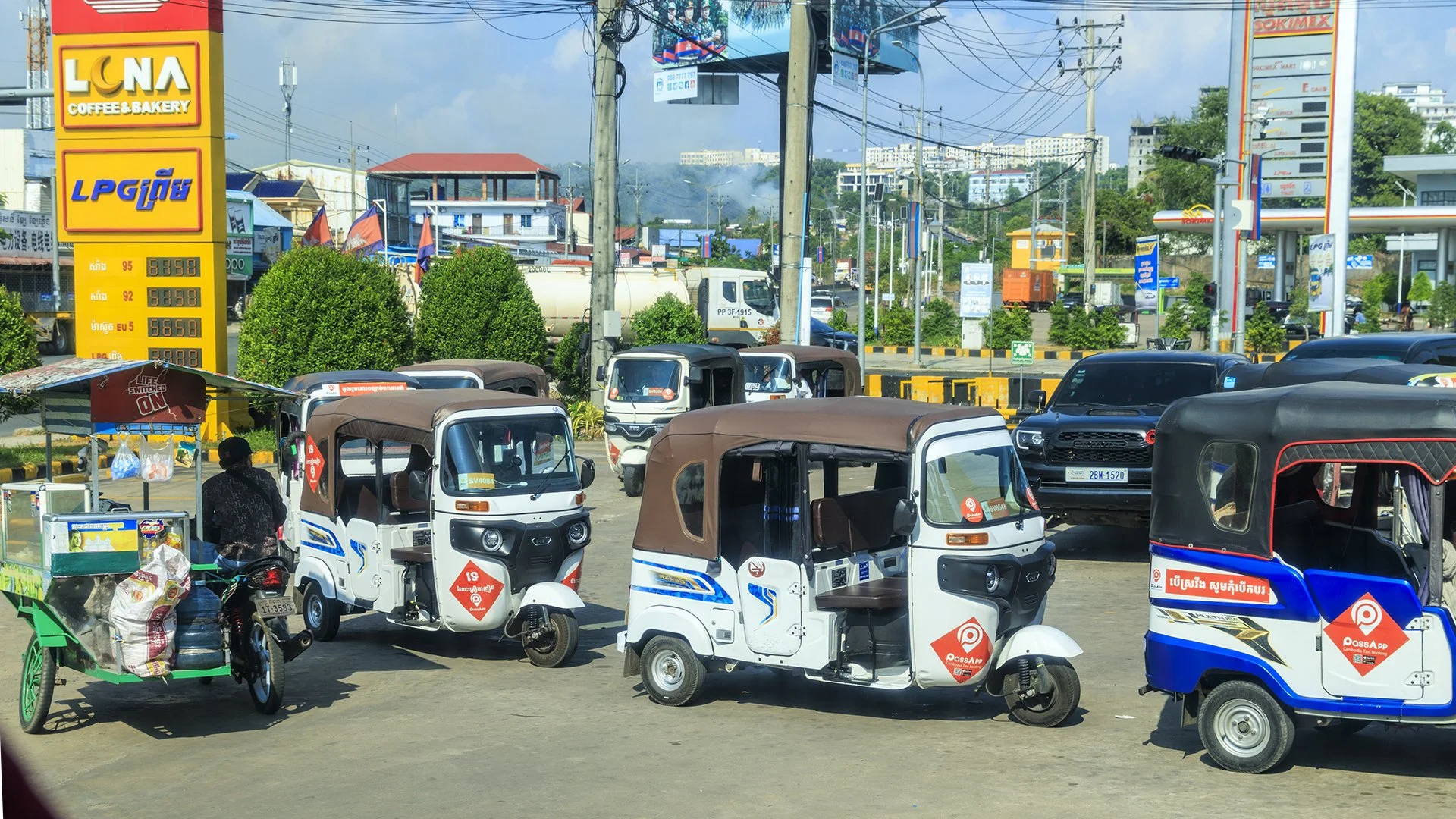
Long line of Tuk Tuks waiting for gas. Our guide told us this was unheard of and caused by Trump's war in Iran. He said gasoline, when you could get it, was up 200% or more.
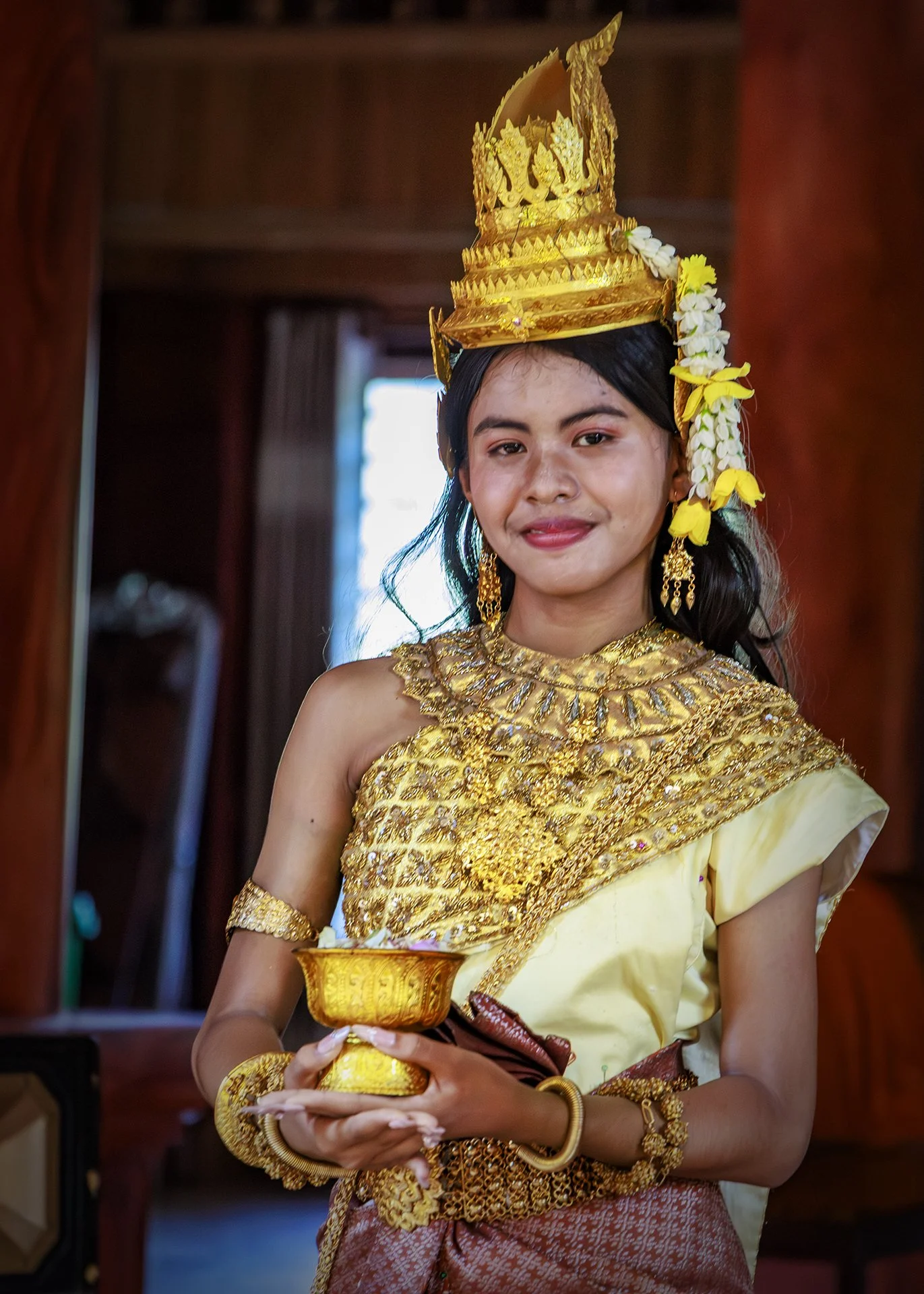
Native dance exhibition at Wat Leu.
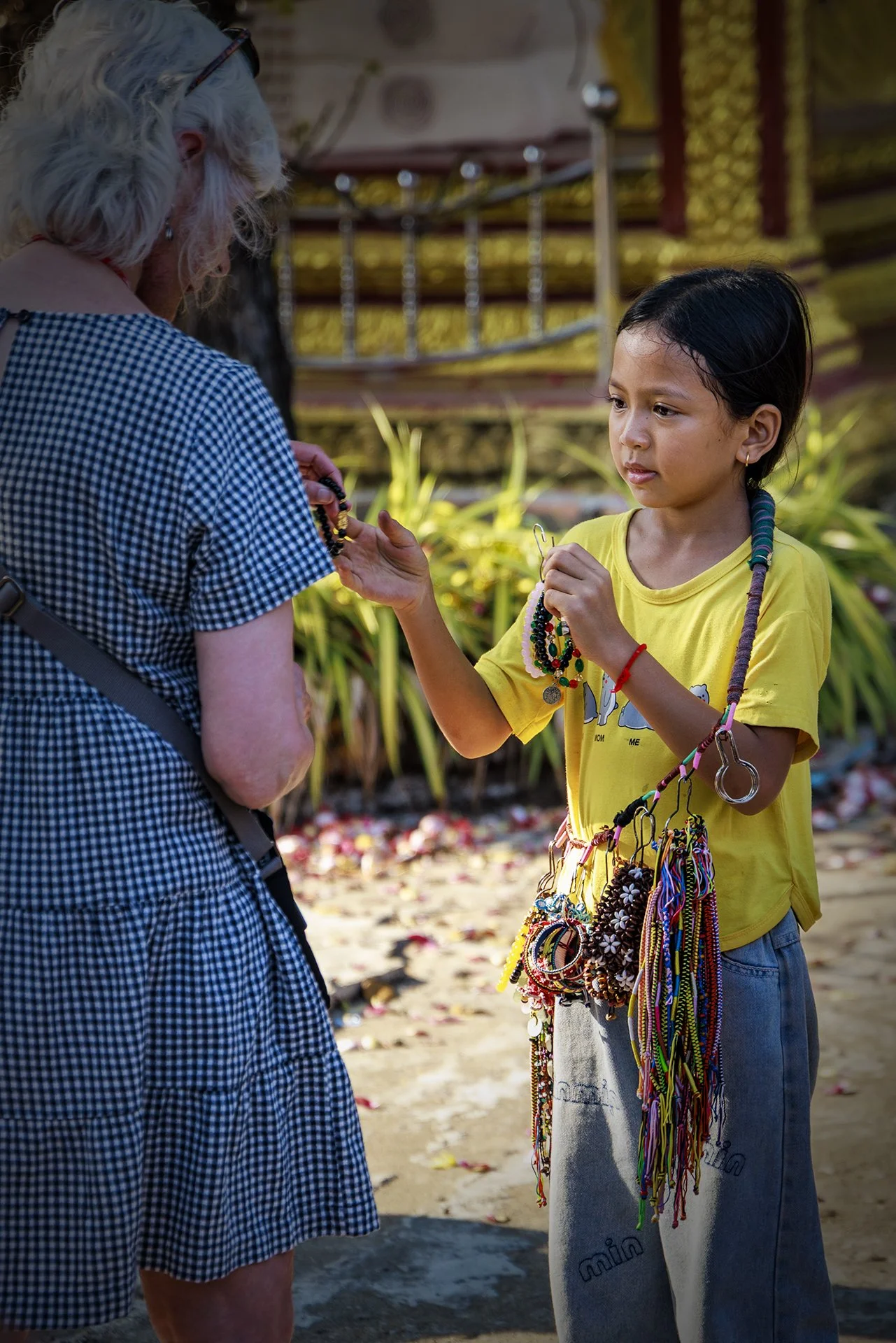
Child selling handicrafts to tourists at Wat Leu.
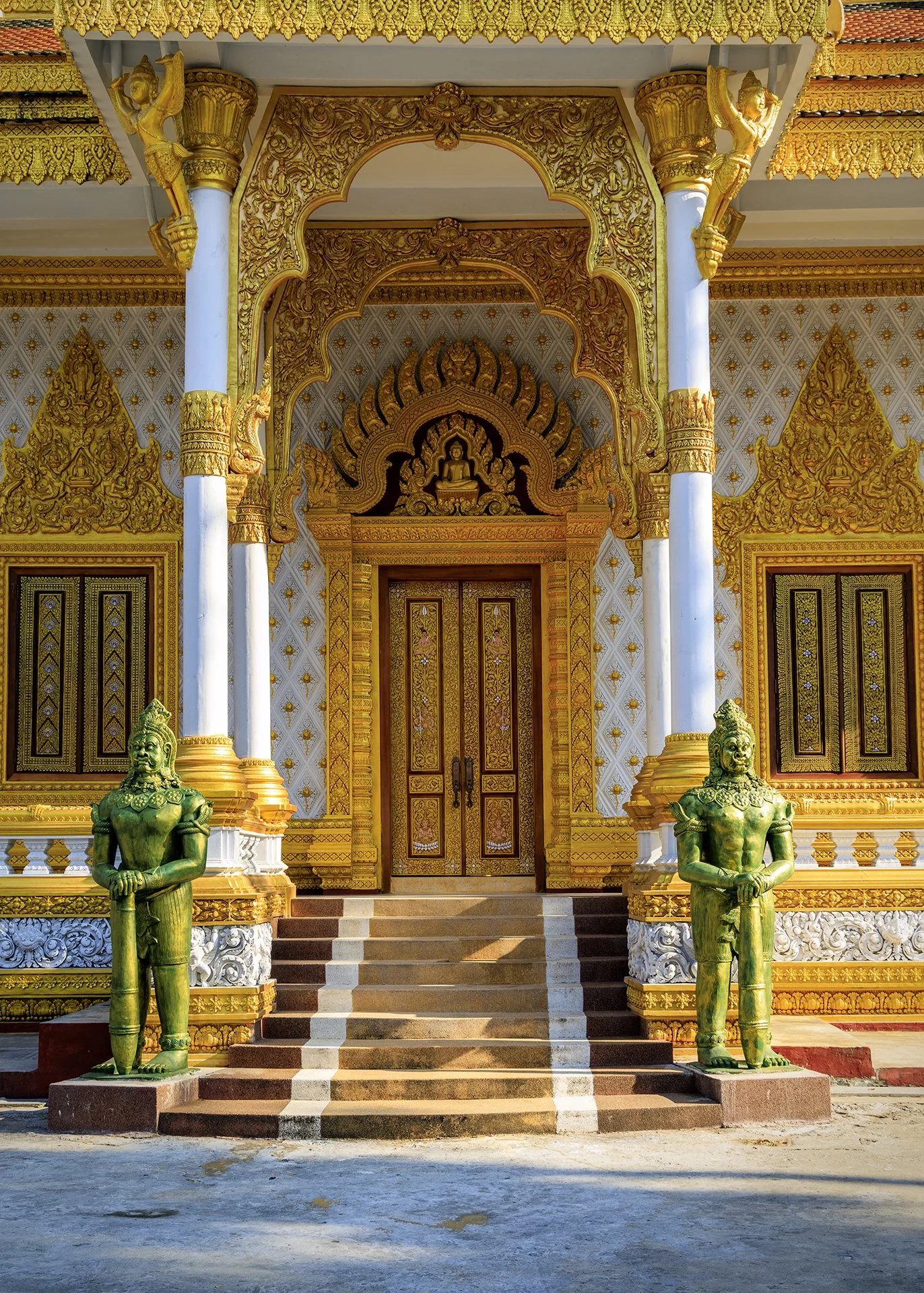
Entrance to Wat Leu.
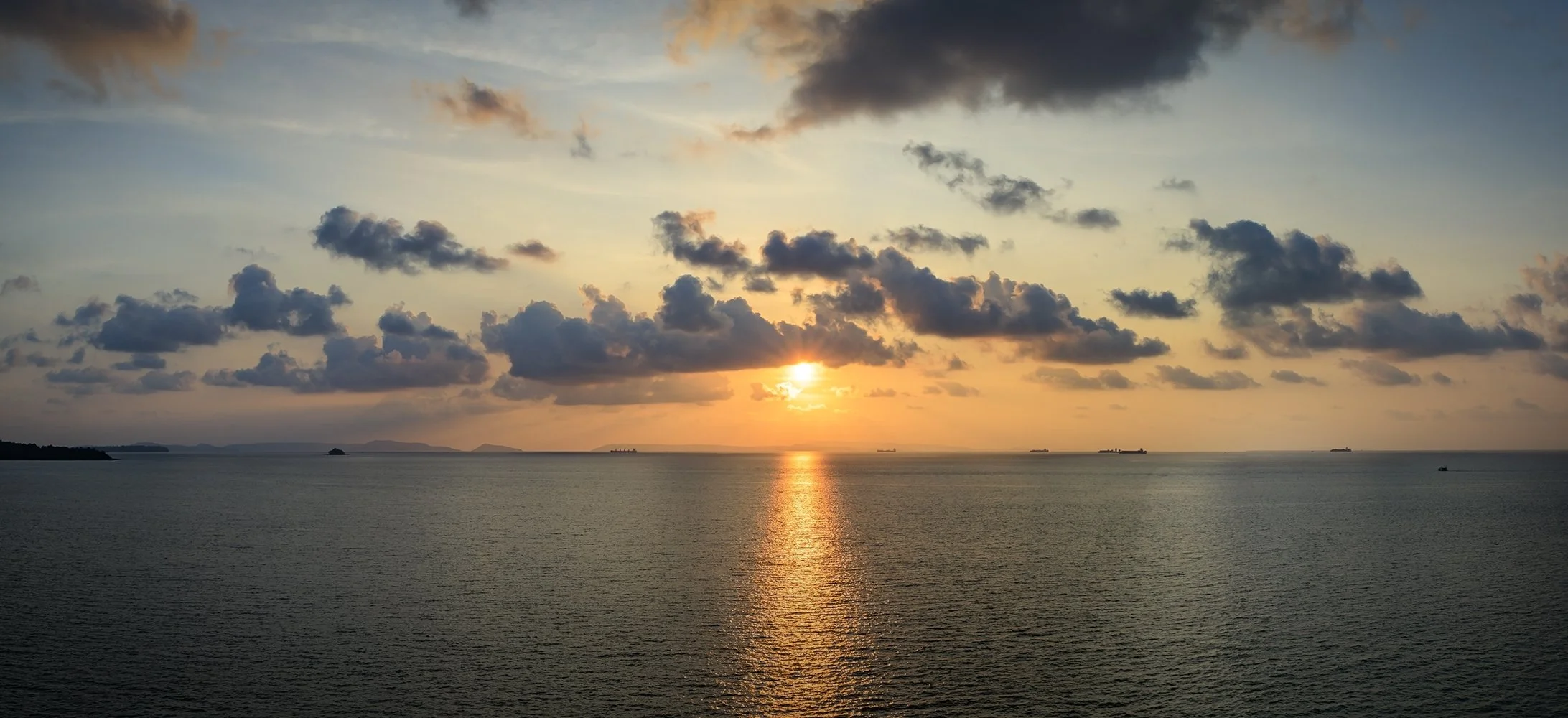
Sunset, Bay of Kampong Som.
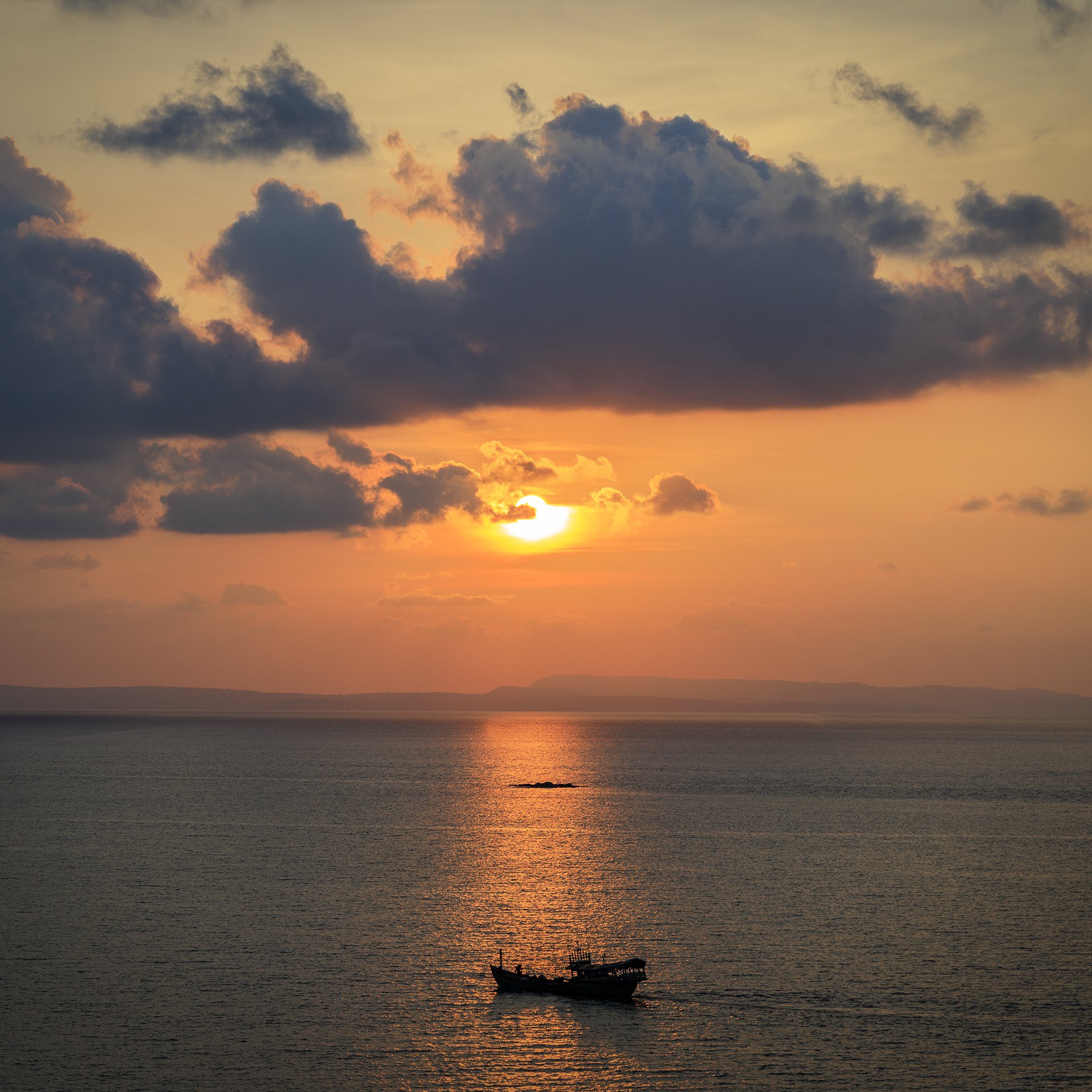
Fishing boat at sunset, Bay of Kampong Som.
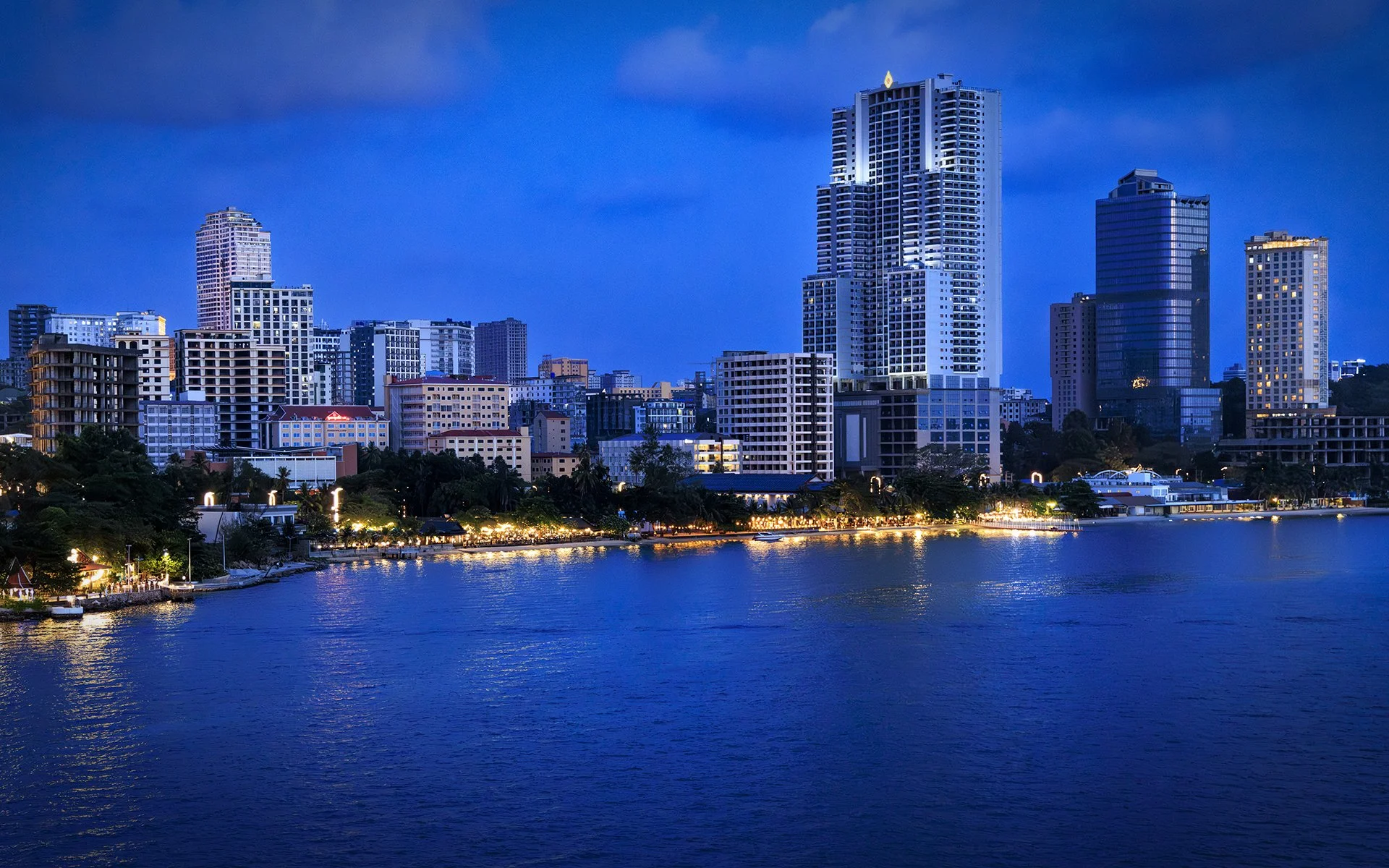
Sihanoukville Cambodia at evening.
On our second day at Sihanoukville we visited Wat Krom (another Buddhist temple), a Cambodian farm house in a small village where we sampled local grown fruits and traditional snacks, and a Cambodian national park where we took a river boat tour and relaxed on a local beach.
Photographically this was just a series of snap shots. I kept my camera in shutter priority mode. I switched between my usual walkaround lens (my 24-105 mm zoom) and my long telephoto (100-500 mm zoom) as needed.
Wat Krom was a little different from the other Buddhist temples we'd visited at this point because it was on a forested mountain. There was a lot of climbing stairs and hiking along forest paths. Being able to be in the shade was nice since it was warm.
After Wat Krom, our visit to the farm house was interesting. On one hand it was a little weird because this bus full of (mostly) American tourists descended on this little family's home. They were gracious and served us snacks and local fruits that they grew on the farm. The parents were busy serving but one of the children enjoyed chatting with the tourists.
She was very fluent in English and told me she learned English at school. She told me all the children study English and Chinese as well as Cambodian and that her favorite subject was mathematics.
It was a relaxing stop. I took photos of the family working and the children playing.
The visit to the Ream national park was very touristy. We walked through part of the park but since it was the dry season the forest was pretty dry and looked pretty desolate.
After our walk we boarded small boats and travelled up the river through the rest of the park. There were a lot of boats and the guides didn't have much to talk about. I was hoping to see some wildlife (especially monkeys) so I had my long telephoto lens on the camera but it mostly a waste of time.
We ended the tour at nearby Hawaii Beach. Hawaii Beach is a pretty little beach but you have to run a gauntlet of locals trying to sell you massages and little trinkets.
There were a number of local folks enjoying the beach including some Buddhist monks that I enjoyed photographing.
Here's a selection from the snapshots I took that day....
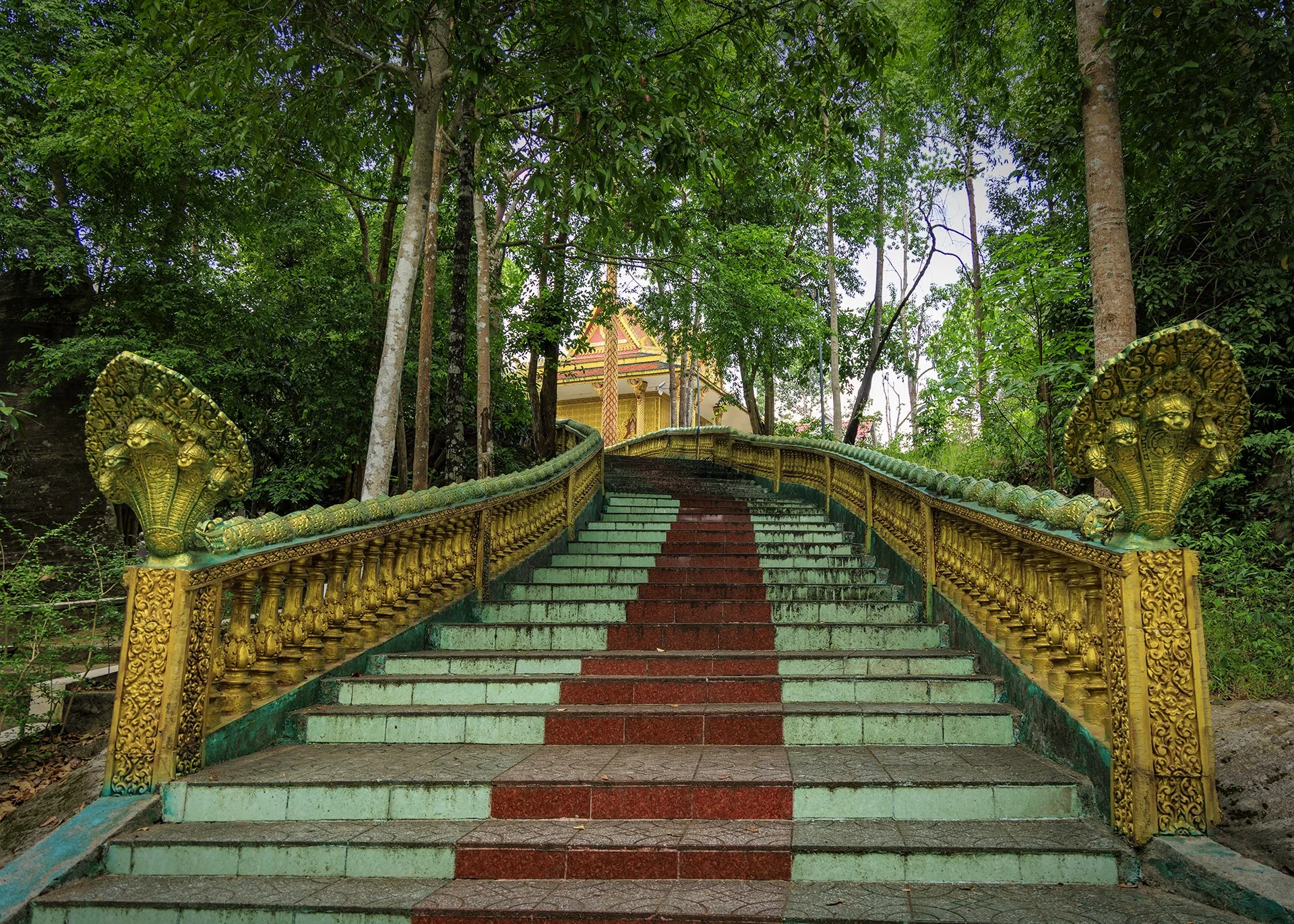
Stairway to Wat Krom.
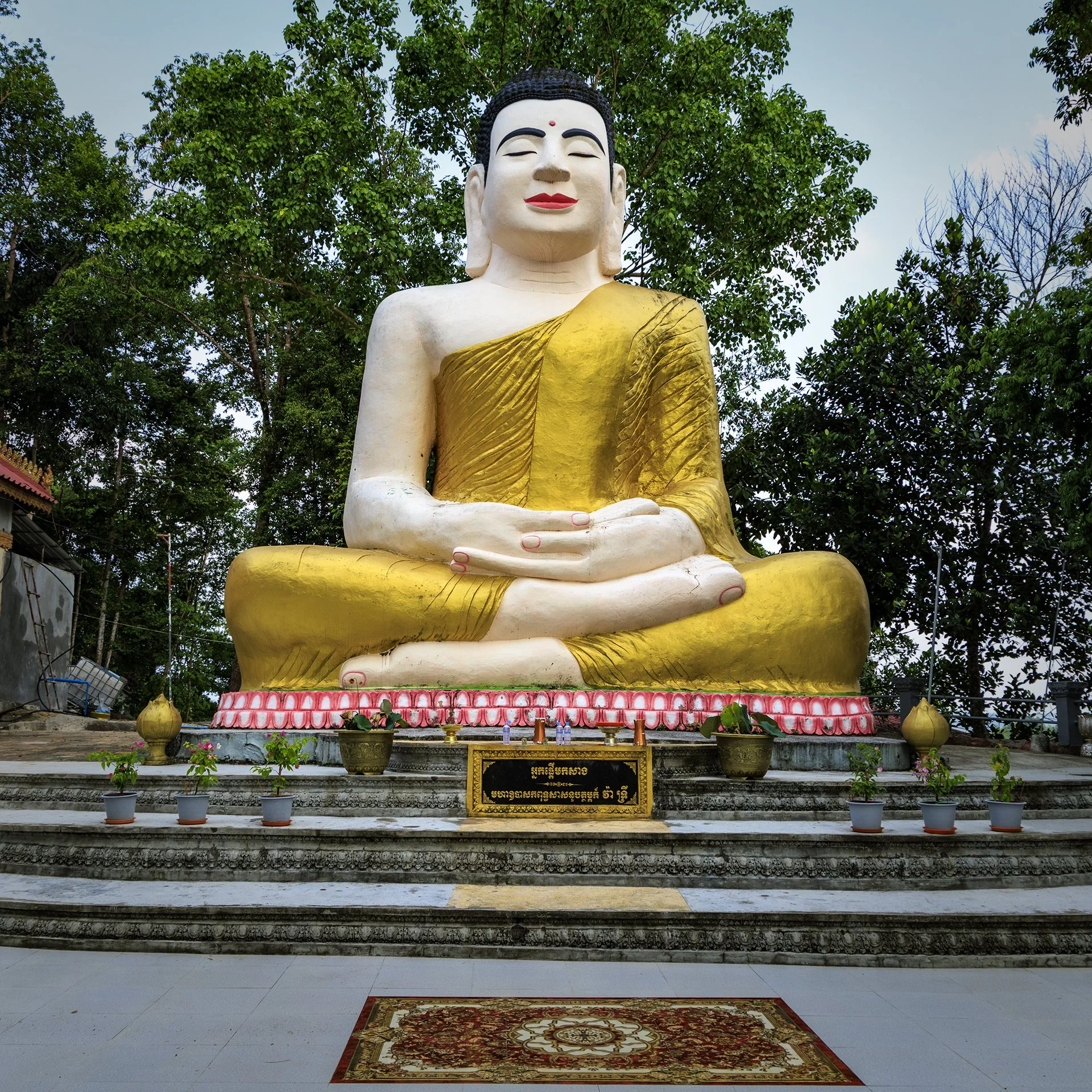
Big Buddha at Wat Krom.
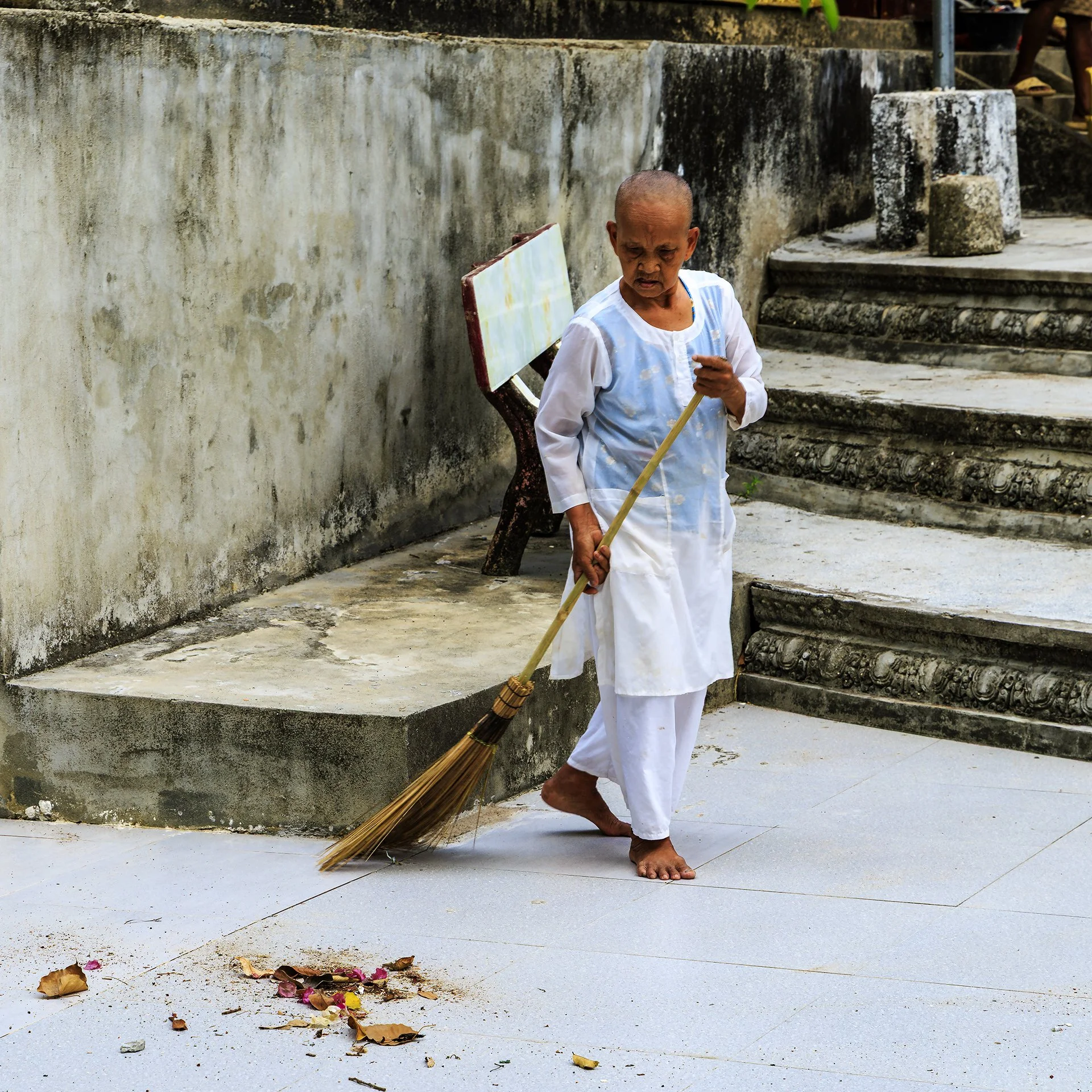
Worker at Wat Krom.
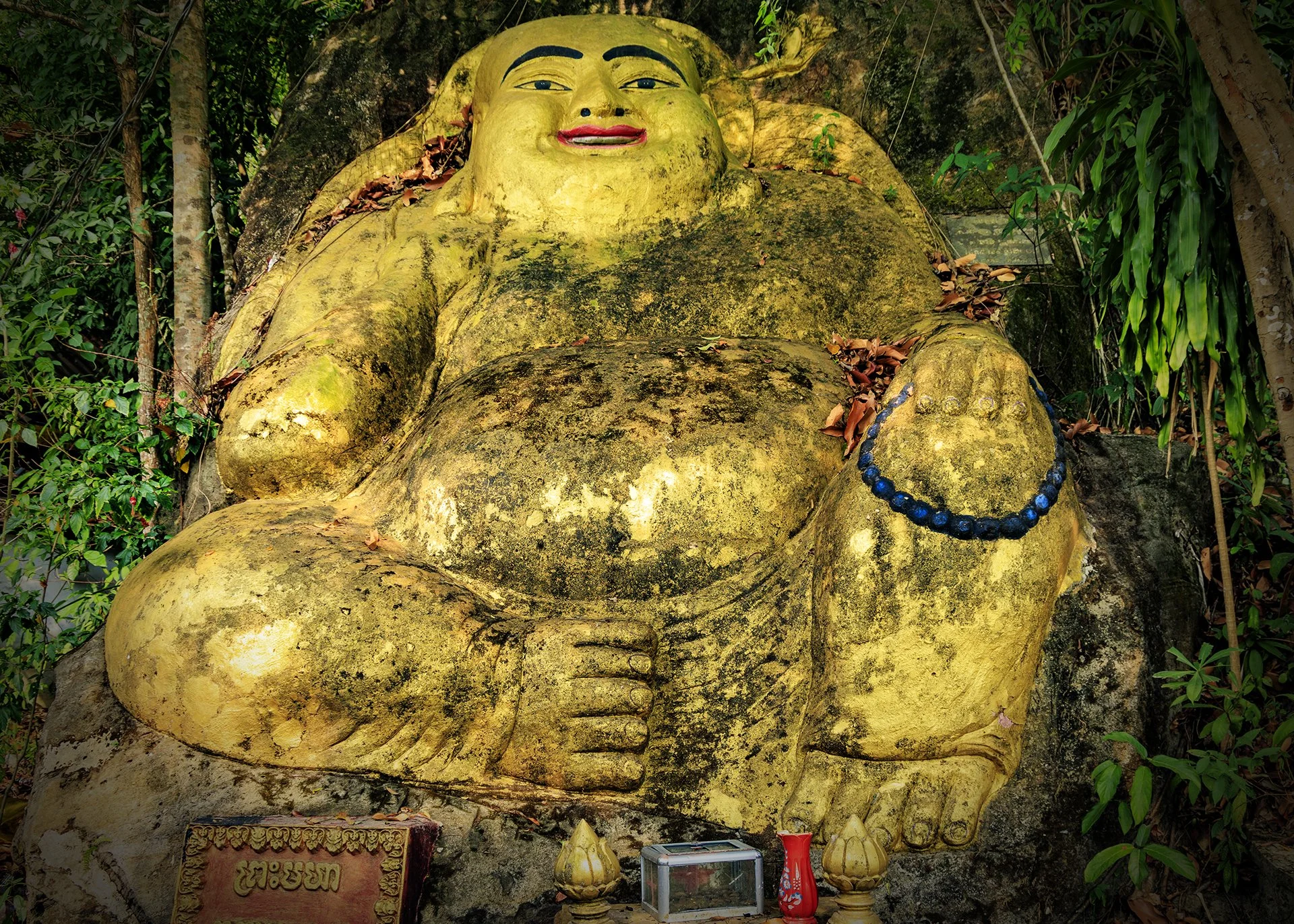
Buddha in the forest at Wat Krom
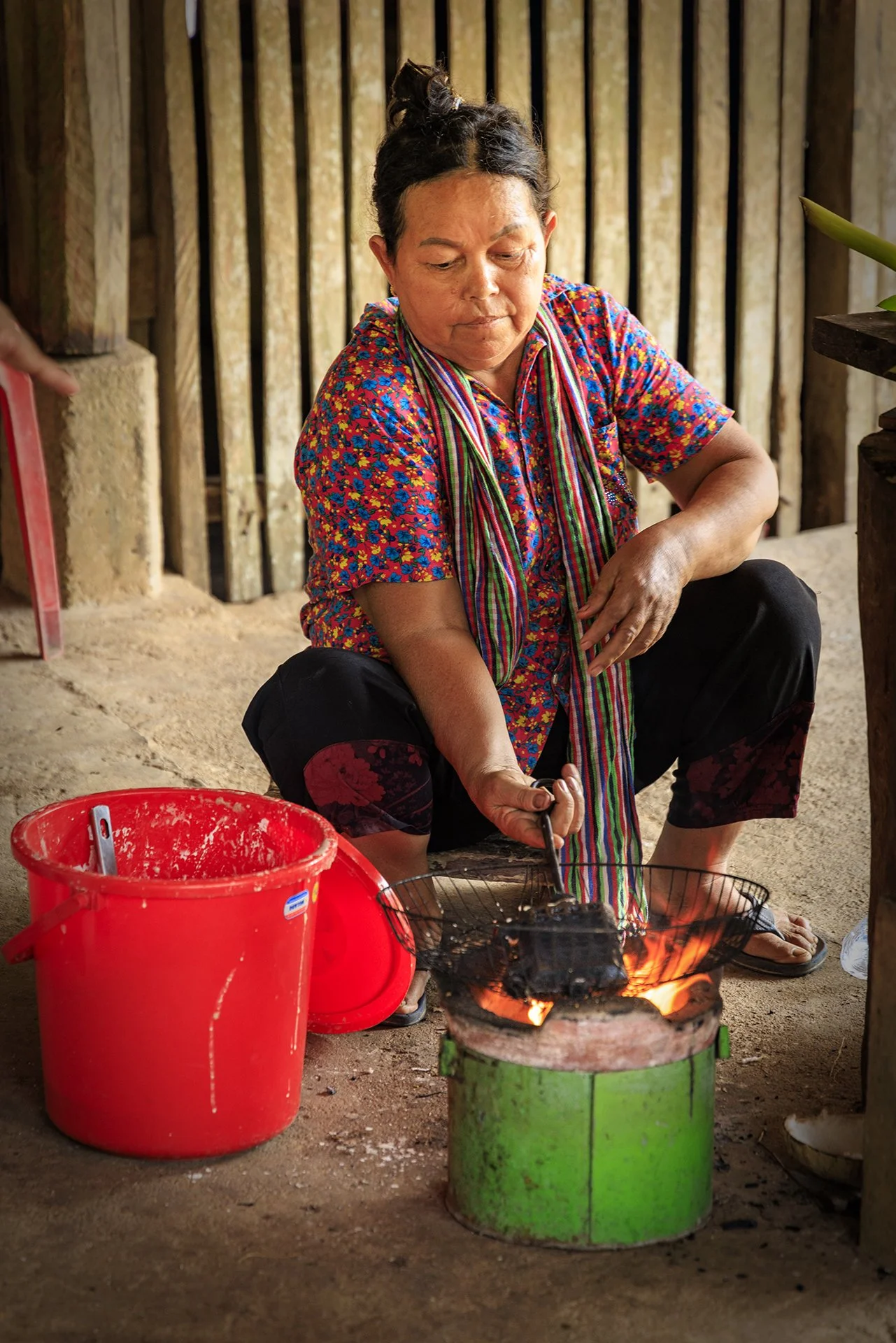
Villiage woman cooking.
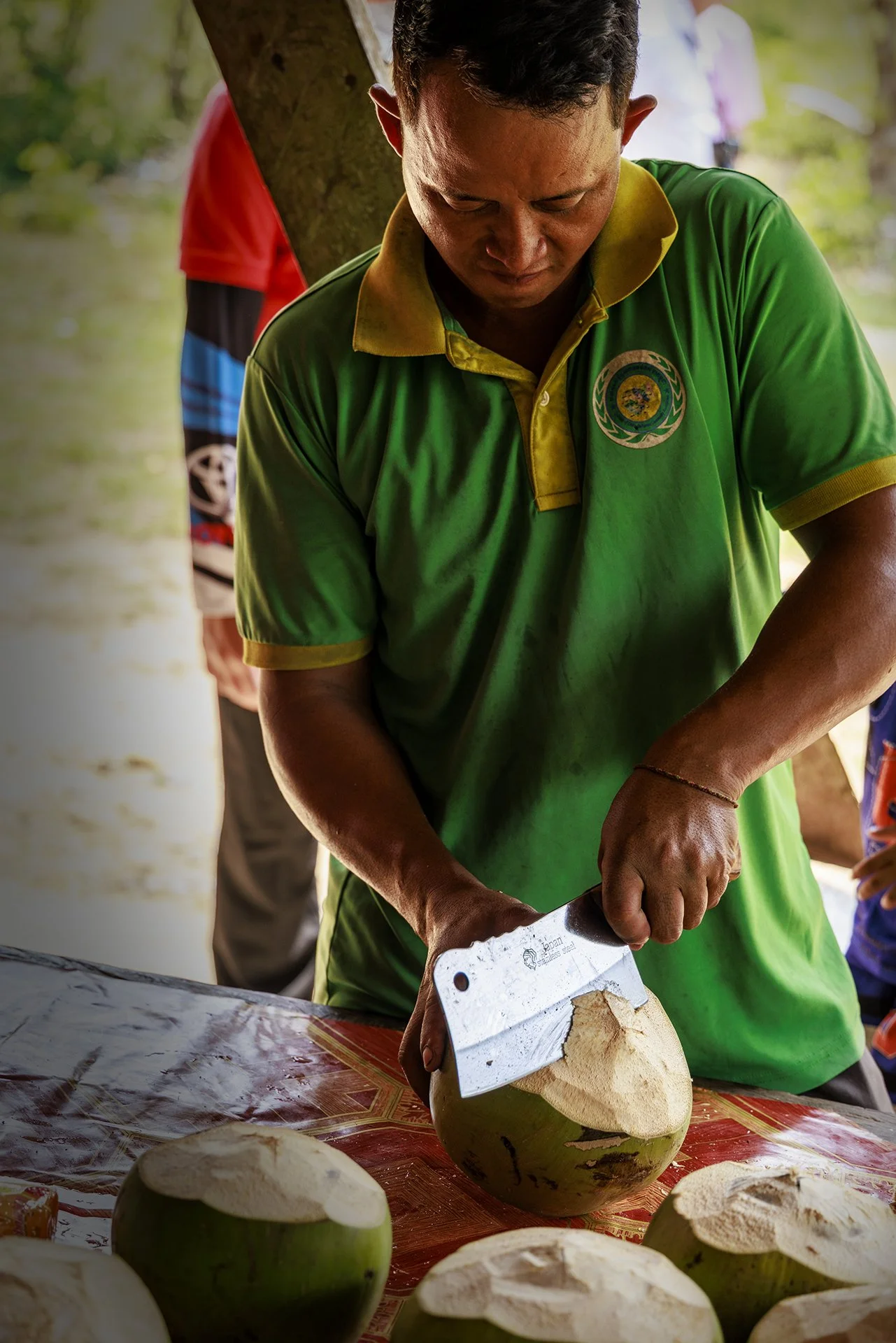
Villager cutting coconut for the tourists.
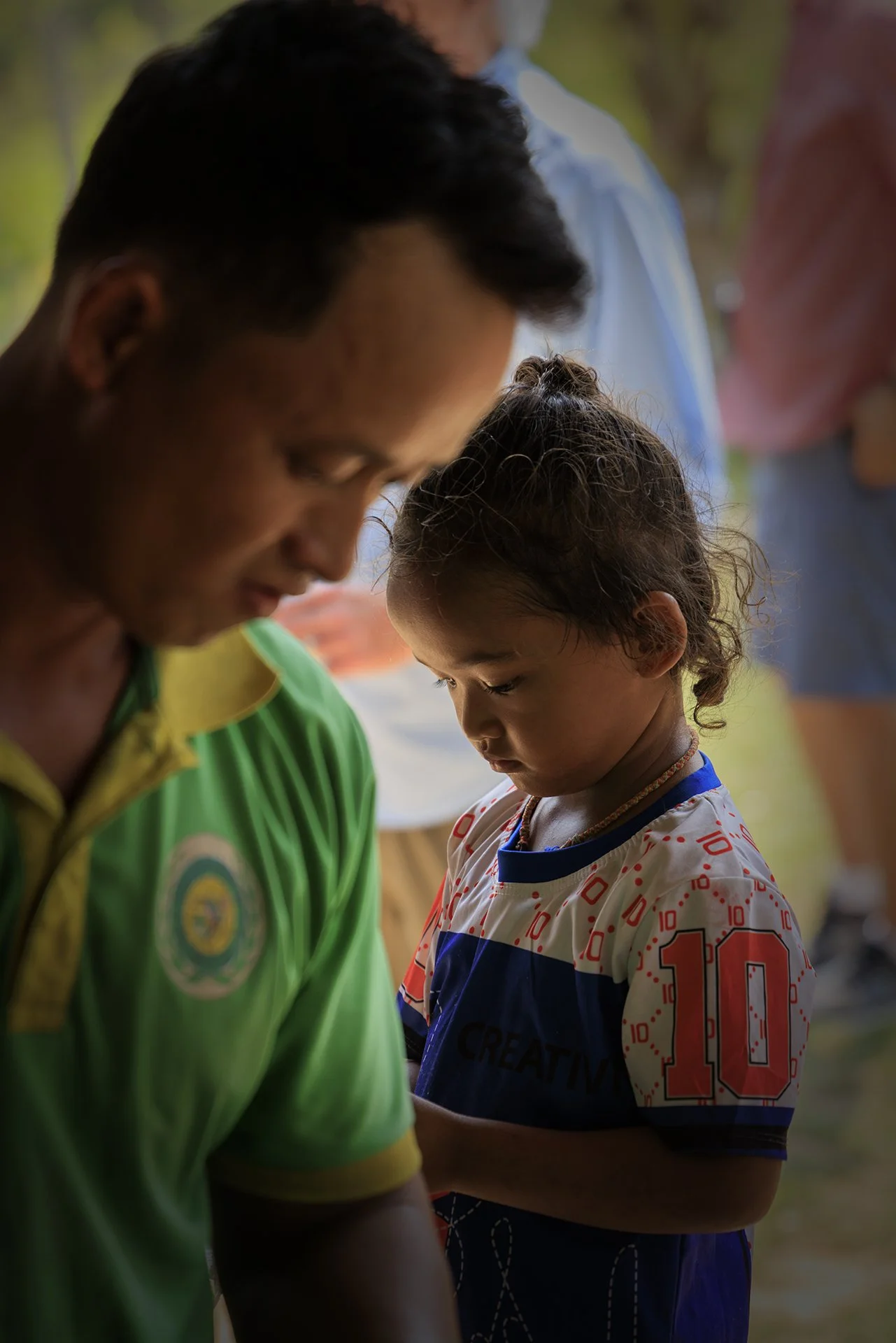
Village father and daughter.
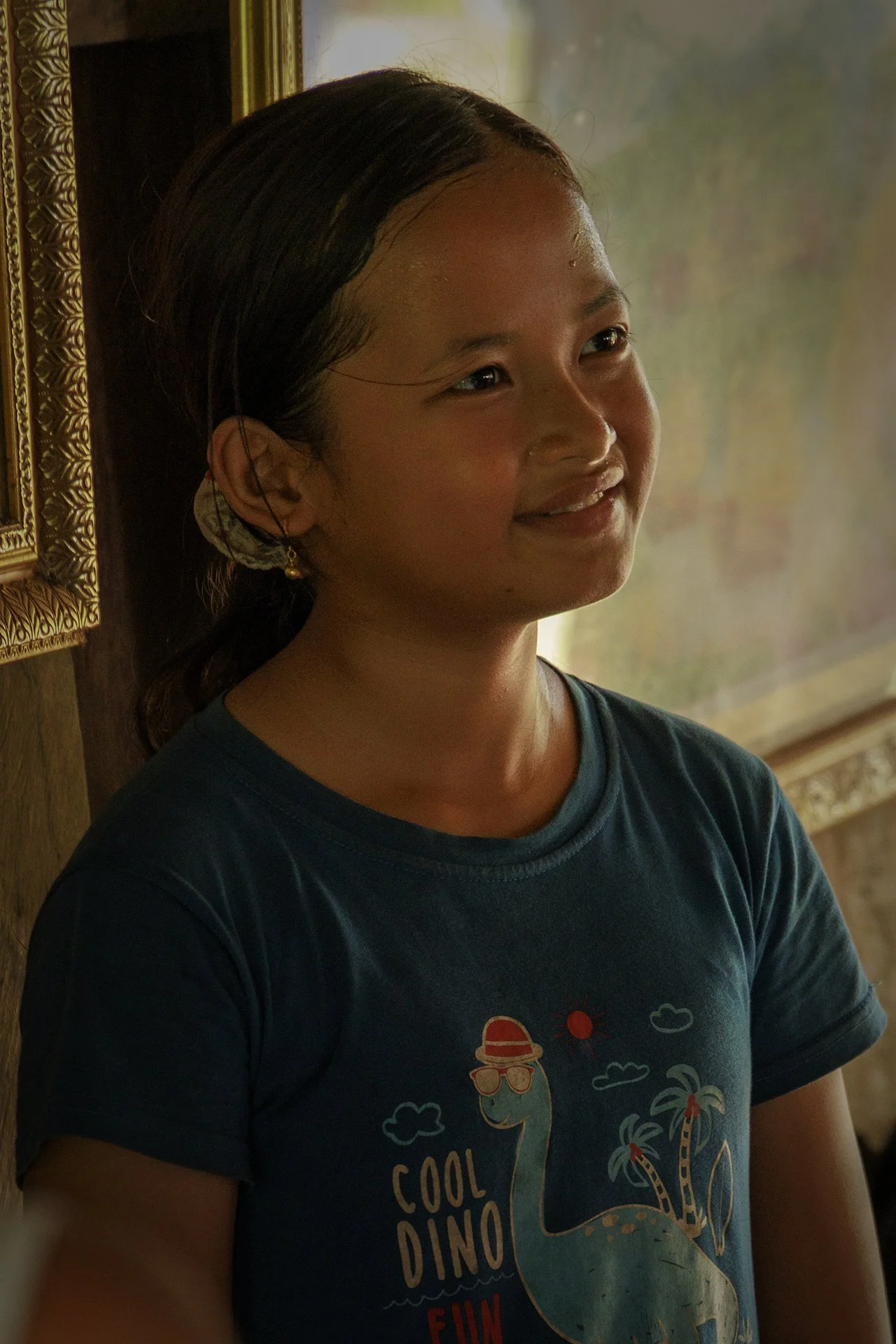
Another Daughter chats with tourists.
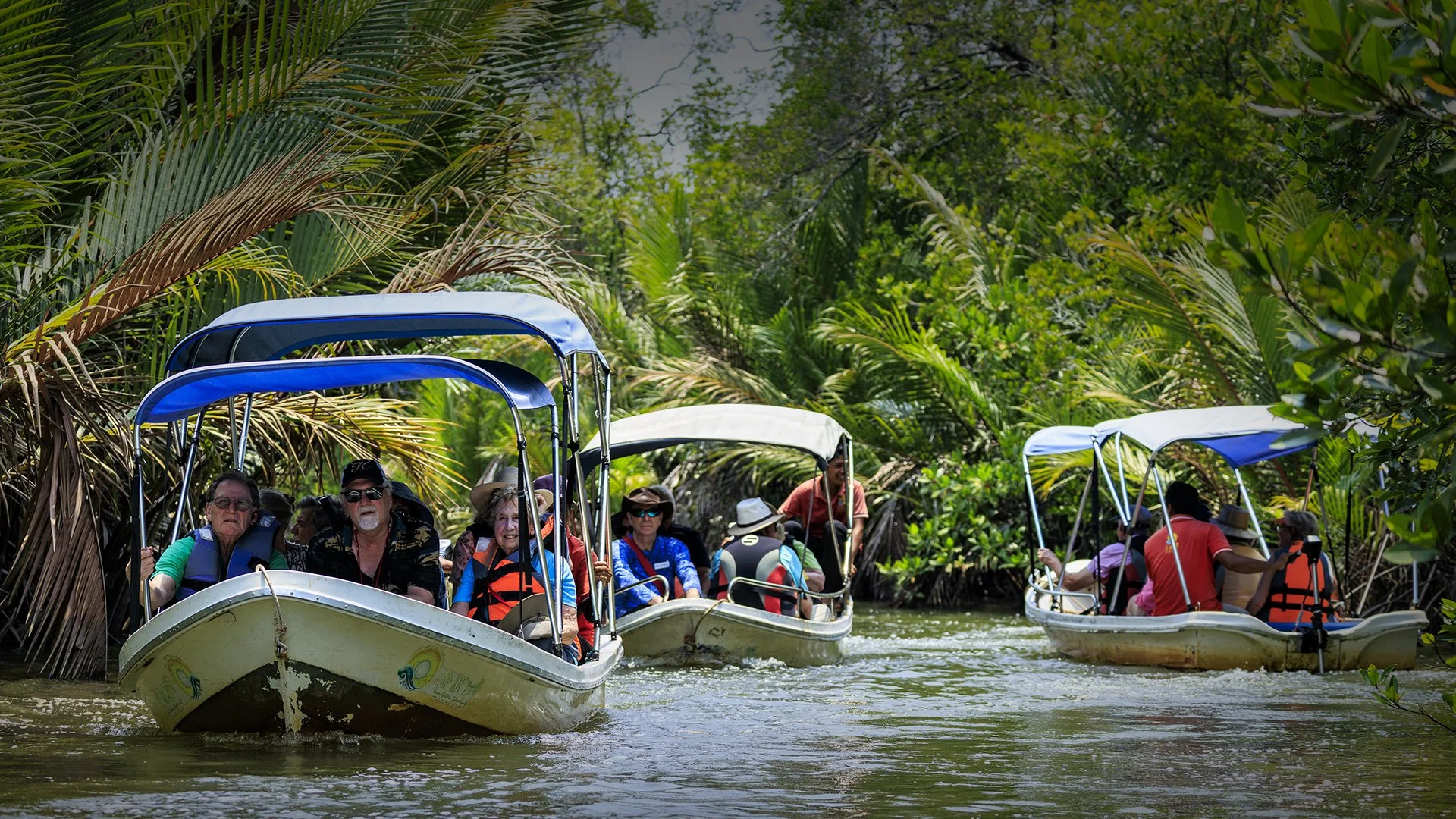
Tourists in boats in Ream national park.
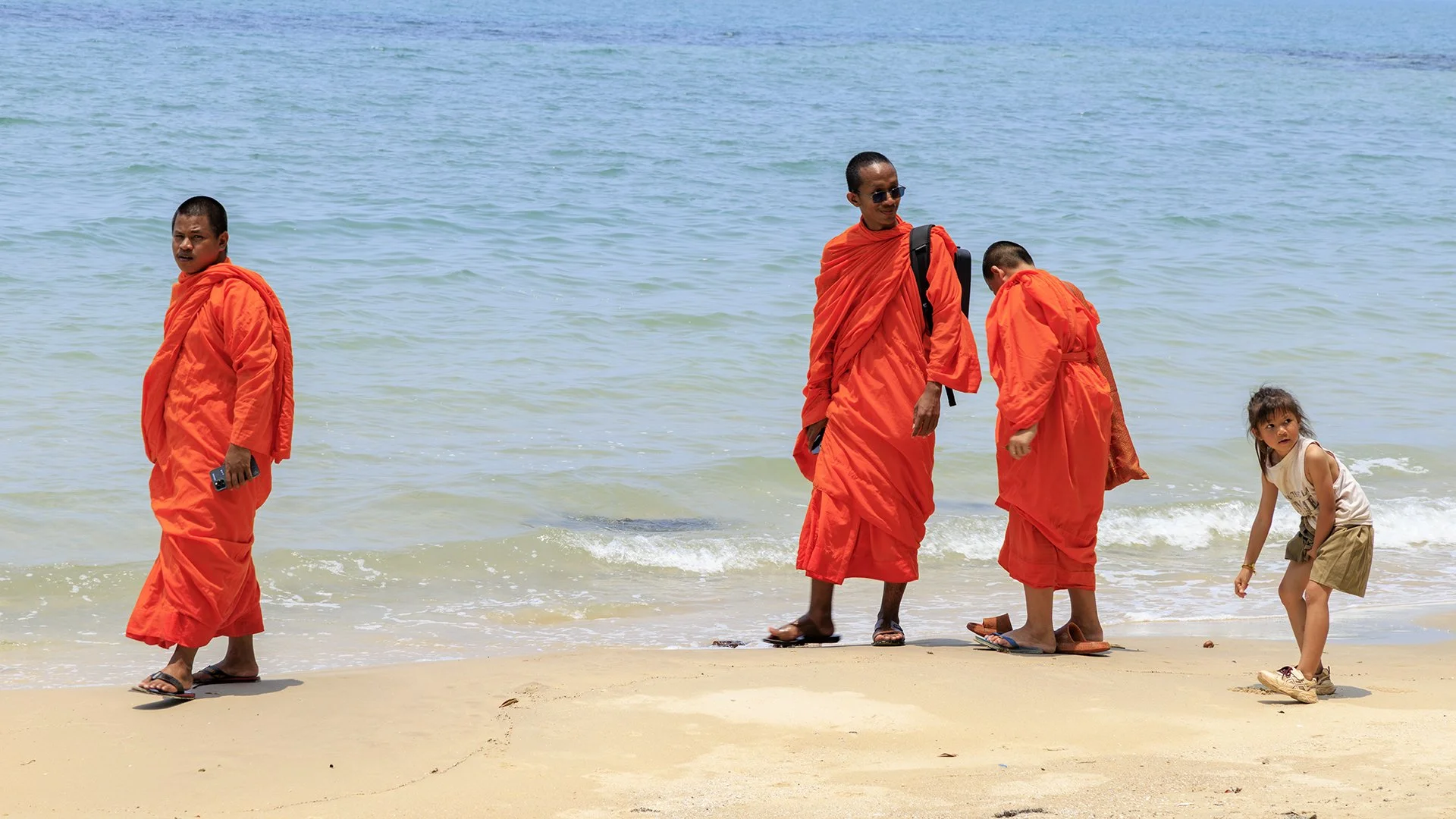
Monks at Hawaii Beach.
Ho Chi Minh City (Saigon)
After leaving Cambodia and having a day at sea we docked in Vietnam. Our anchorage was a couple hours drive from Ho Chi Minh City. This meant that our ability to go explore on our own was very limited. Instead, we relied again on organized tours from the ship.
Our first outing was a visit to Ho Chi Minh City late in the day (all the locals called it Saigon which surprised me). After seeing part of the central city at and after sunset, we had a dinner cruise on the Song Sai Gon river near downtown.
The city is vibrant, active, rapidly growing. I learned as we travelled in Vietnam that this country is growing rapidly. Saigon is very modern, very clean, very safe and very focused on making money. Communism is very much in the background in daily life.
Photographically, this was another street photography outing. I kept my camera in shutter priority mode with auto ISO. Some of the images were shot at extremely high ISOs since the sky was dark and I was hand-holding the camera so the shutter speeds had to be at least 1/100 (I was using my 24-105 mm telephoto zoom lens).
Fortunately modern cameras have very good low light performance. Even at very high ISOs the images are generally useable but even when the noise and grain is too much, AI noise reduction is very good and can fix photographs that would have been binned before.
Here is a selection from central Saigon and our night river cruise.
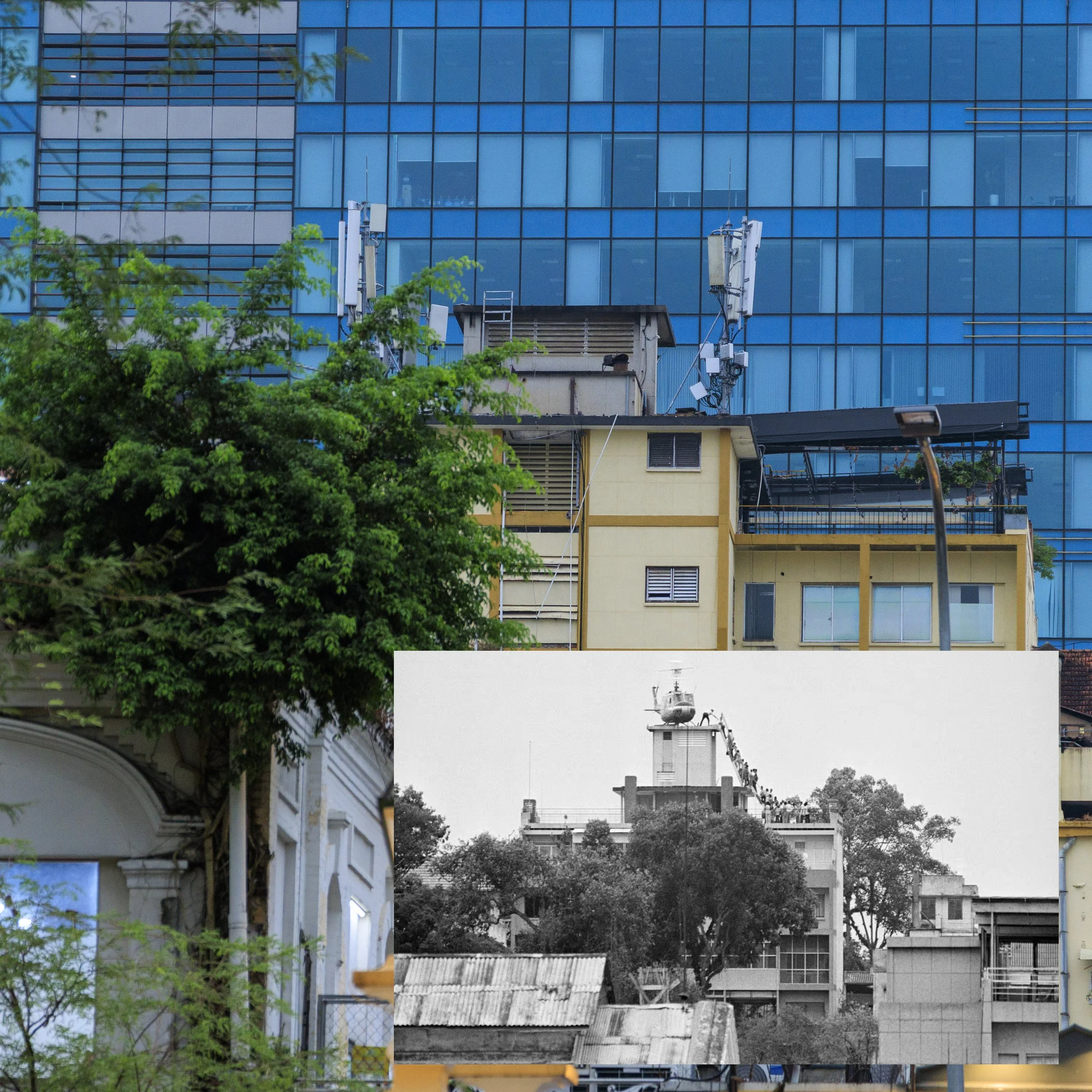
I took this photograph of the building where the famous "fall of Saigon" photo was taken. I put the famous picture as an inset so you can see where it is. I'm surprised the building is still standing and even more surprised it's just a normal apartment today instead of a museum or land mark of some kind.
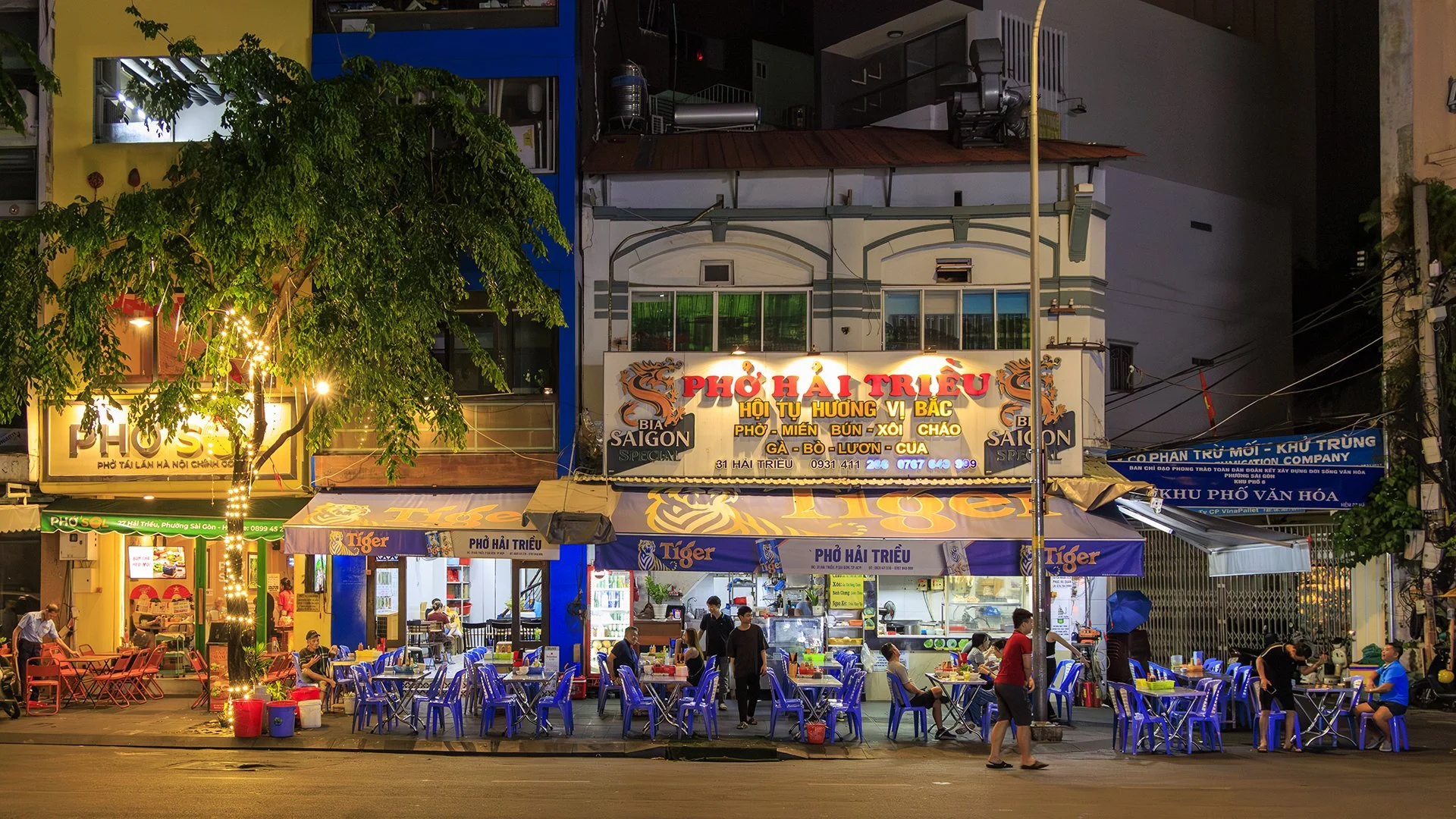
Nightlife in the city.
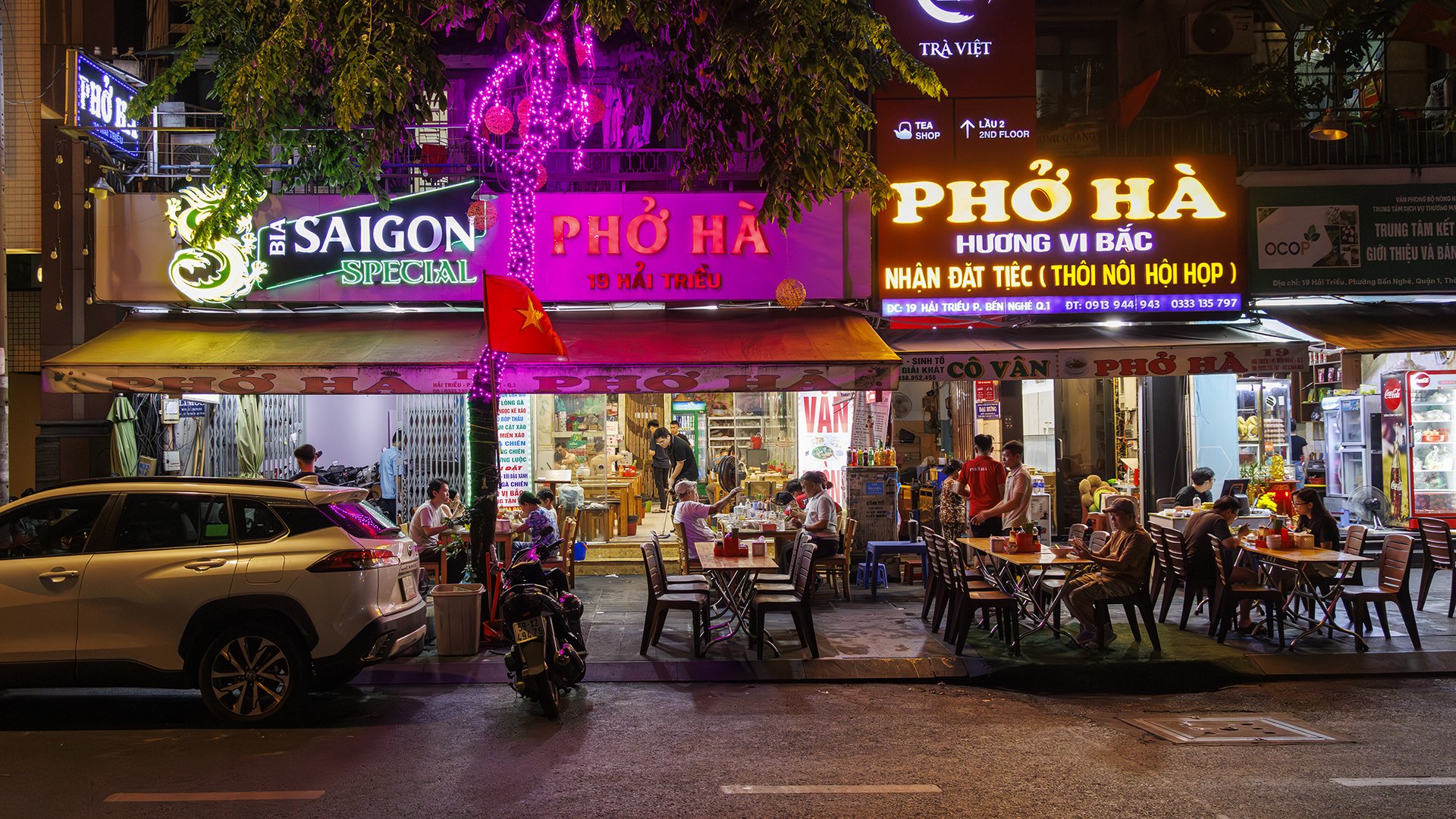
Nightlife in the city.
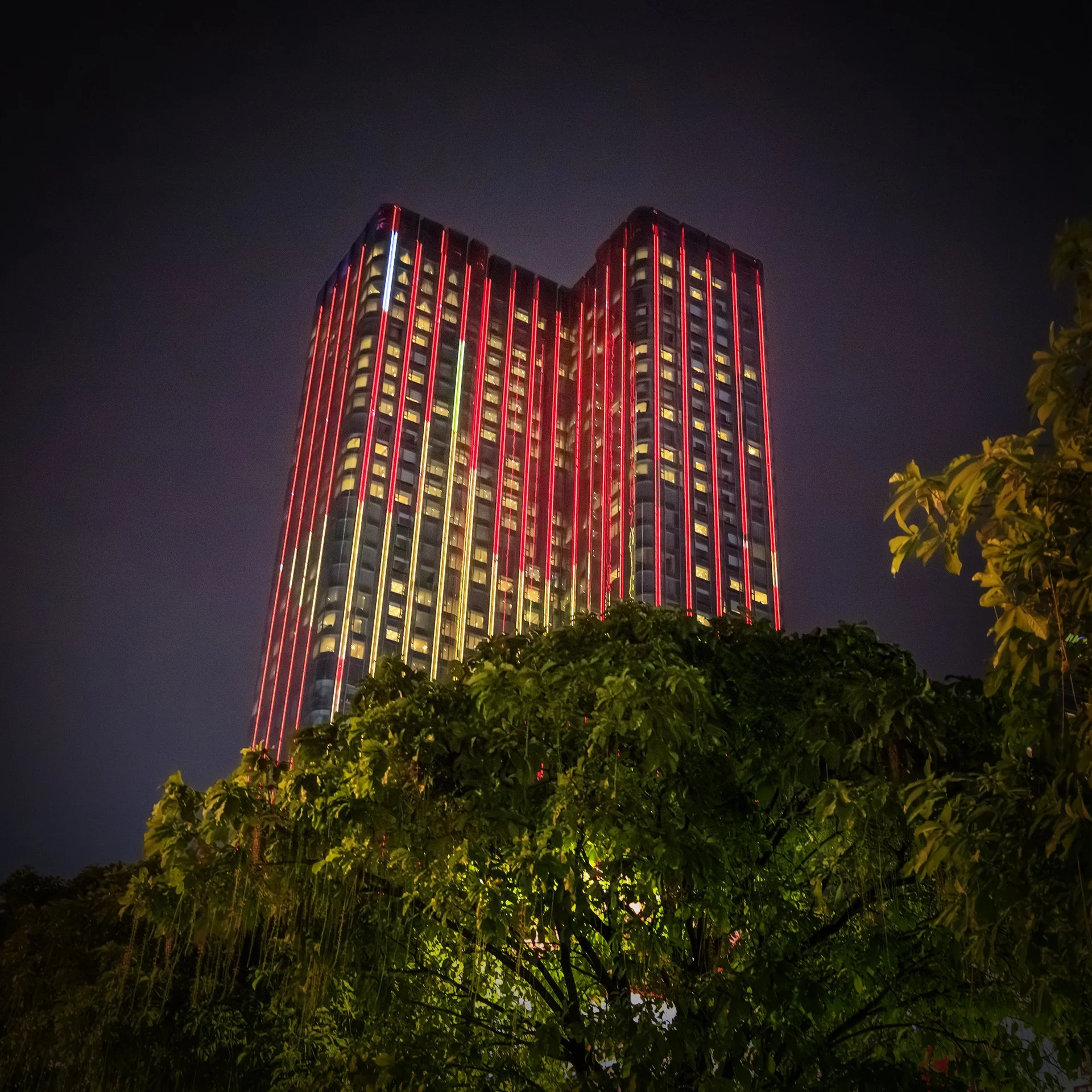
Saigon times square building.
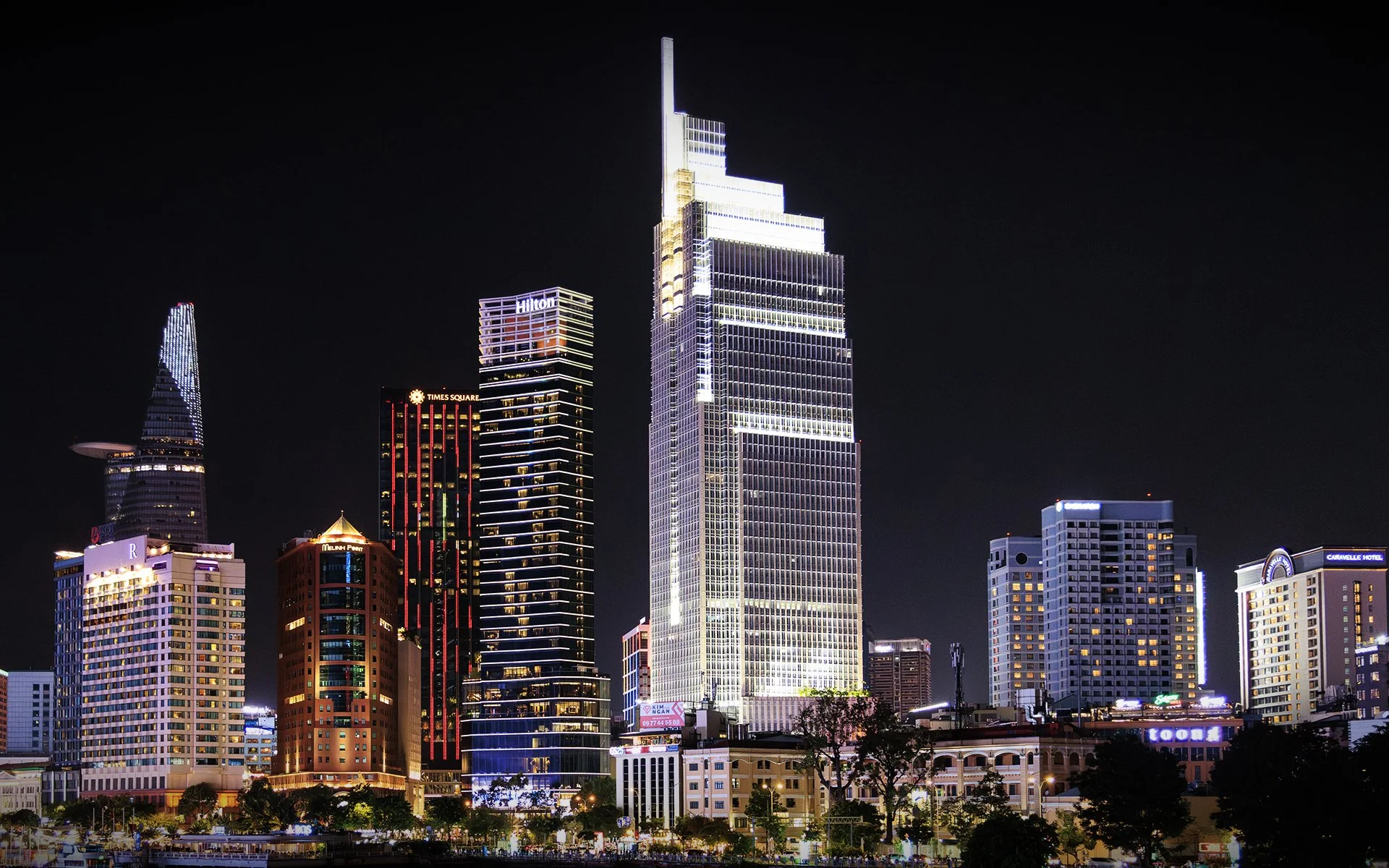
Saigon skyline at night.
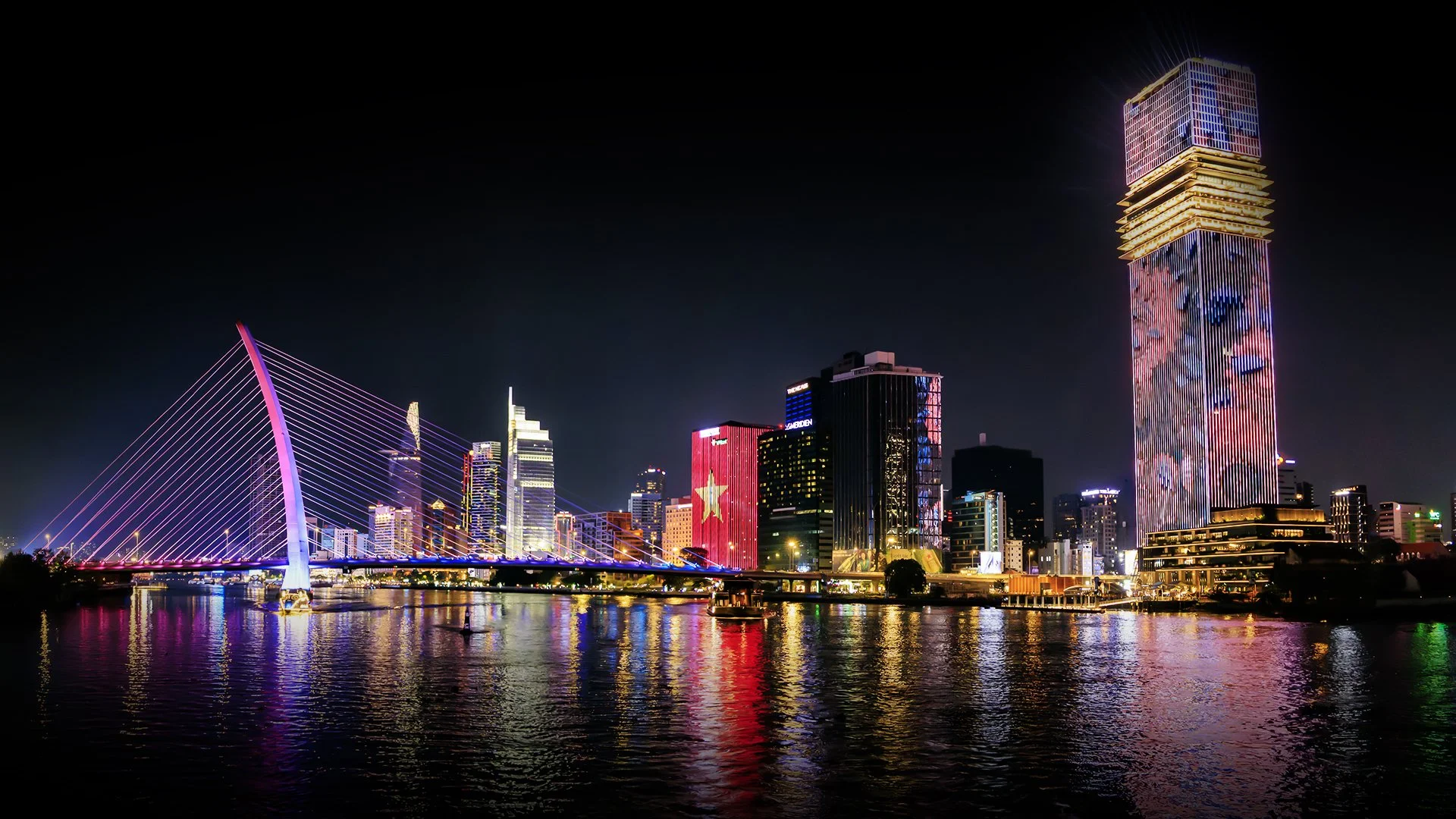
Saigon skyline at night.
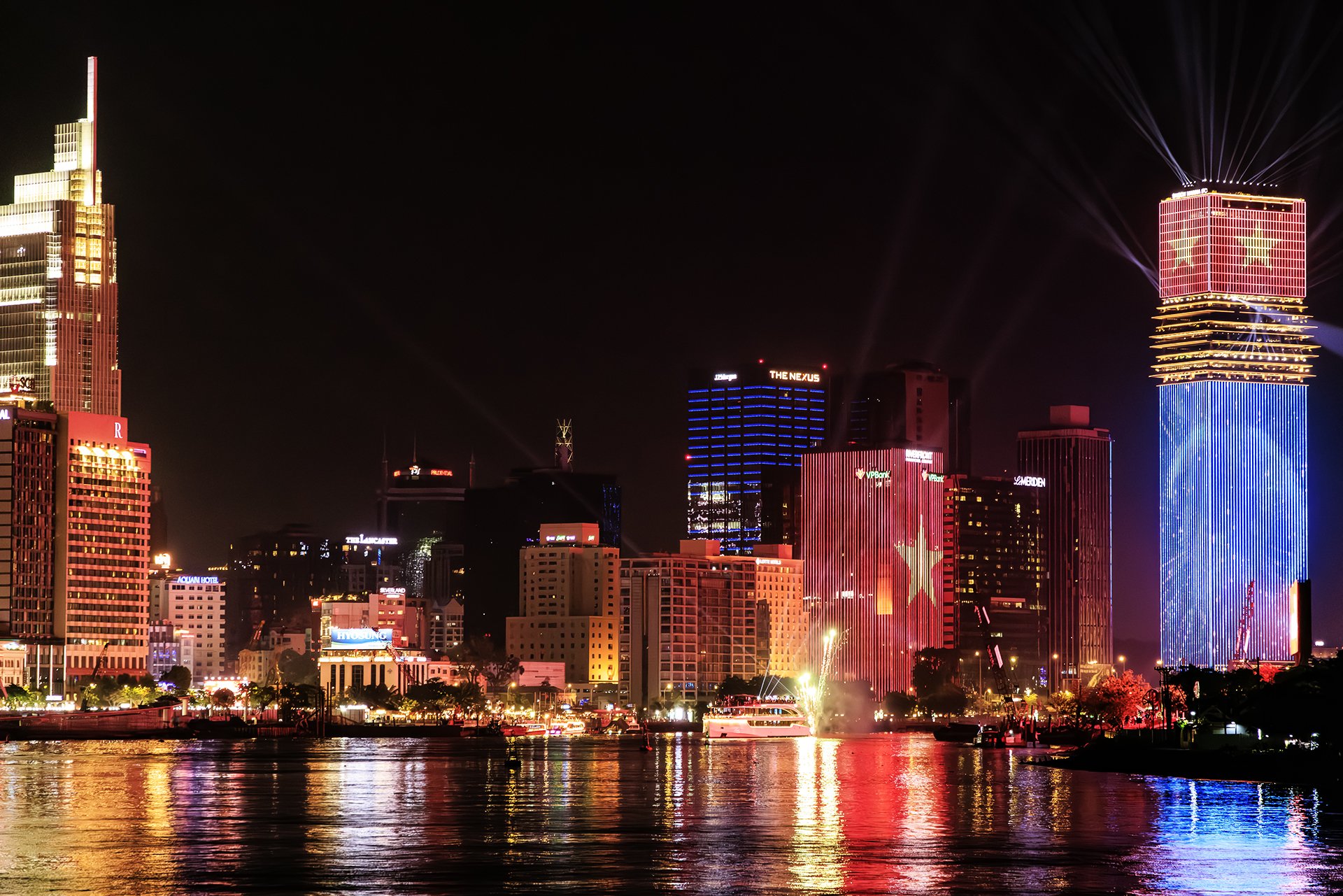
Saigon skyline at night.
Vietnam Mekong Delta
On our second day in Vietnam we took a Mekong Delta tour. We had the opportunity to travel up river in a small boat. Of course I couldn't avoid thinking about the opening scenes from Apocalypse Now although there wasn't any feeling of impending doom or risk of being shot at as far as I knew. Maybe I’m just naïve.
We made our way up river to Cai Bei where we visited a small traditional floating village were people make handicrafts to sell. Then we stopped at a local restaurant for traditional local food. It was various kinds of Vietnamese rice paper rolls, soups and rice dishes. All fresh and all excellent.
After lunch we had the chance to be taken on a traditional sampan boat to explore the small tributaries that serve as the roads and highways of the delta region. The boats were all rowed by hand by village women who all wore face coverings. I found out later that they wear the face coverings because in that part of the country skin complexion is very important for women. They wear the face coverings to protect themselves from sun damage and also from air pollution. I did not think the air pollution was any worse than we have at home nor was the sun necessarily as intense as we have in Arizona. Maybe we should be wearing face coverings too.
Photographically this was essentially another street photography outing. Again I kept my camera in shutter priority mode at 1/100 s minimum and auto ISO. This outing was better than the previous one because it was less hurried.
On the way back, I enjoyed shooting photos of the traffic from the bus. It made the long drive seem to go by faster but of course I had to shoot through the bus window. That was very restrictive with respect to compositions and also affected the color cast and optical distortion in the images. Still, I was pleased with how well some of the images documented life along the incredibly busy highways of Vietnam in the Mekong and Saigon regions.
Here's some photos…
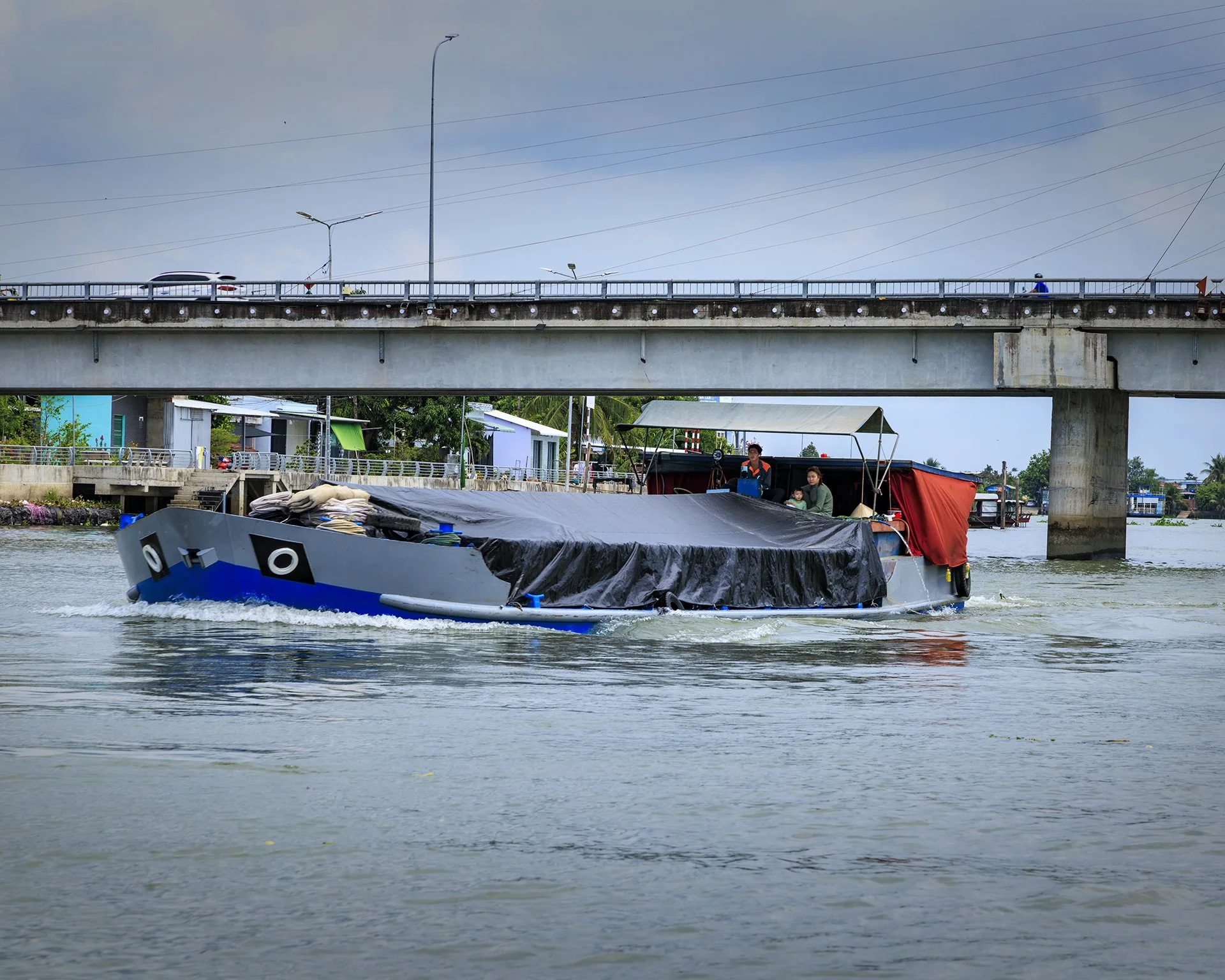
The Mekong river is a very busy industrial waterway. Notice this boatman has his whole family aboard. I’m pretty sure they live on the boat. Our guide told me that all these boats are owned by families, not corporations and they usually live on the boats.
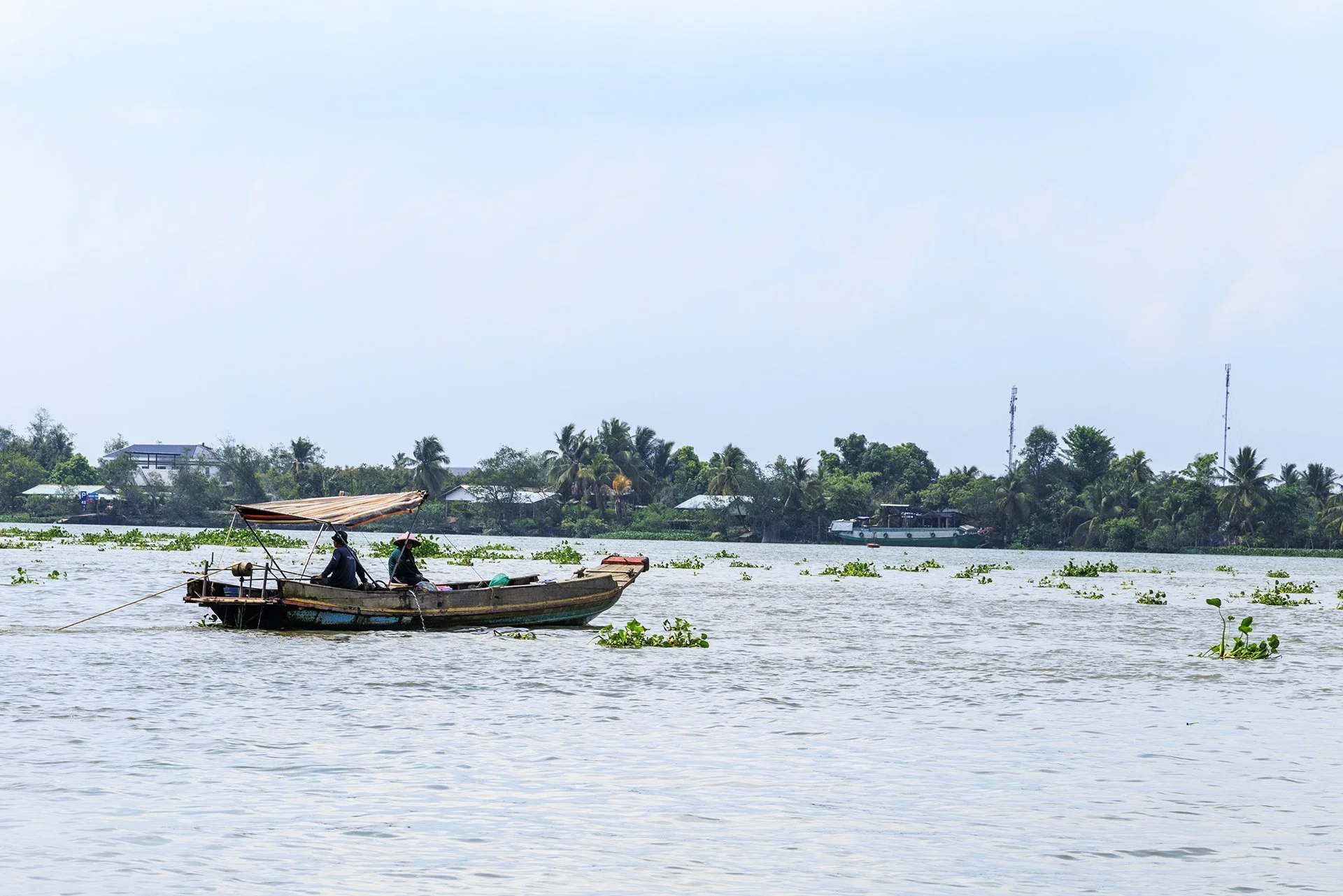
Of course, fishing is very important on the Mekong.
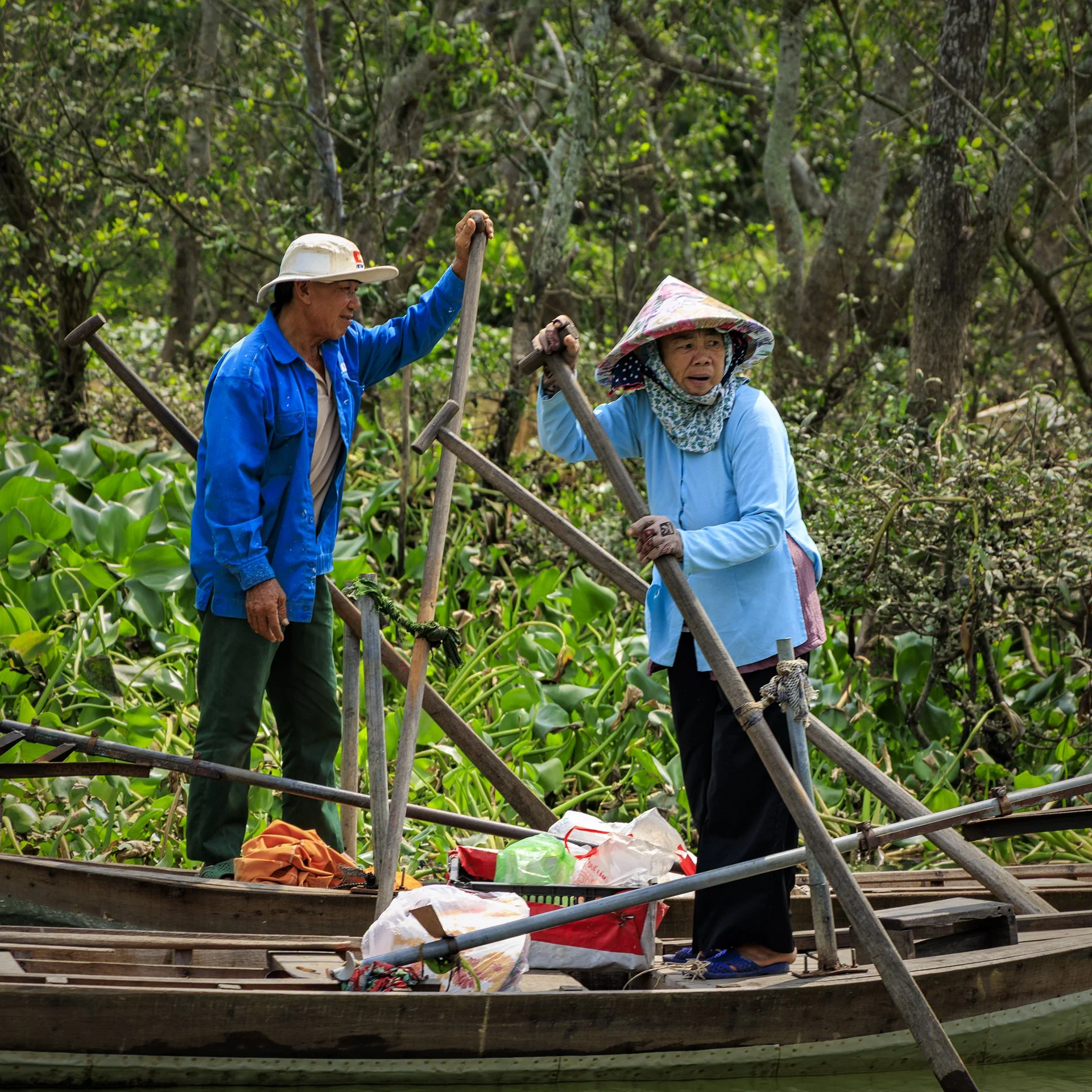
These are neighbors having a chat, probably on their way back from the local food market.
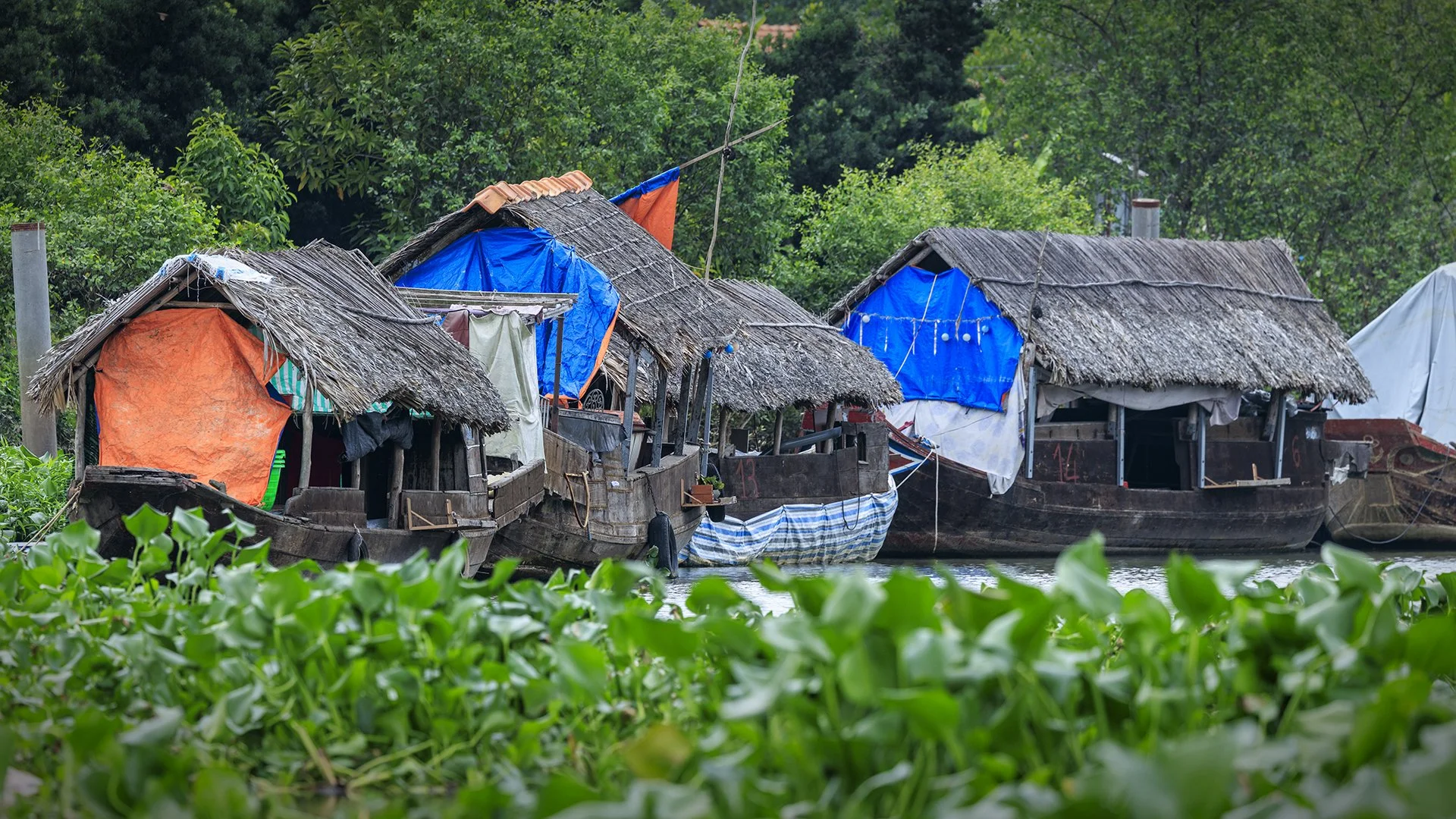
Traditional floating village. The people live their entire lives on boats on the river. They fish and make handicrafts to sell.
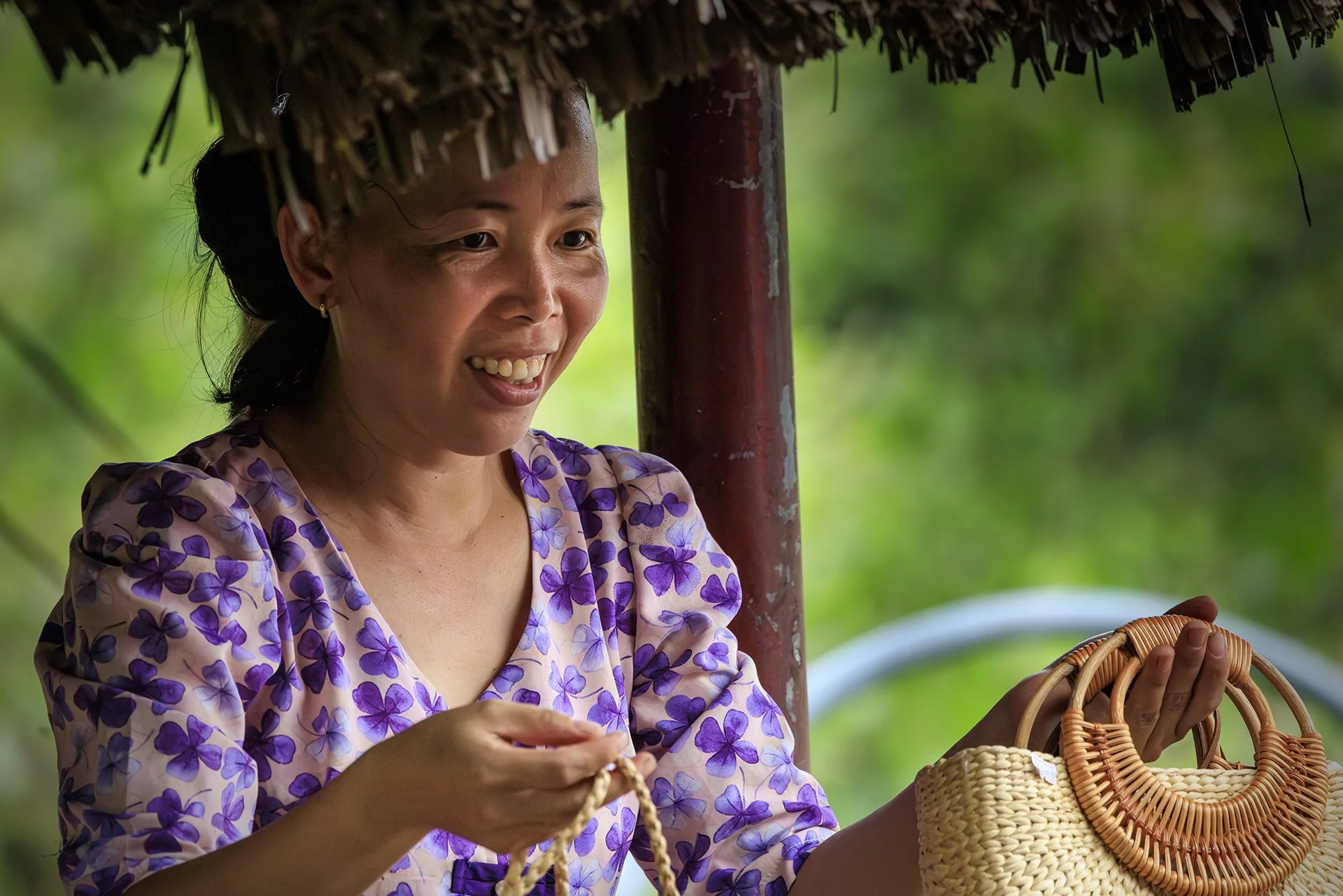
Village woman selling her handicrafts. It was mostly baskets and woven jewelry made from local river reeds and hyacinth. The quality of the work was outstanding and it was incredibly inexpensive. A US dollar goes a long way.
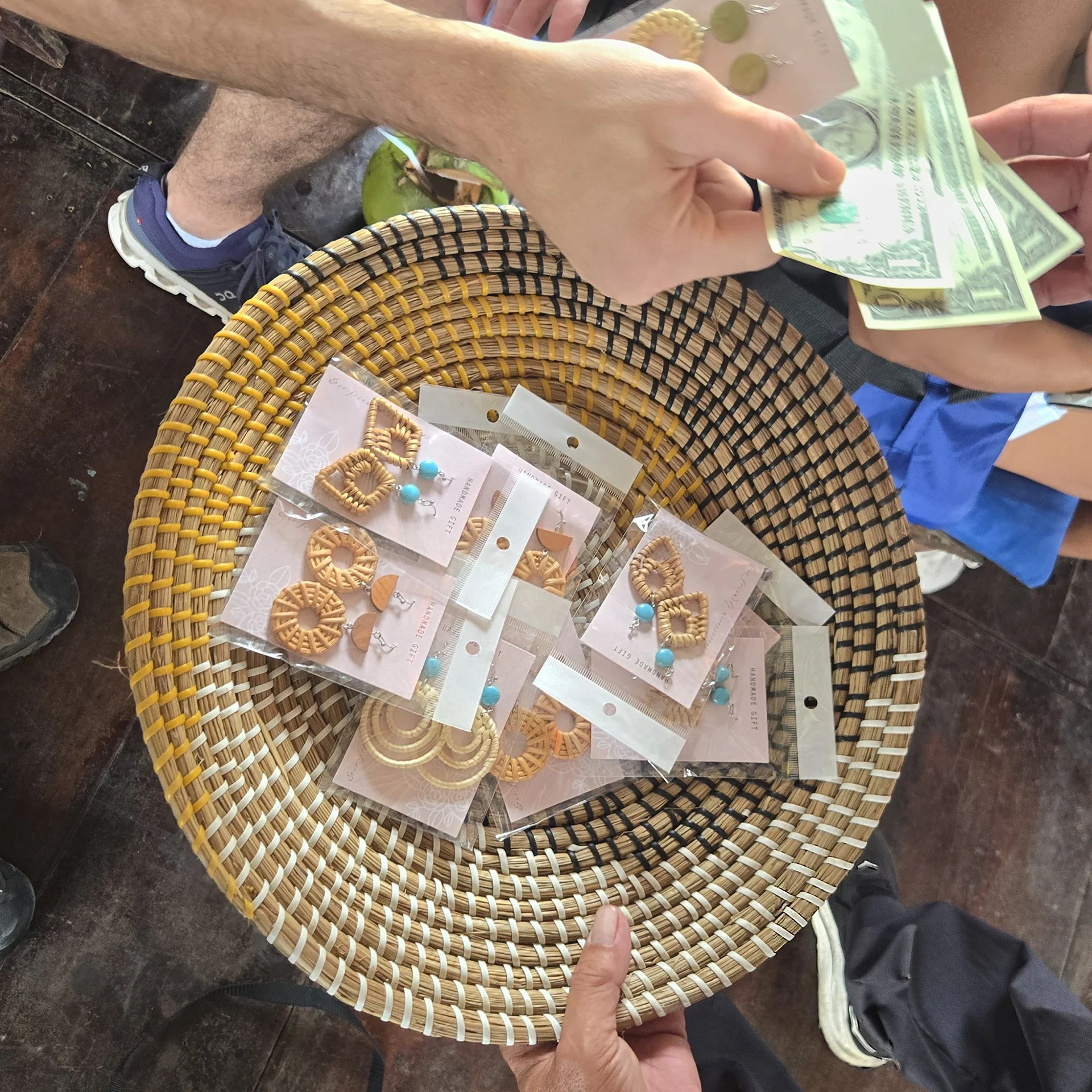
Money from tourists is probably the biggest source of income for floating villages.
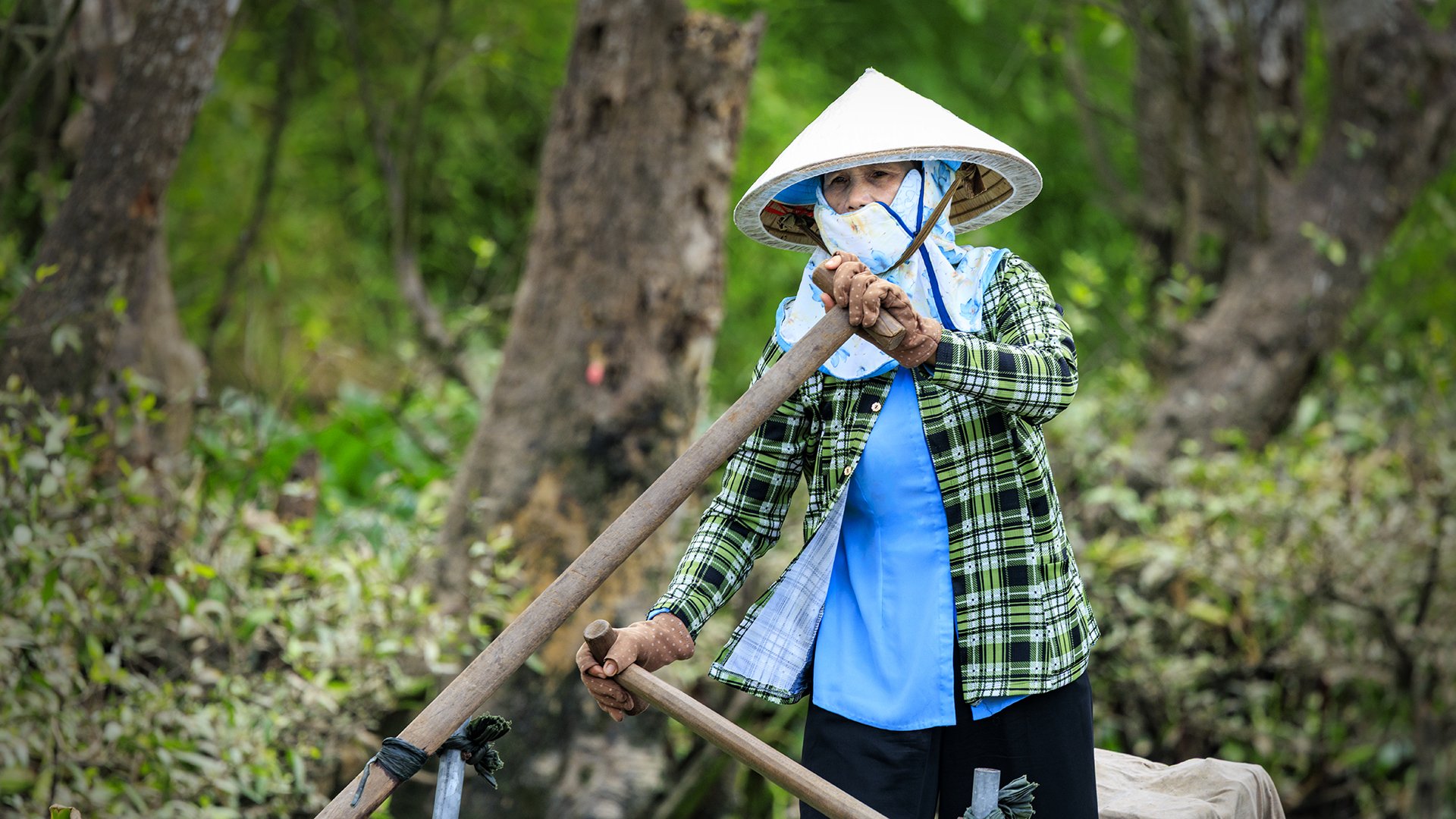
The woman rowing our boat. It was quiet and relaxing paddling along the maze of little streams that serve as the local streets and highways.
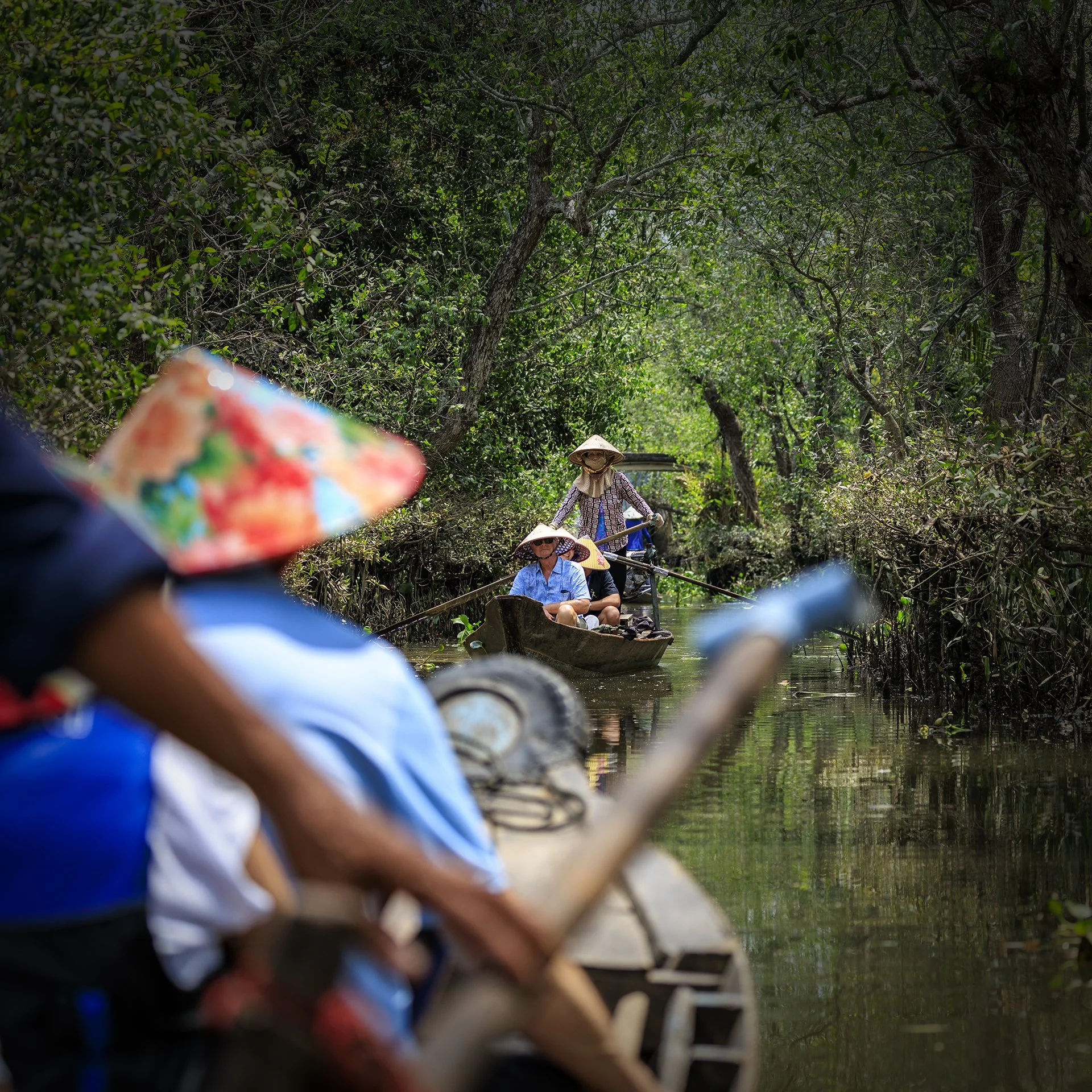
Traffic in the delta.
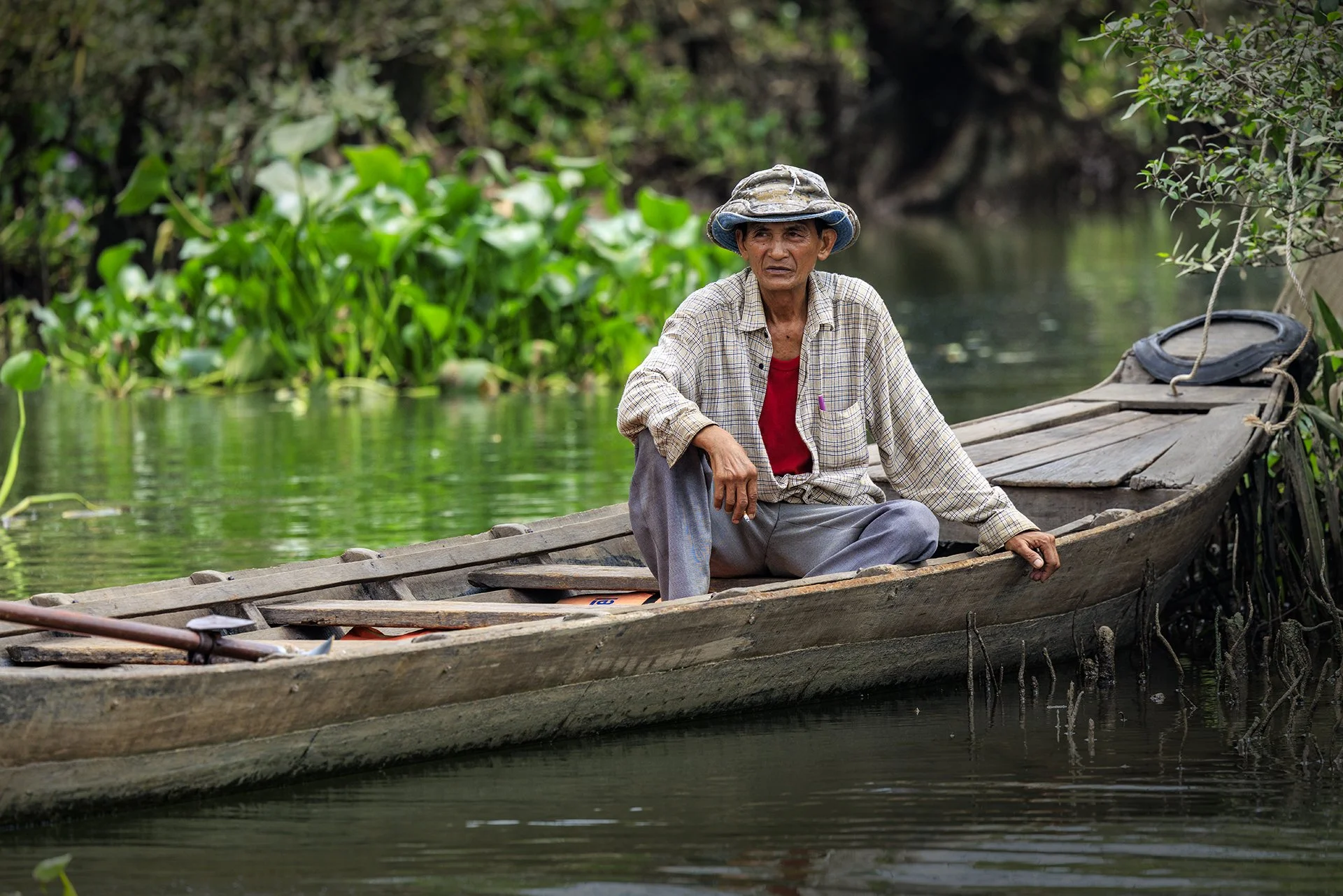
Another local villager on the river.
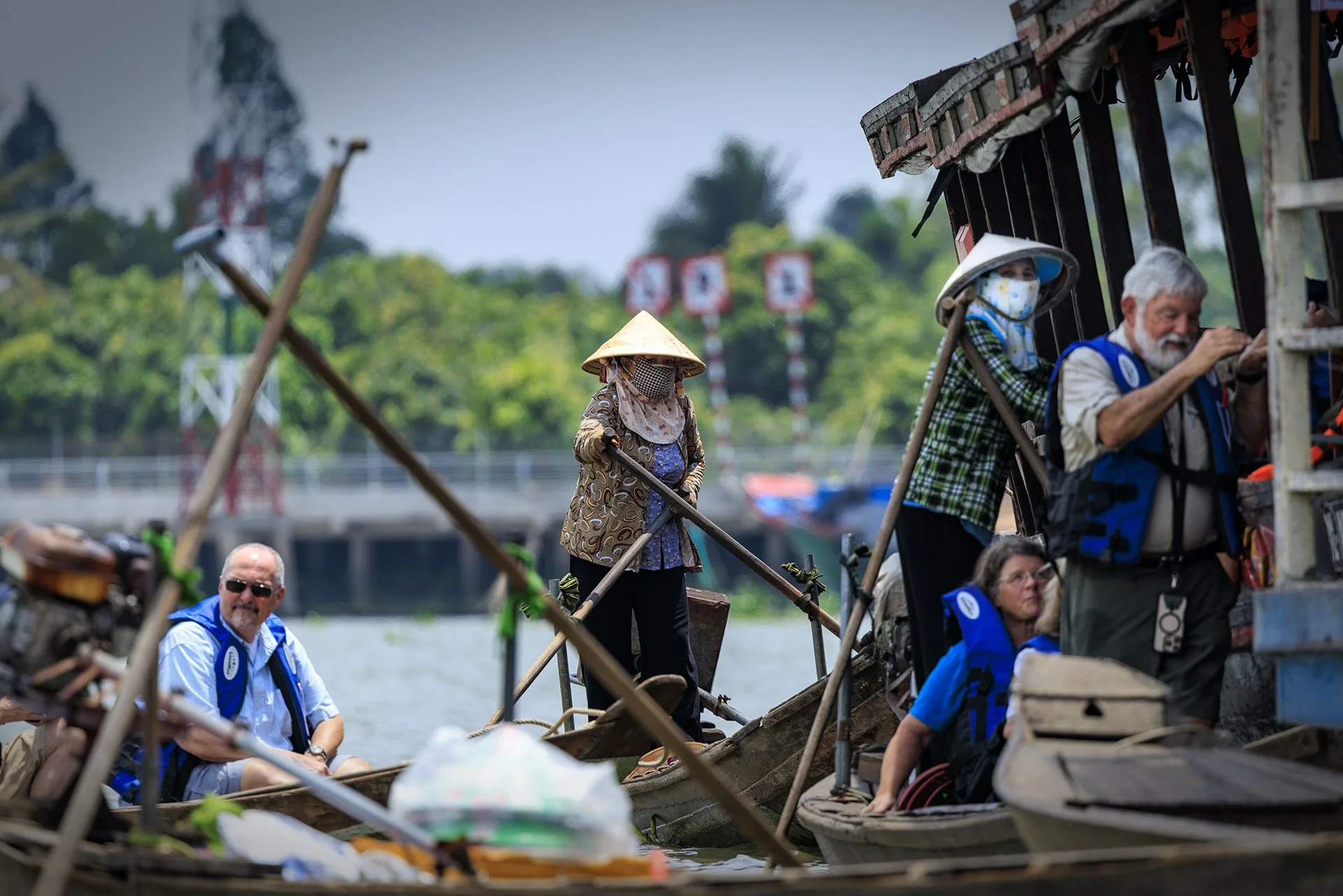
Tourists transferring to the river boat from sampans. They managed not to lose any tourists but it was close a few times.
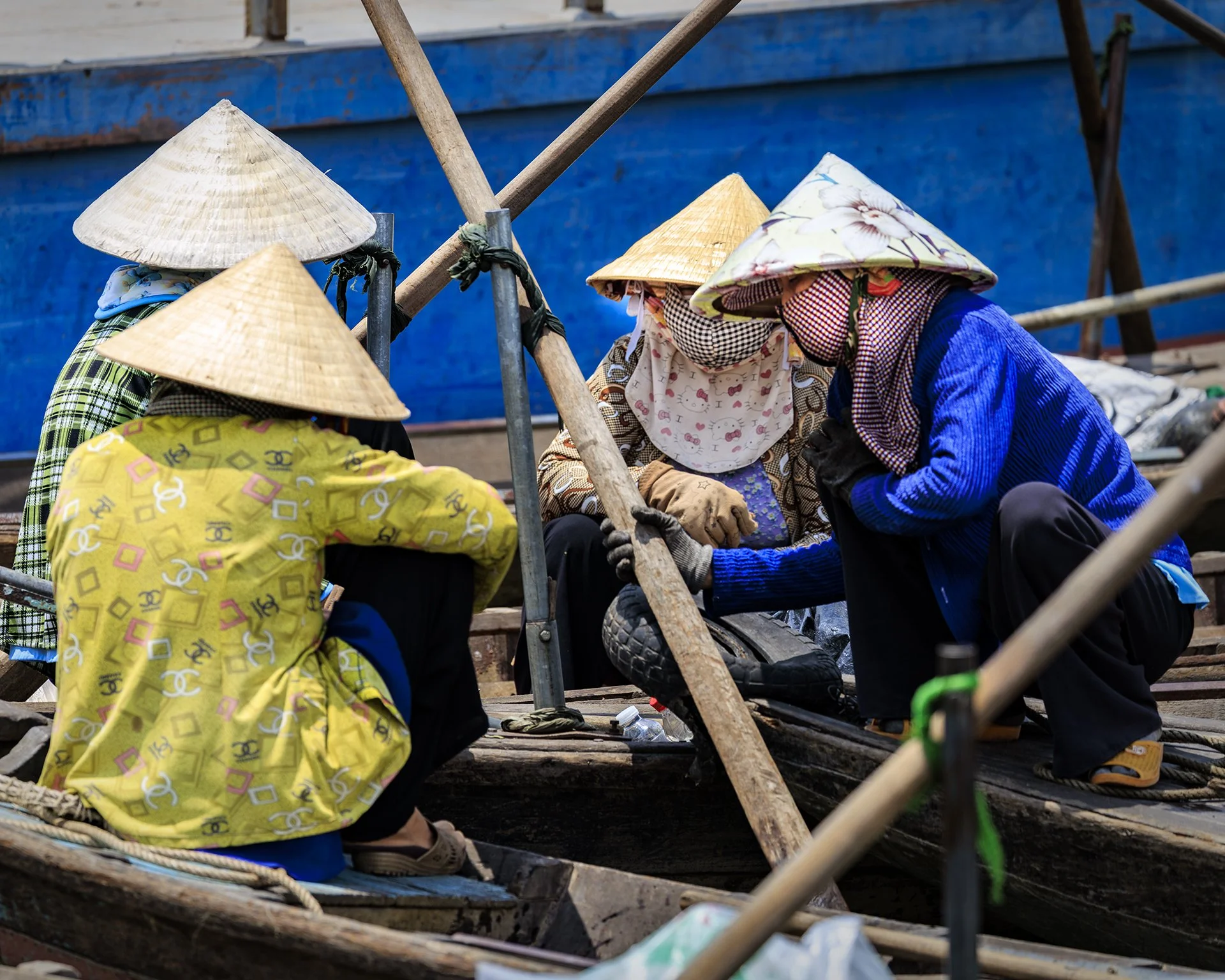
Local paddlers waiting for more tourists. They were having a very animated conversation -- lots of laughter and rapid talk.
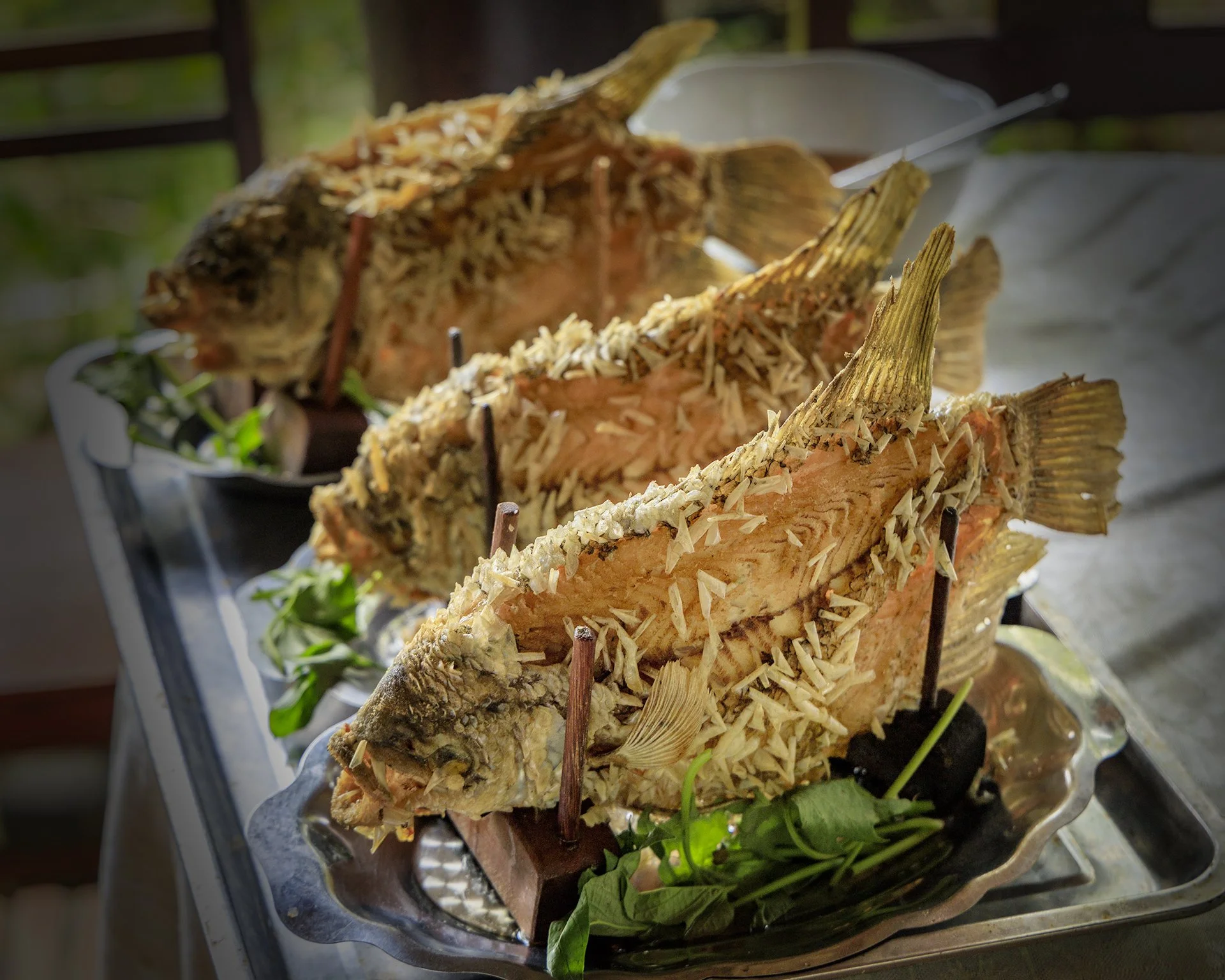
Traditionally prepared river tilapia.
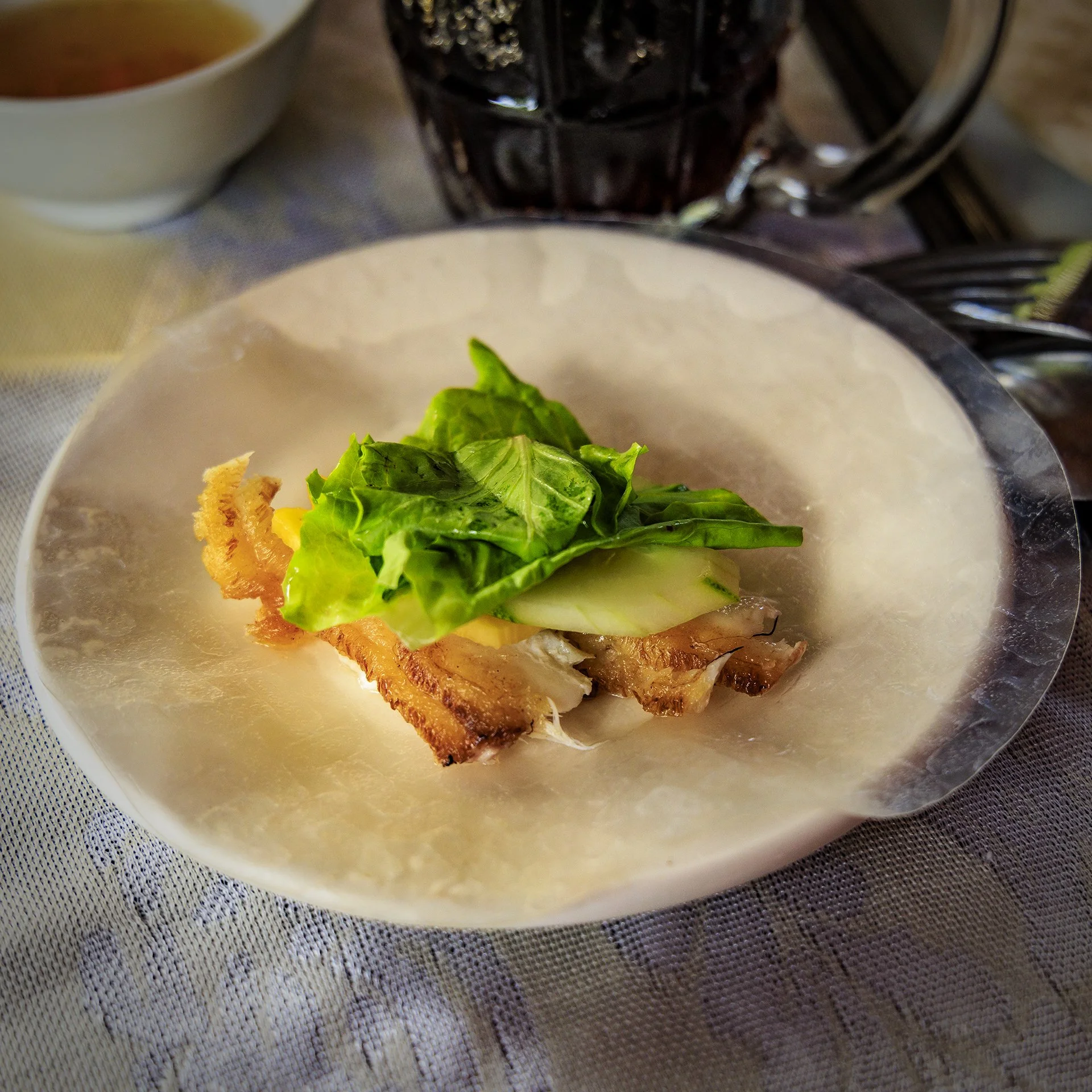
Tilapia spring roll in process.
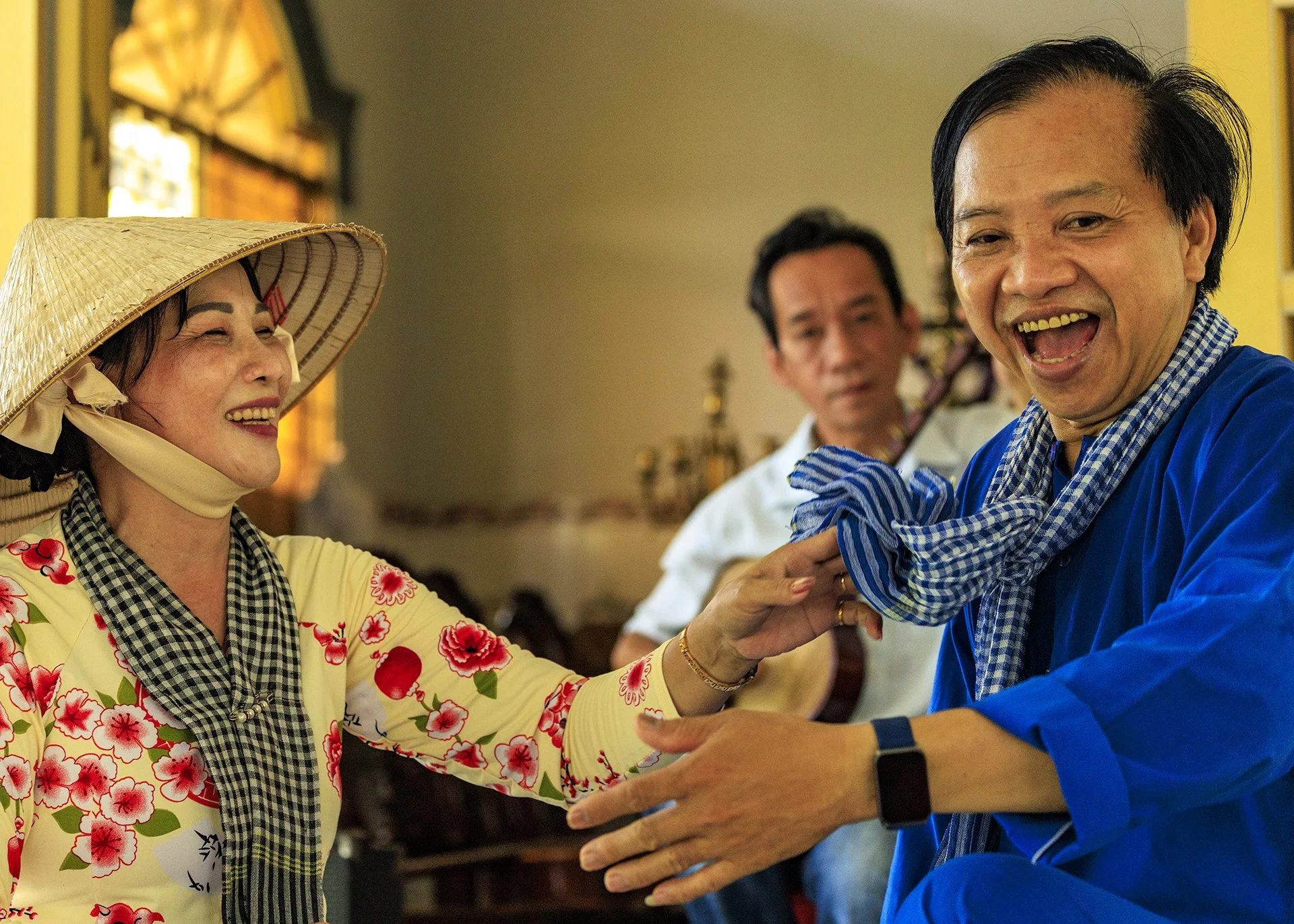
After dinner we had a funny traditional story presented as a play.
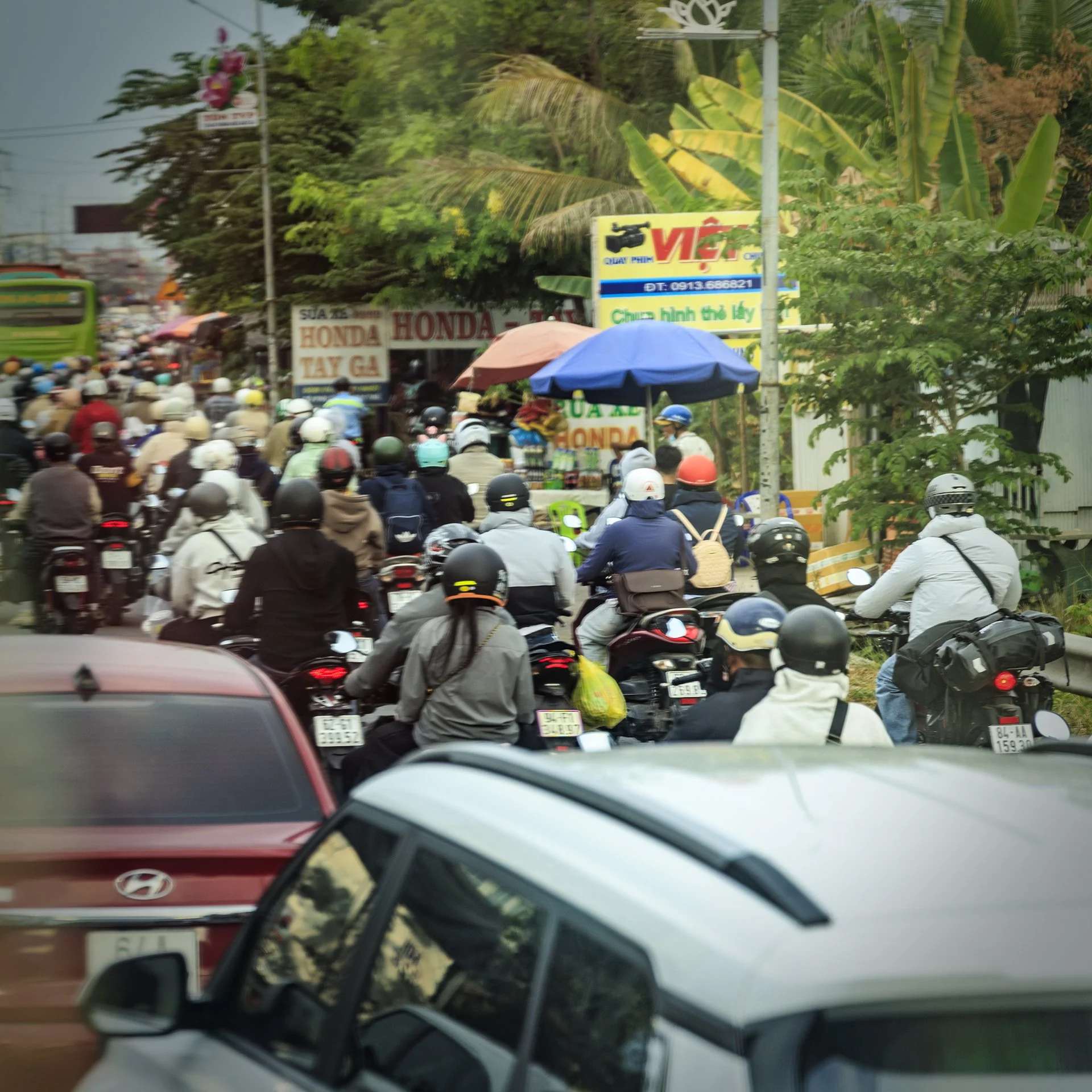
Traffic on the way back to the ship. It was crazy.
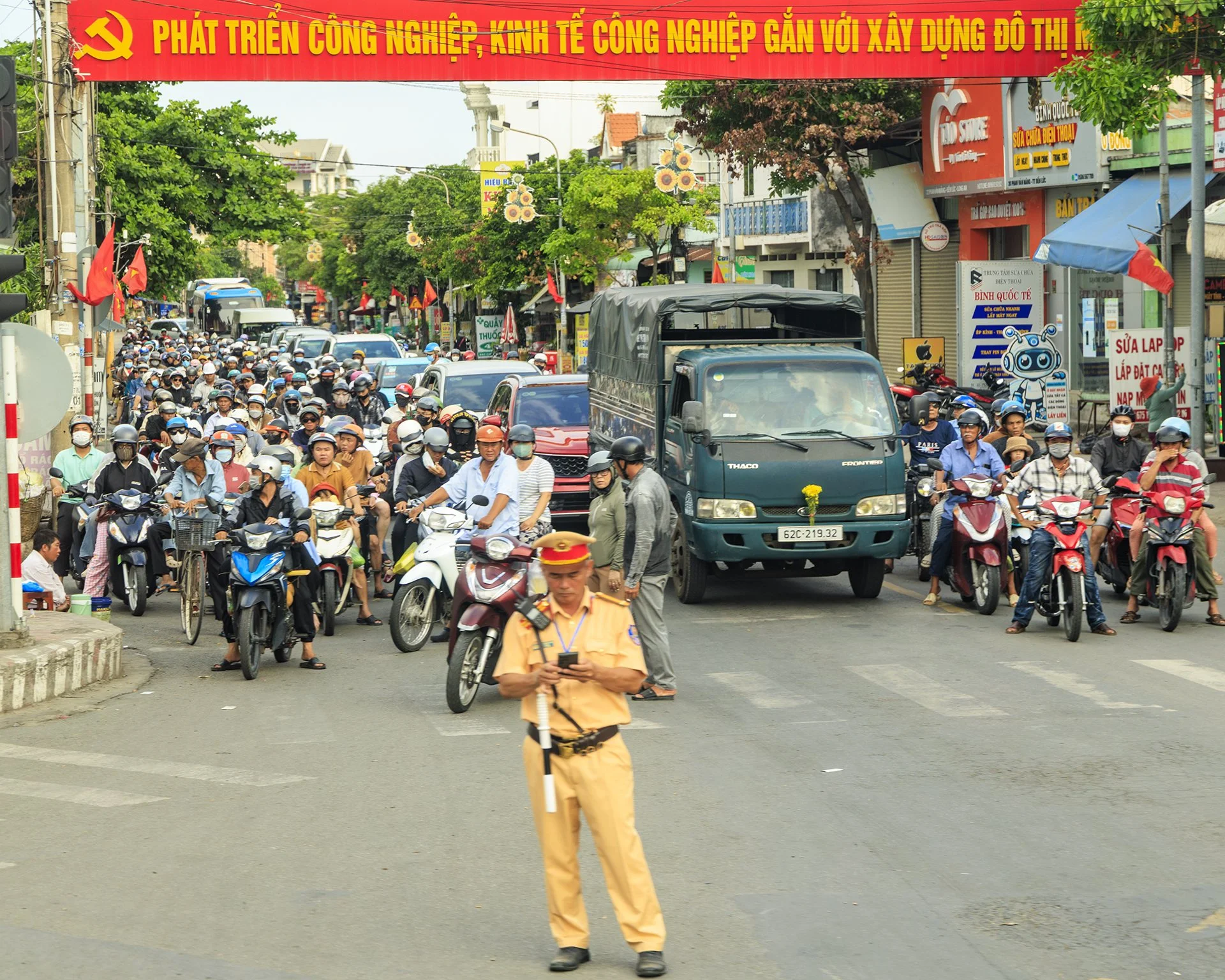
No traffic lights -- I don't think they would have been obeyed anyway. I guess this traffic cop is making everyone wait while he checks his social media posts.
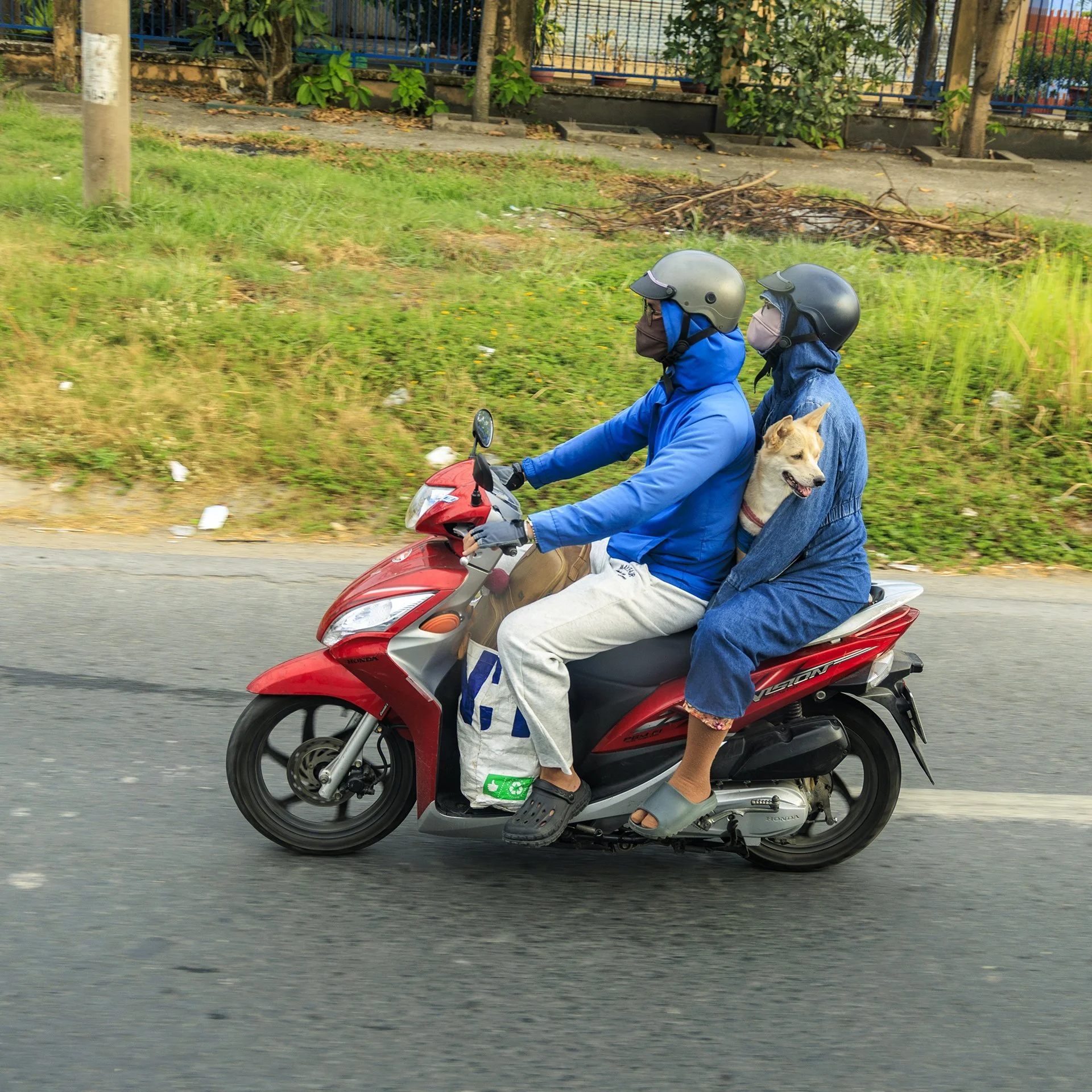
Everyone rides scooters in Vietnam. Even the family dog.
For me one of the greatest joys of travel are moments of real connection with local people. I make a point of talking with local tour guides, food servers, etc. whenever possible. Sometimes that moment of connection is fleeting but still carries a great impact. This photo captures one of those moments. It’s one of my favorite photos from the entire trip.
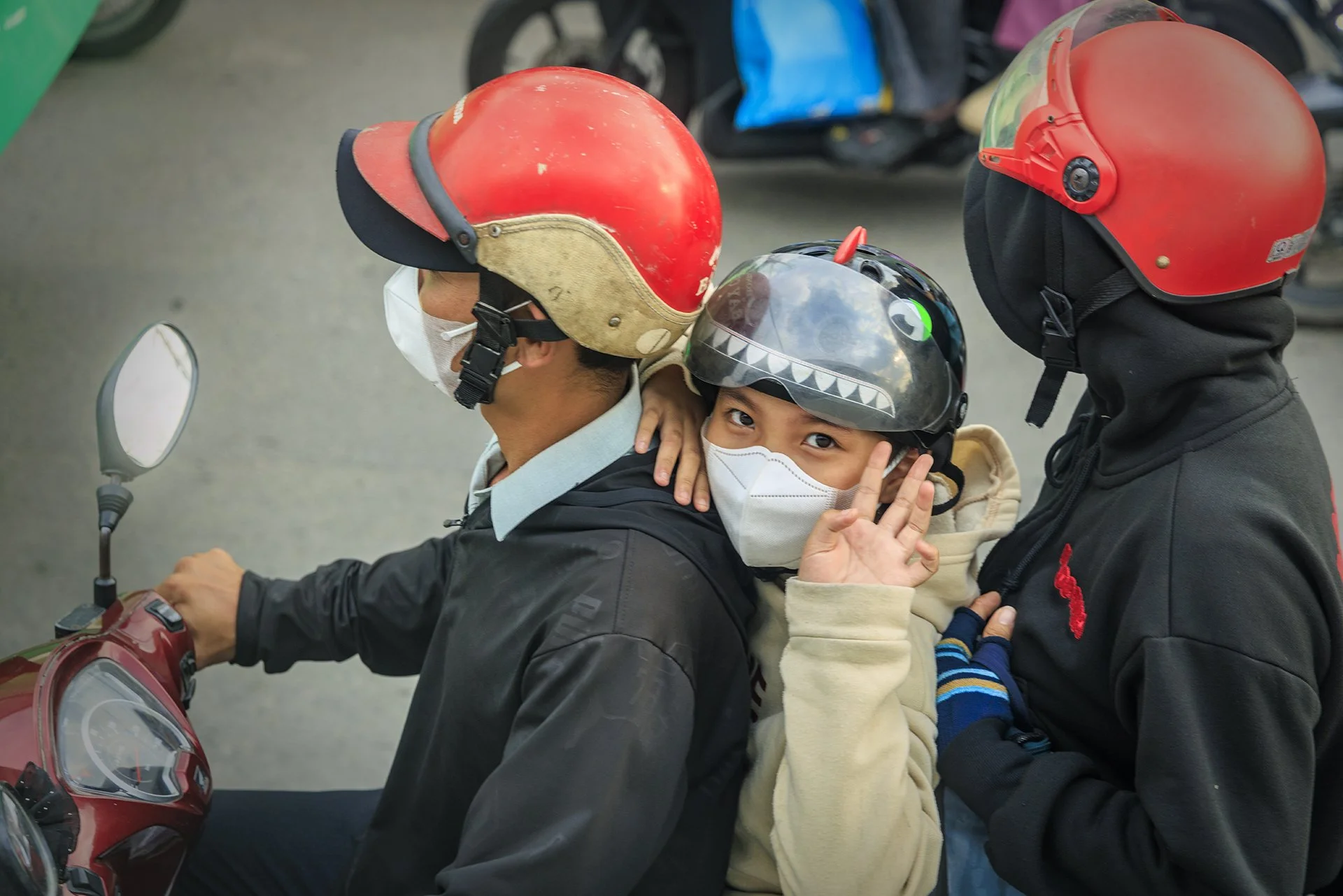
Family commuting.
Da Nang Vietnam
After the second day in Vietnam, we moved from the Saigon area on to Da Nang over night. Da Nang has been famous since pre-historic times as a source of beautiful limestone. It has always been a center of stone carving trades and this continues today. The following photos include some from our stop at the Non Nuroc stone carving factory.
Then it was on to Thuy Son, a marble mountain on the edge of Da Nang where a huge Buddhist shrine and temple complex has been carved into the top of the mountain.
Next on to Da Nang for dinner and a short visit to the famous China Beach (with a short stop on the way back to the ship at Lap An lagoon fishing village on the way)
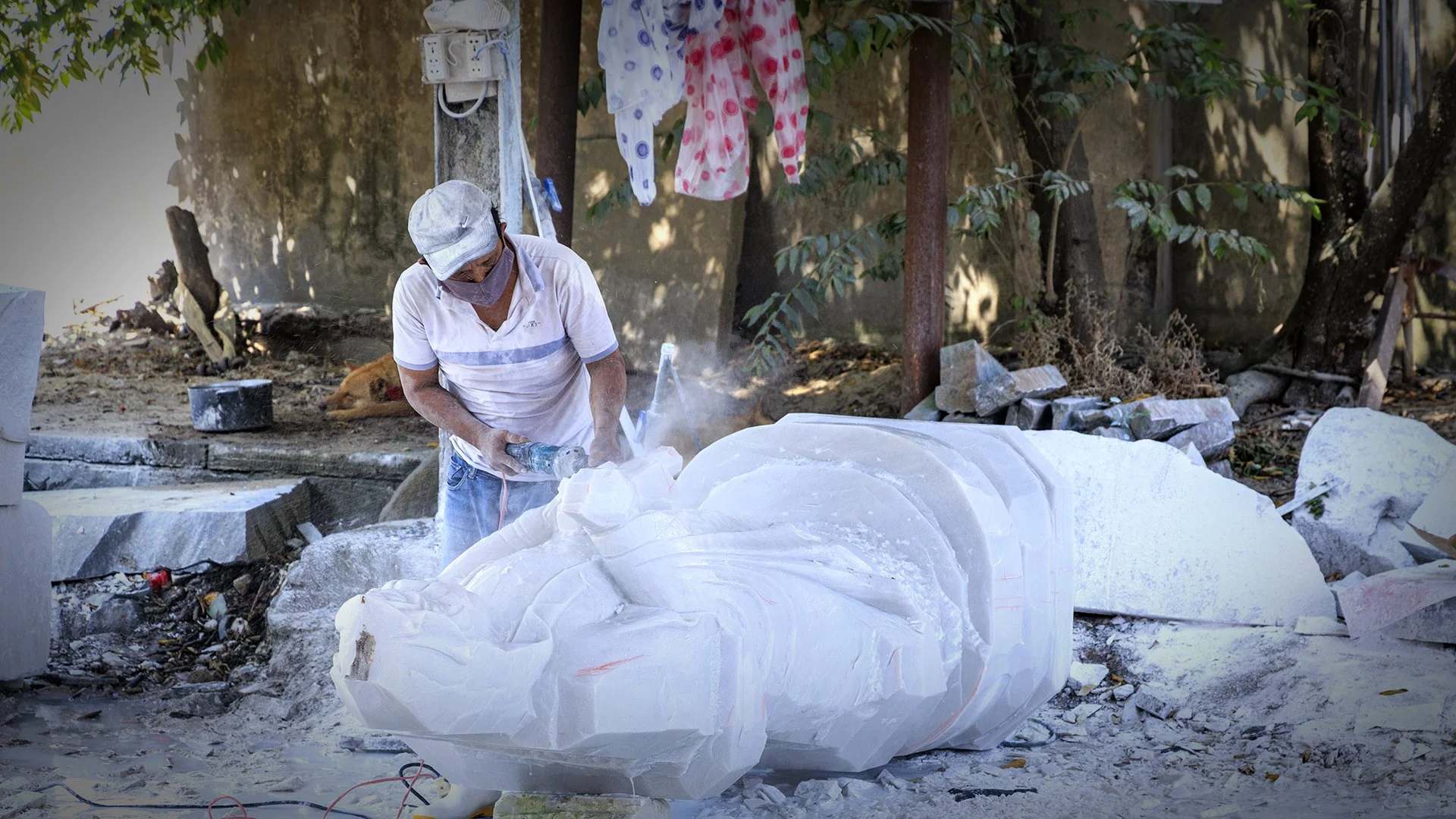
Stone carver working at Non Nuroc.
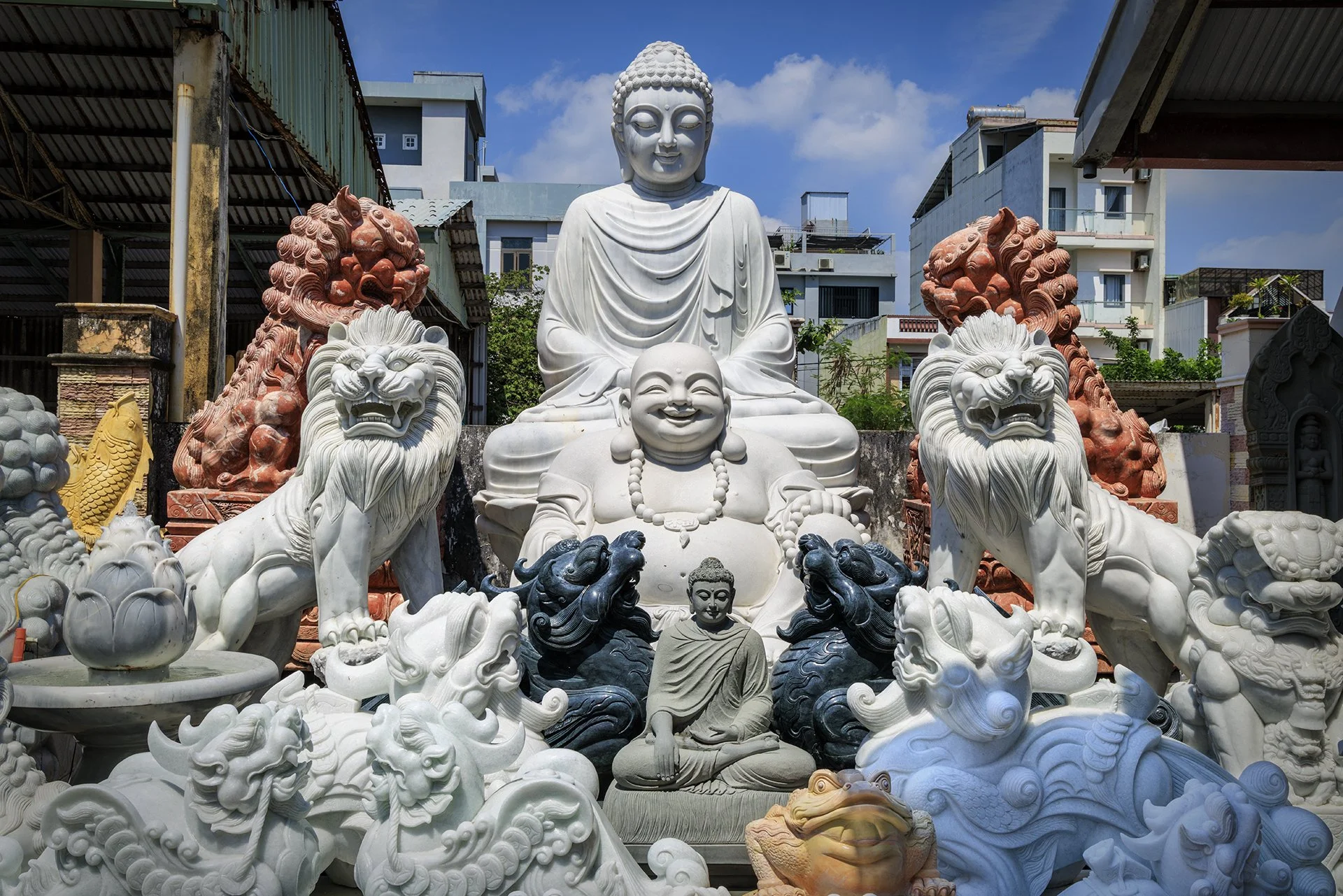
Stonework from the Non Nuroc factory.
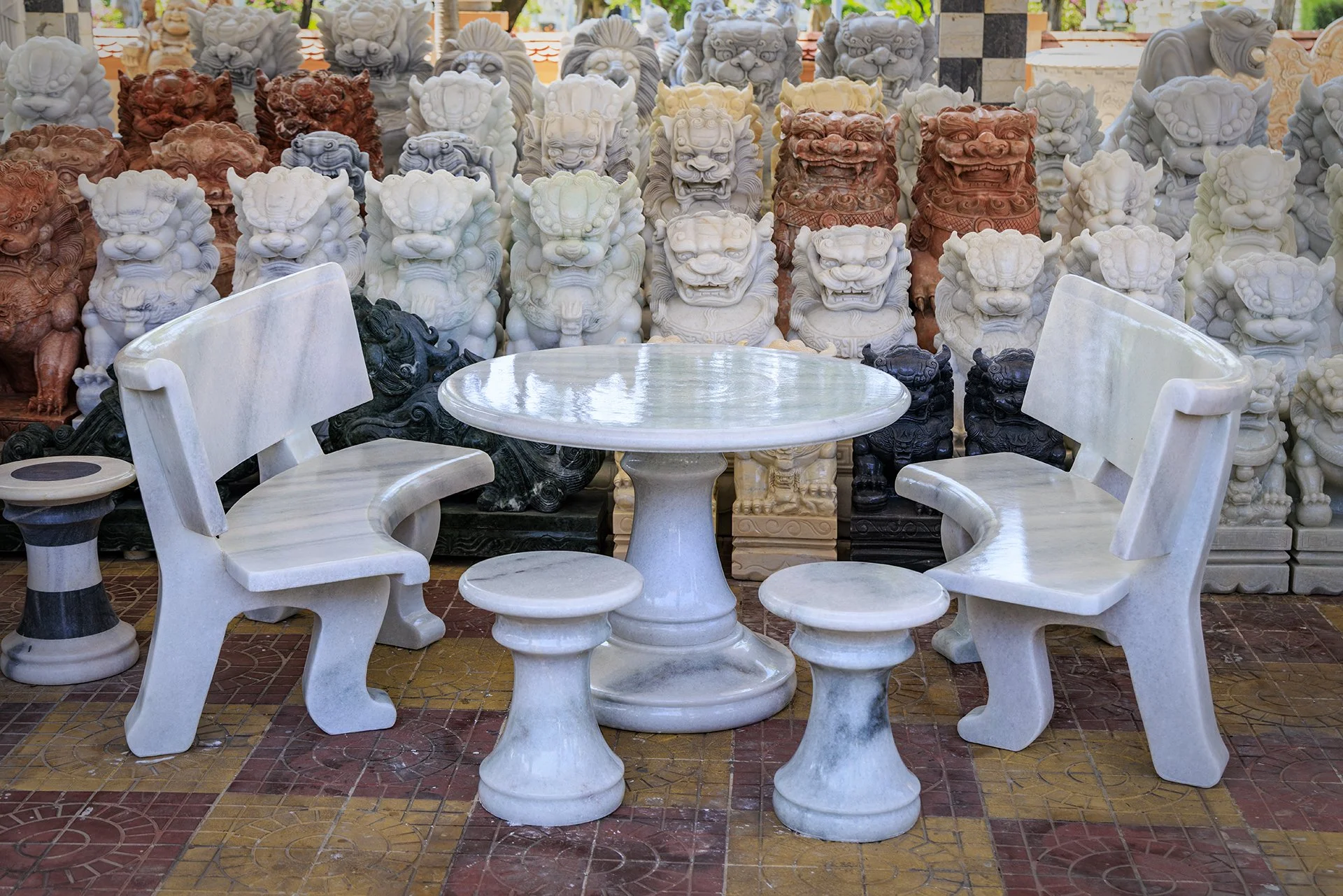
More products of the Non Nuroc factory.
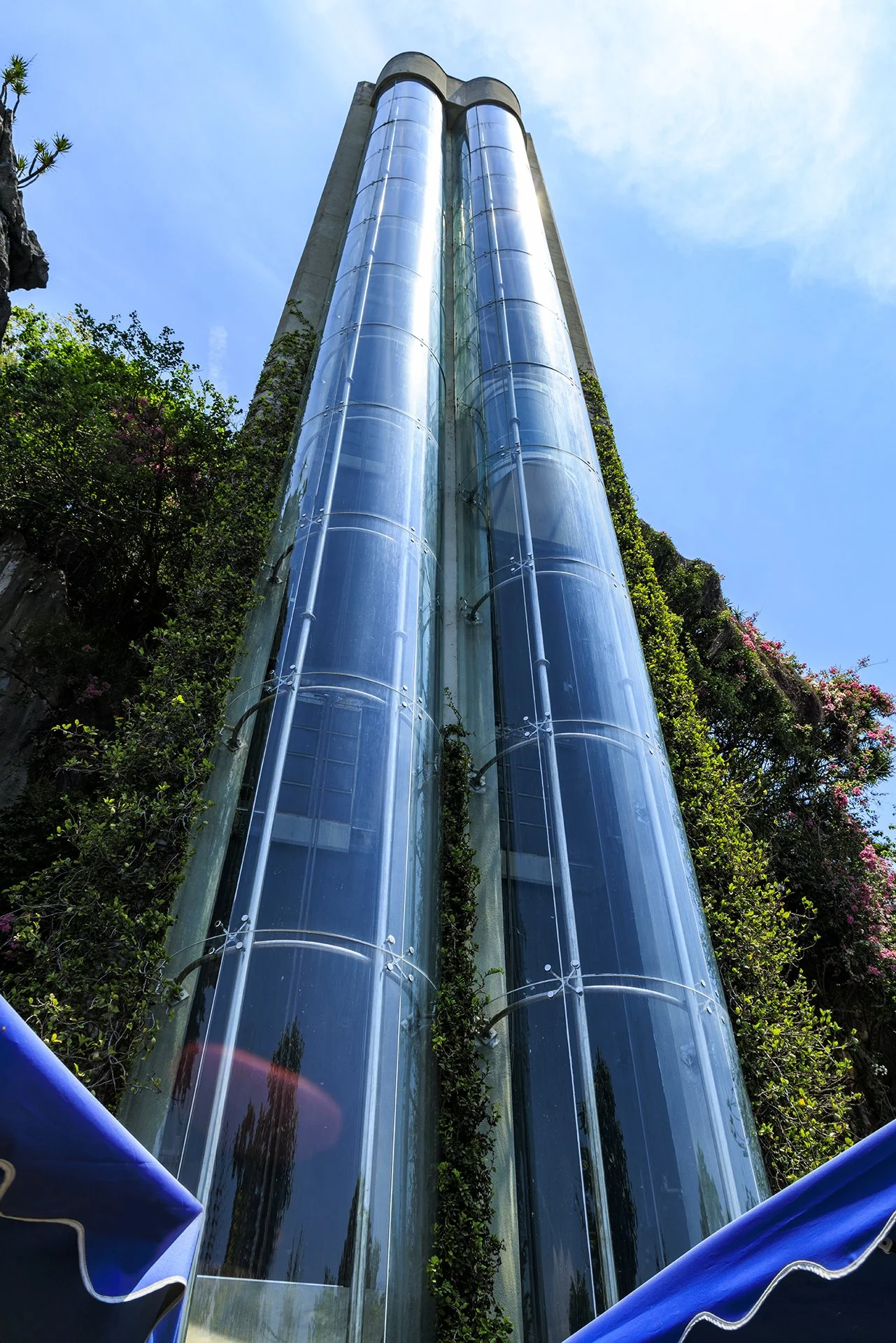
Elevator to the Buddhist temple at the top of Thuy Son mountain.
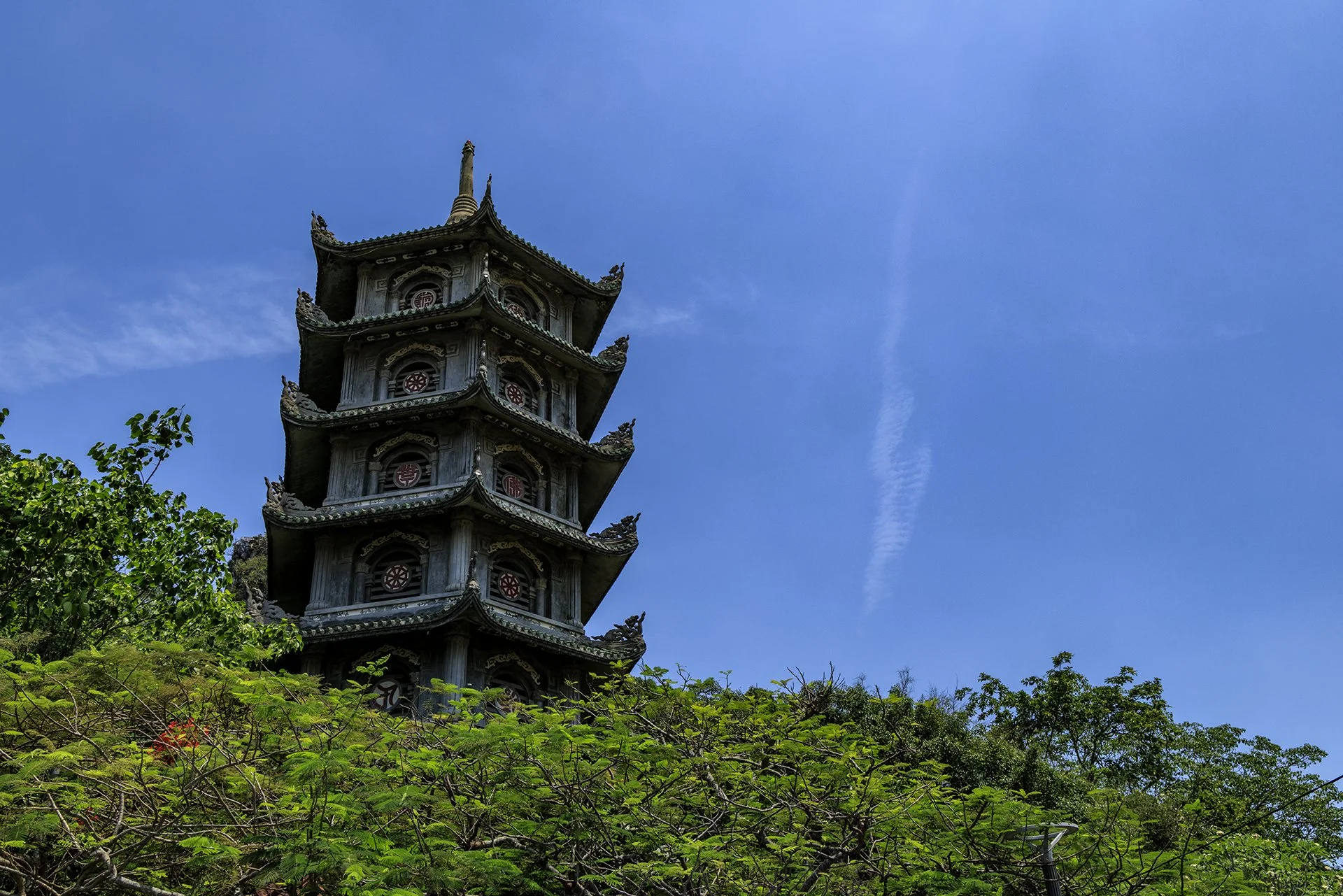
Xo Lai Pagoda at the top of Thuy Son mountain.
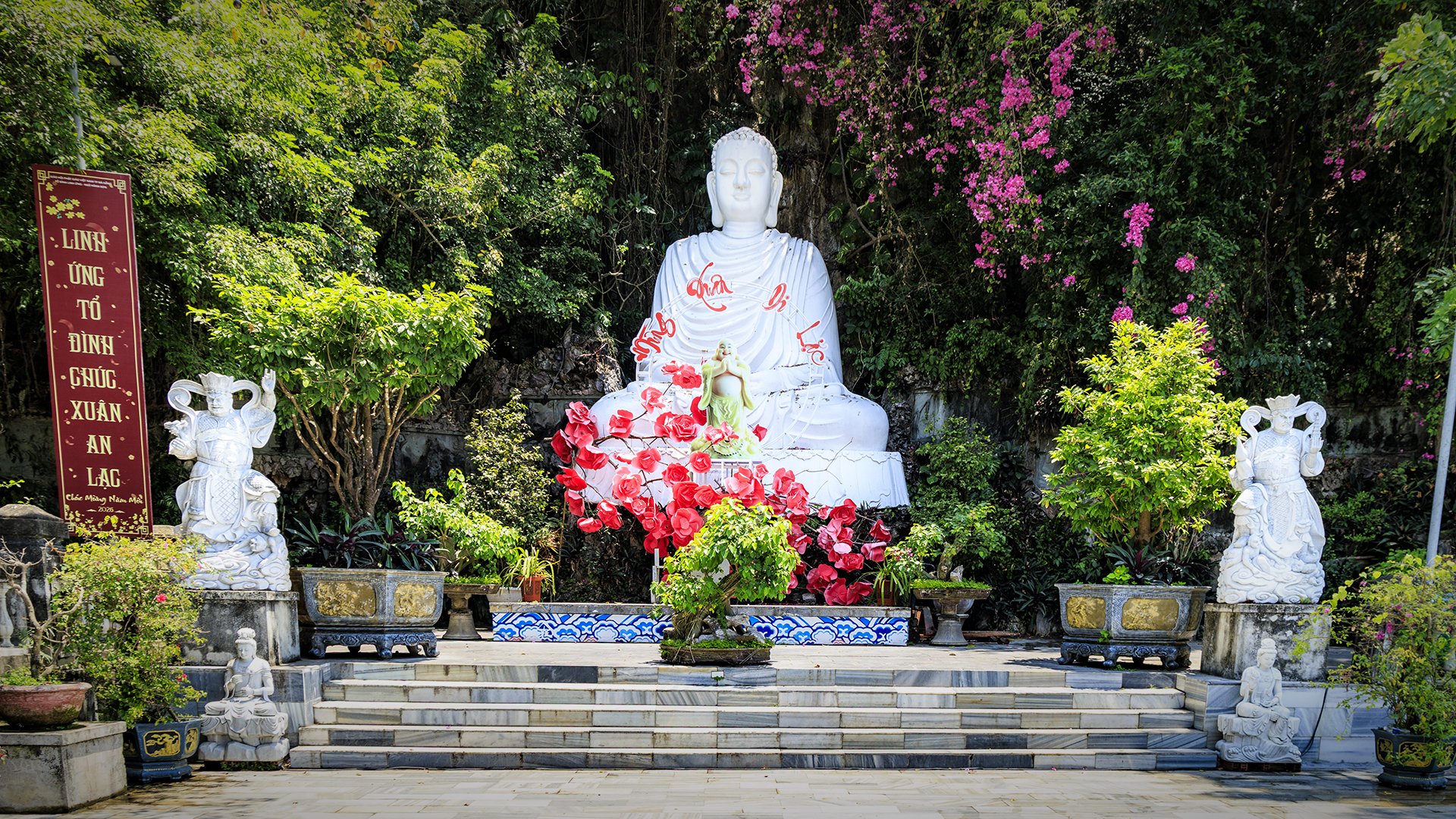
One of the carved marble Buddhas at the Thuy Son shrine.
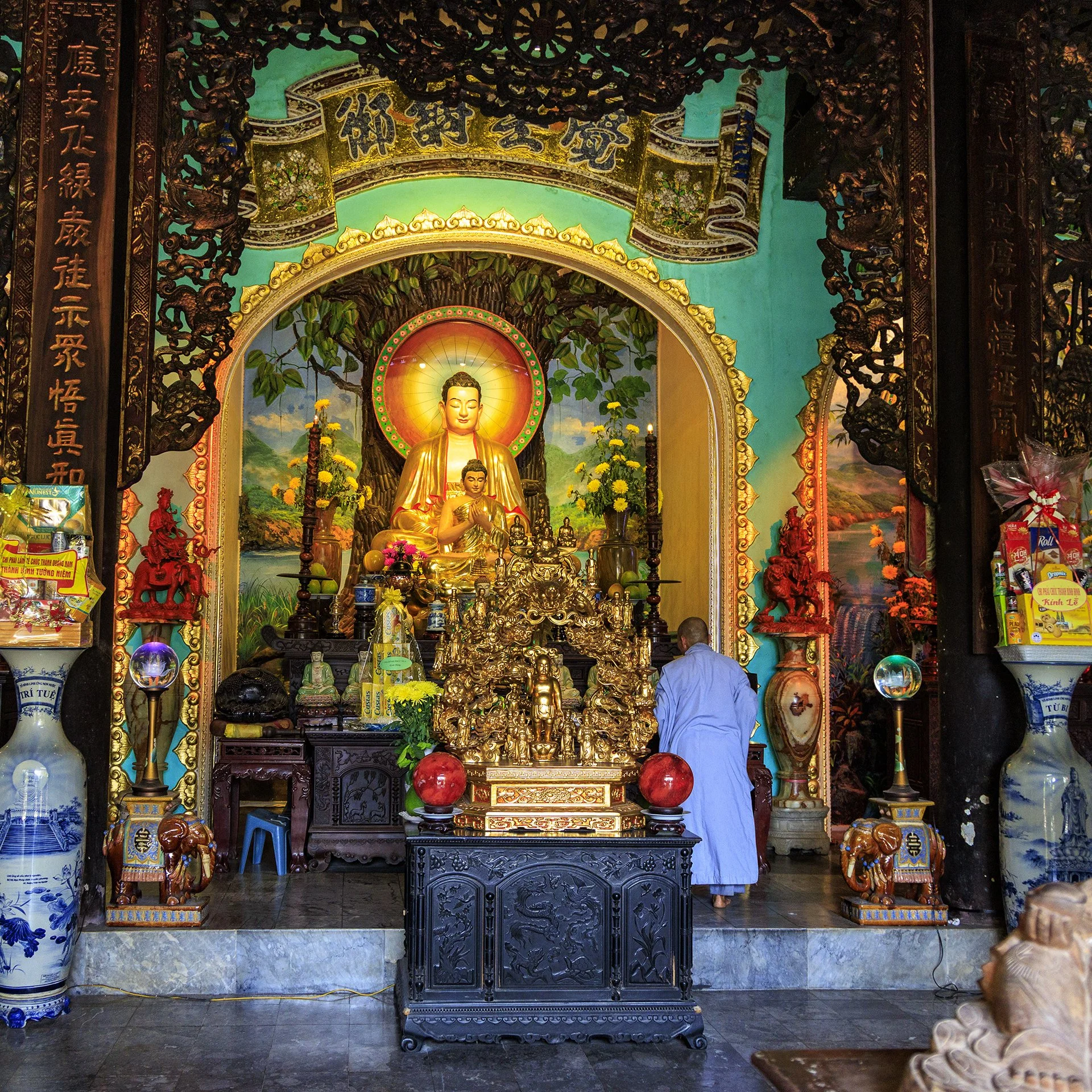
The main Buddha shrine in the caves at Thuy Son.
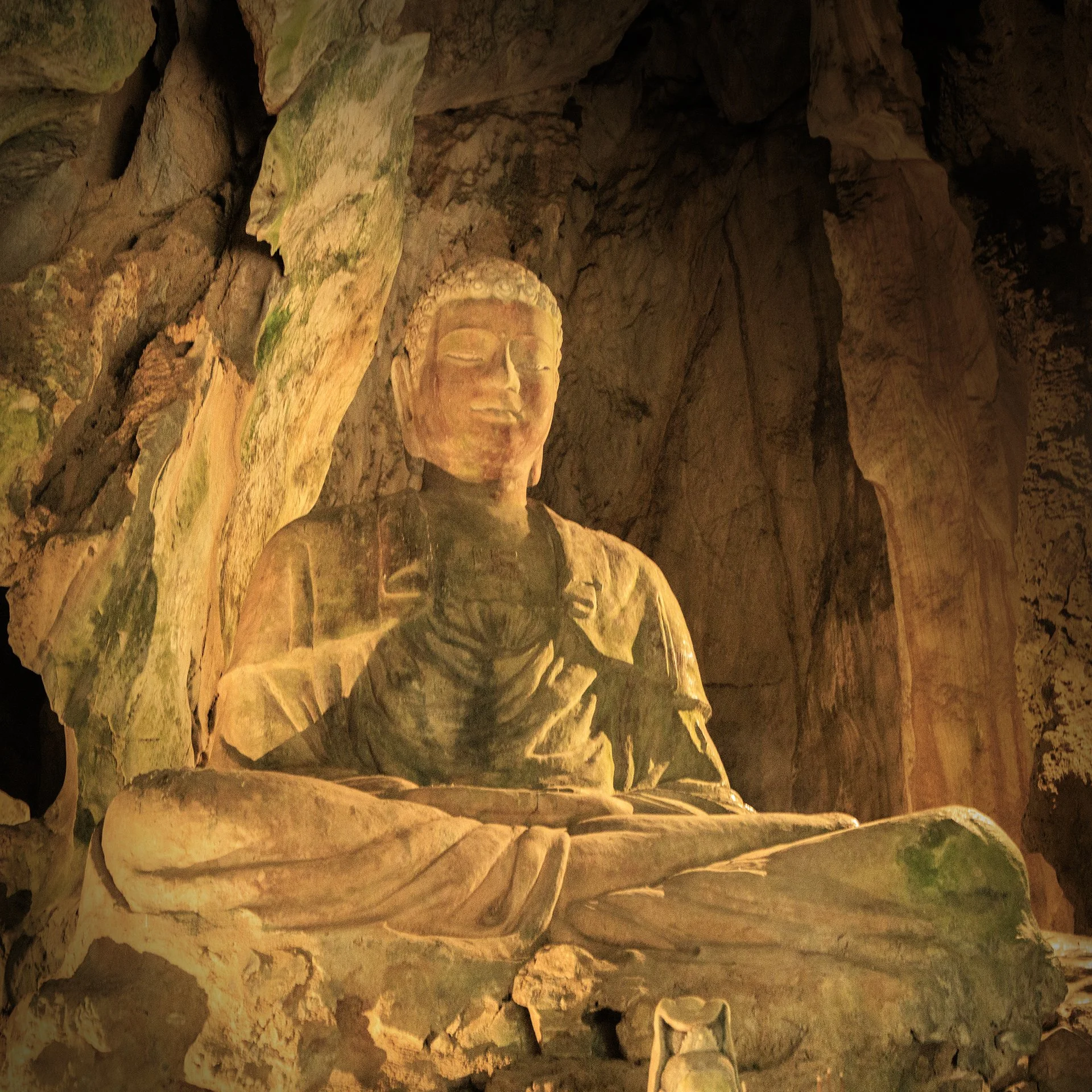
Another Buddha in the caves.
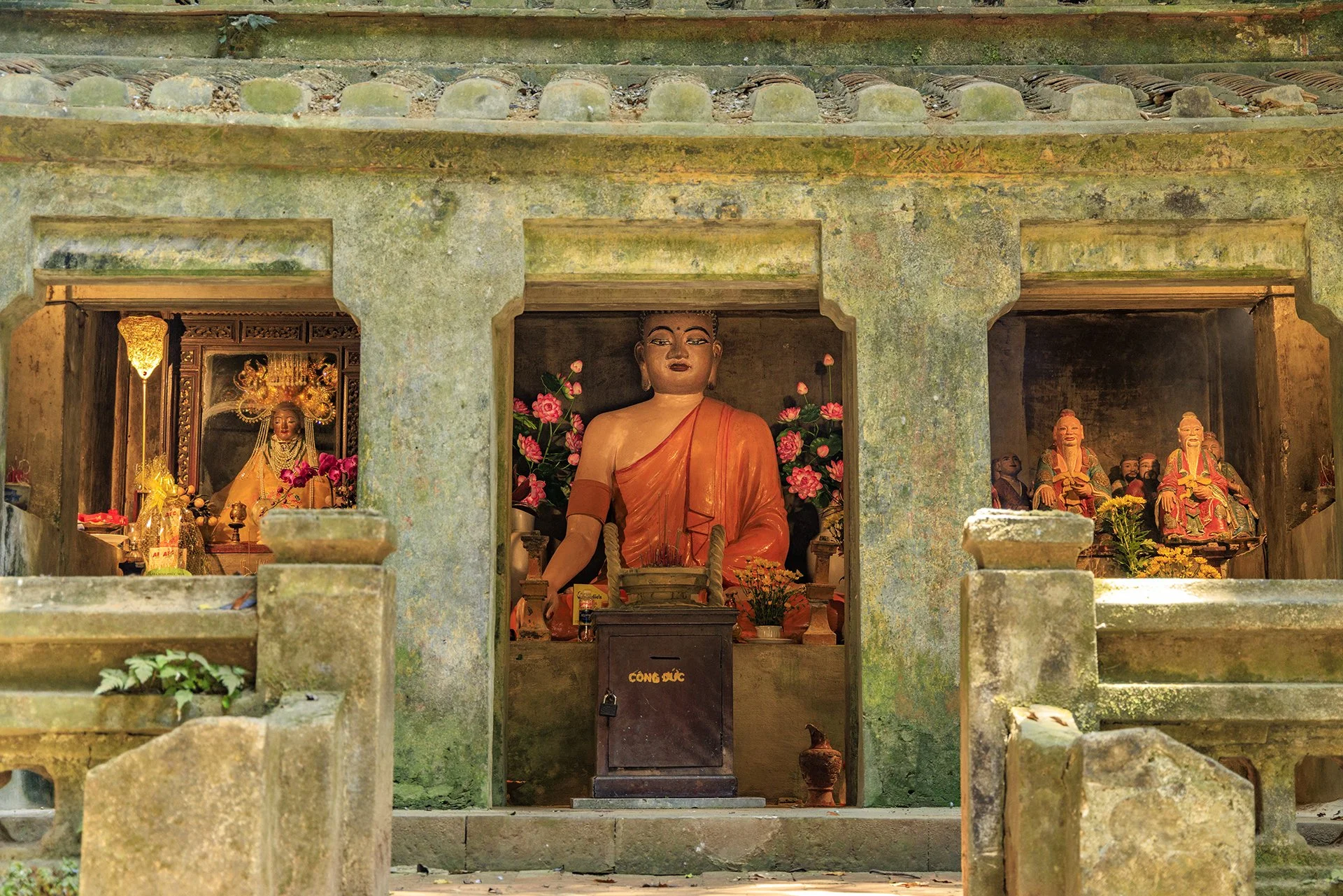
Another Buddha shrine carved into the mountain.
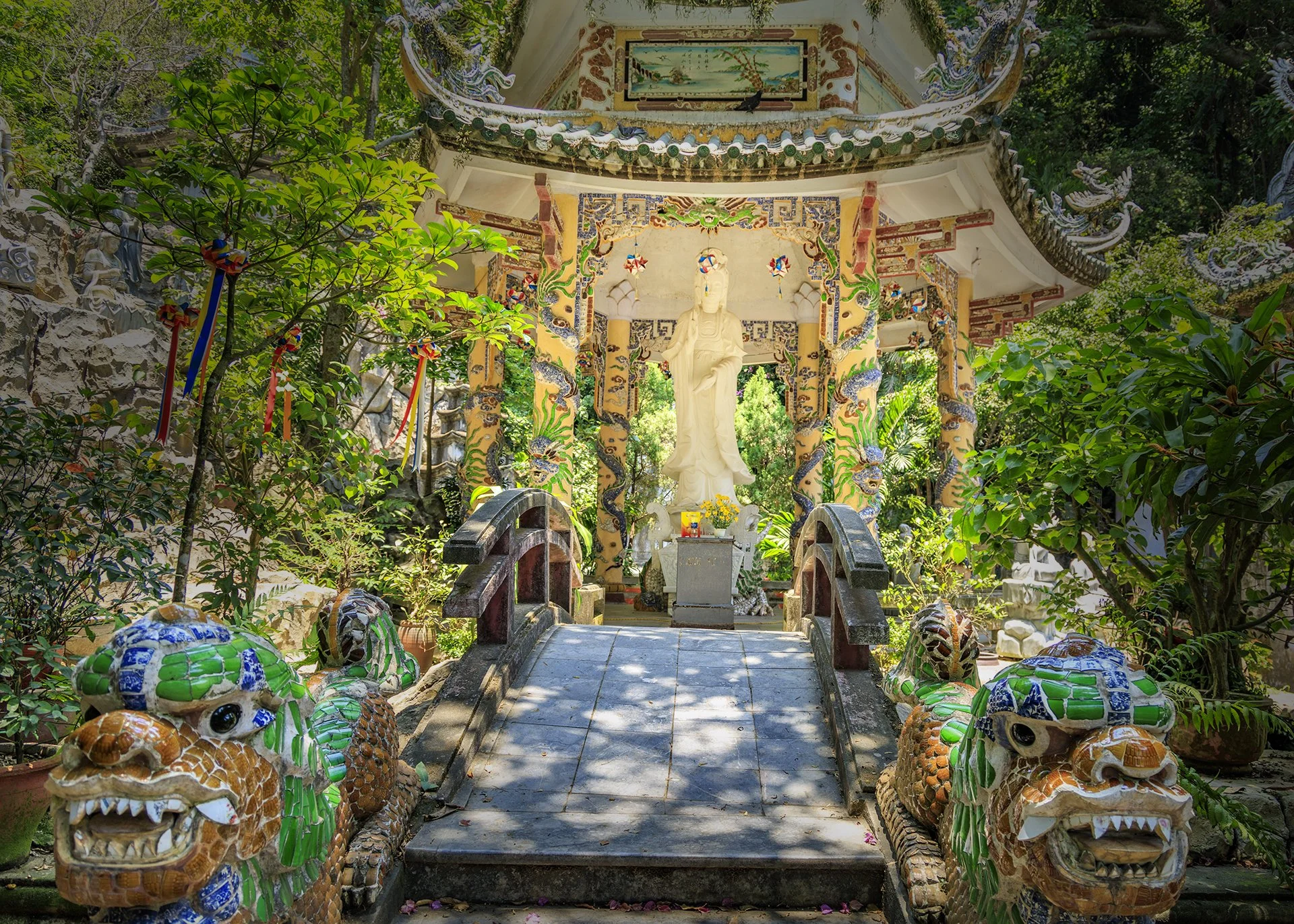
A statue of Quan The Am Bo Tat, the bodhisattva of compassion.
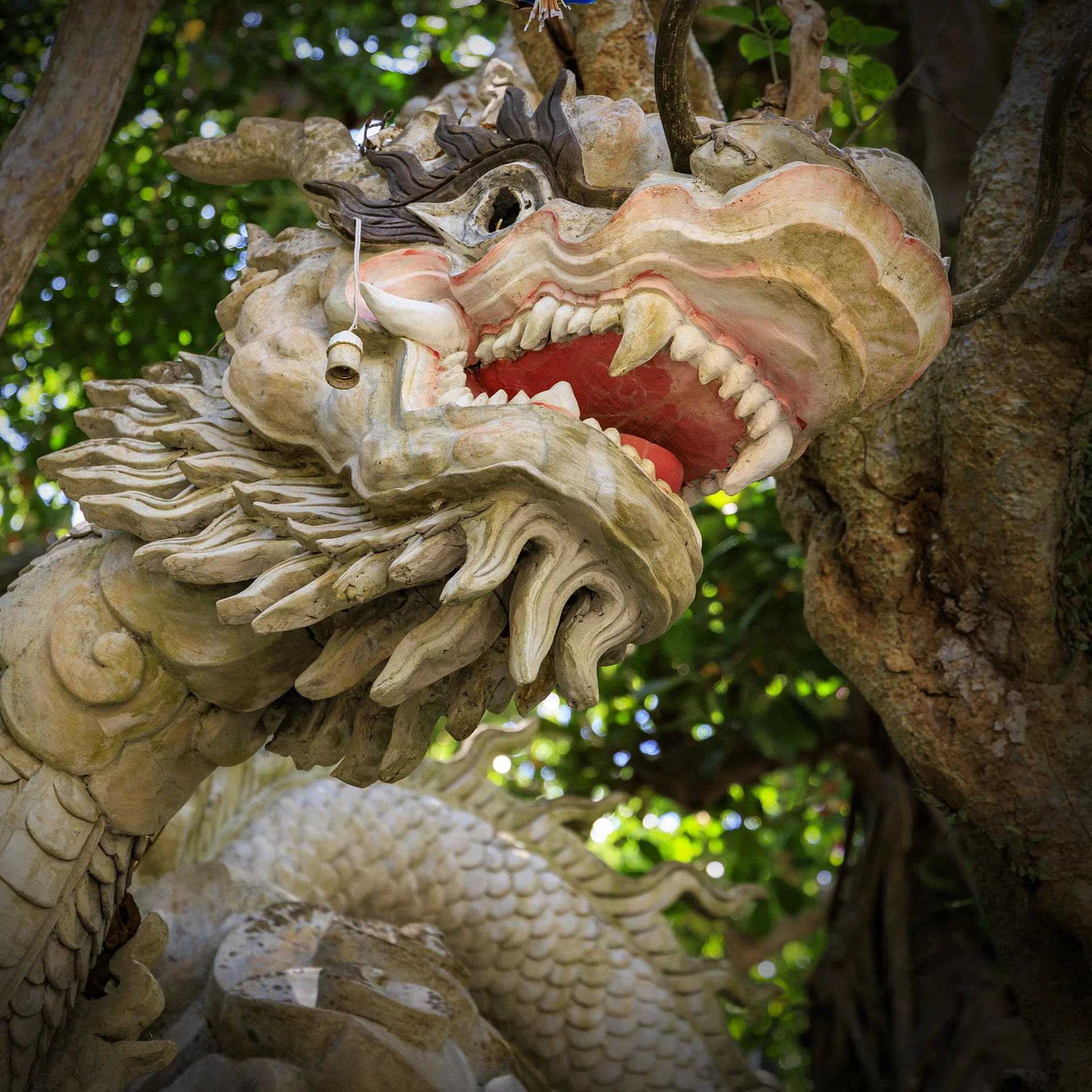
One of many marble dragons carved into the mountain.
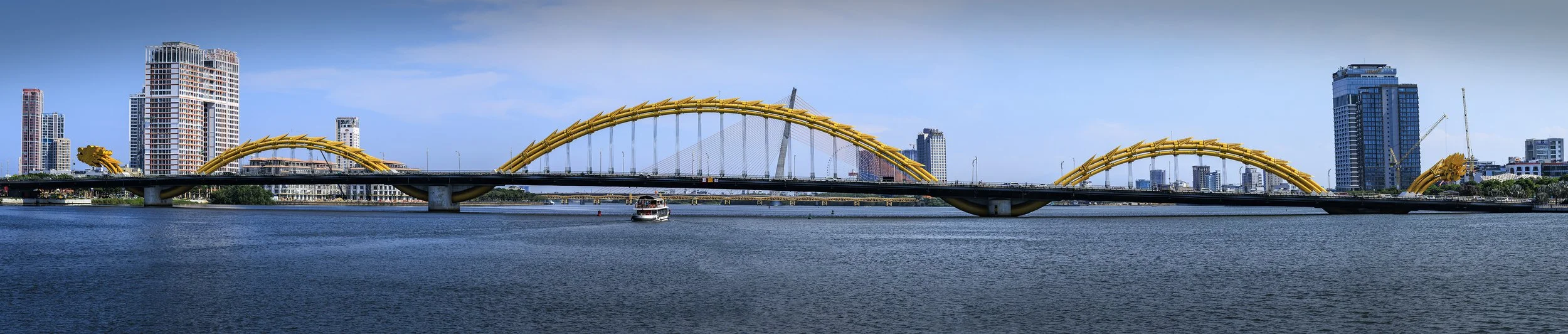
On the way back to the ship we crossed the famous Da Nang dragon statue. This was a bit of a challenge to photograph since it's a multi-image panoramic taken from a moving bus.
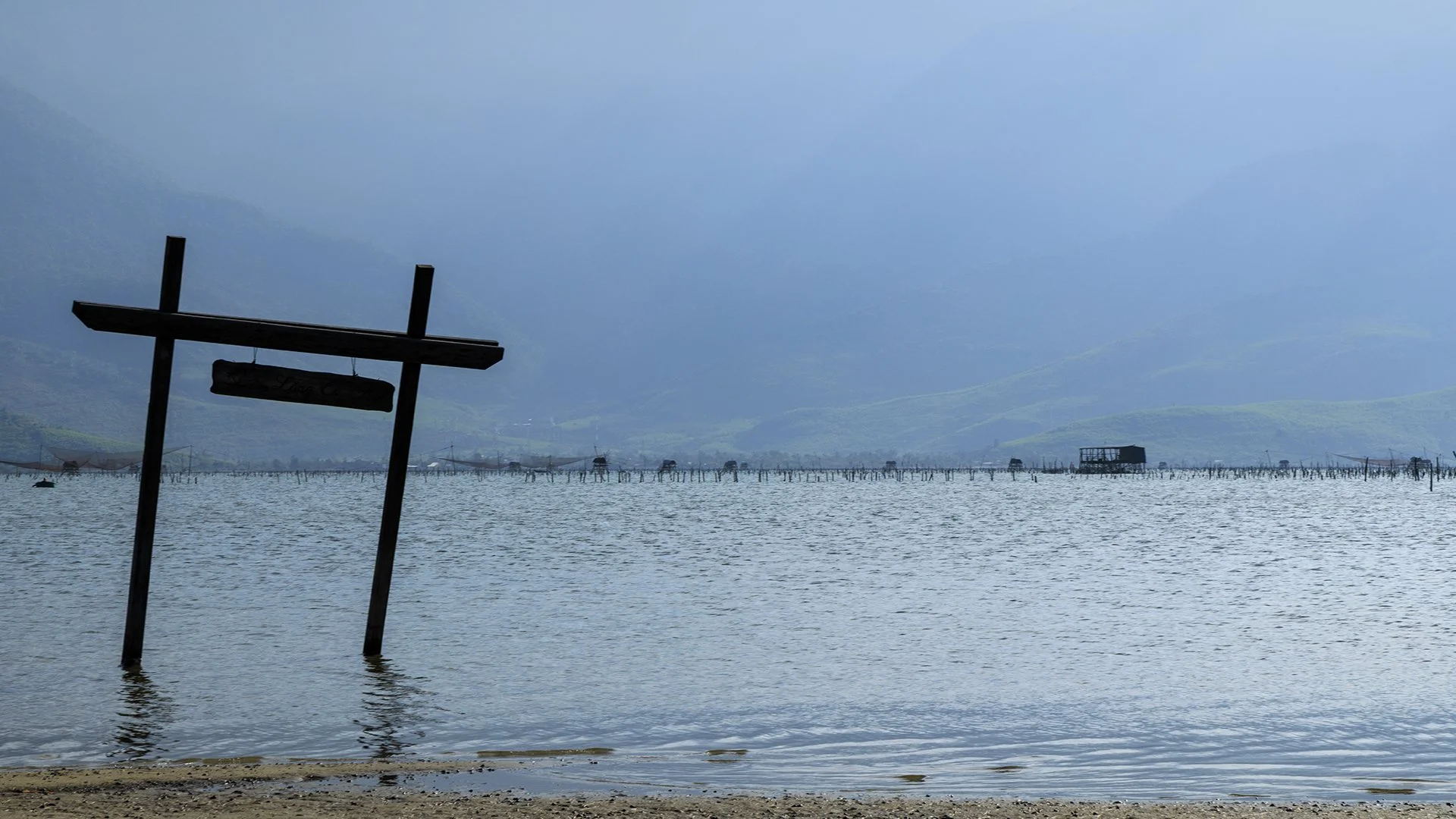
Lap An lagoon. You can see the oyster farming village on the lagoon made up of traditional stilt houses in the distance.
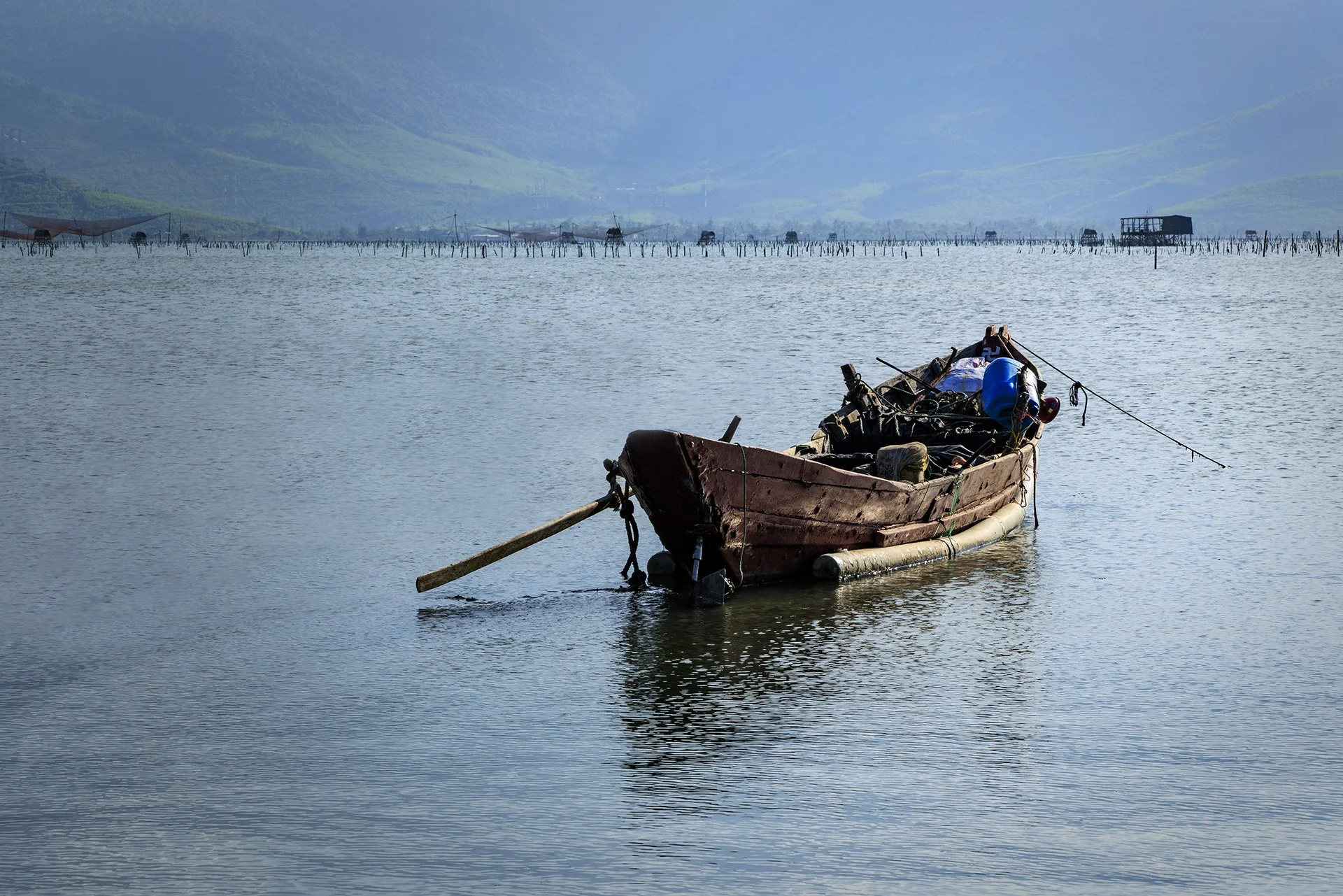
An oyster fishing boat.
Ha Long Bay Day 1
For our third day in Vietnam we moved over night to Ha Long Bay. This is a UNESCO World Heritage site. It's been a location for a few movies, notably Kong Skull Island. It's famous for it's karsk limestone spires. It's also a very busy industrial port.
Sailing into the bay we passed numerous ocean ships and river barges. River traffic converges here at the port and gets transferred over to larger ocean going vessels. Combine that with all the fishing traffic and tourist boats and you have one busy bay.
We sailed up the bay dodging traffic and limestone karsks. Our ship threaded it's way through the maze of the spires and islands and dodged the traffic. I asked a crew member how deep the bay was and was told it averages 16 feet so staying in the main channel added another challenge to navigation. It made for an exciting sail-in.
Later in the day we took a bay cruise to visit another floating fishing village and take a sampan ride around a UNESCO protected part of the bay.
We also made a stop at a cave in one of the limestone islands.
It made for a long day but in the evening I took some photographs of the city lights from the deck.
Photographically it's pretty much the same as it has been for this entire trip. That is, hand held shooting "street photography" style. Shutter priority and auto ISO.
So you'll see all of that in the following images.
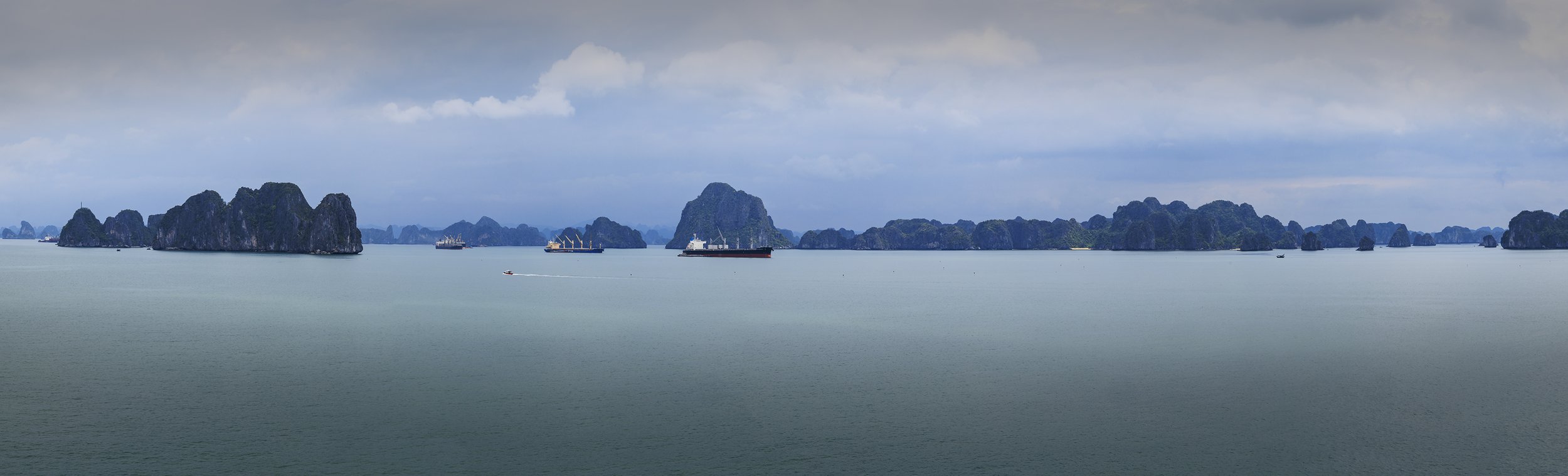
Panoramic of Ha Long Bay as we sailed in on Viking Orion. Ha Long bay means “Descending Dragon” in Vietnamese. You can certainly see how the landscape inspired thoughts of dragons.
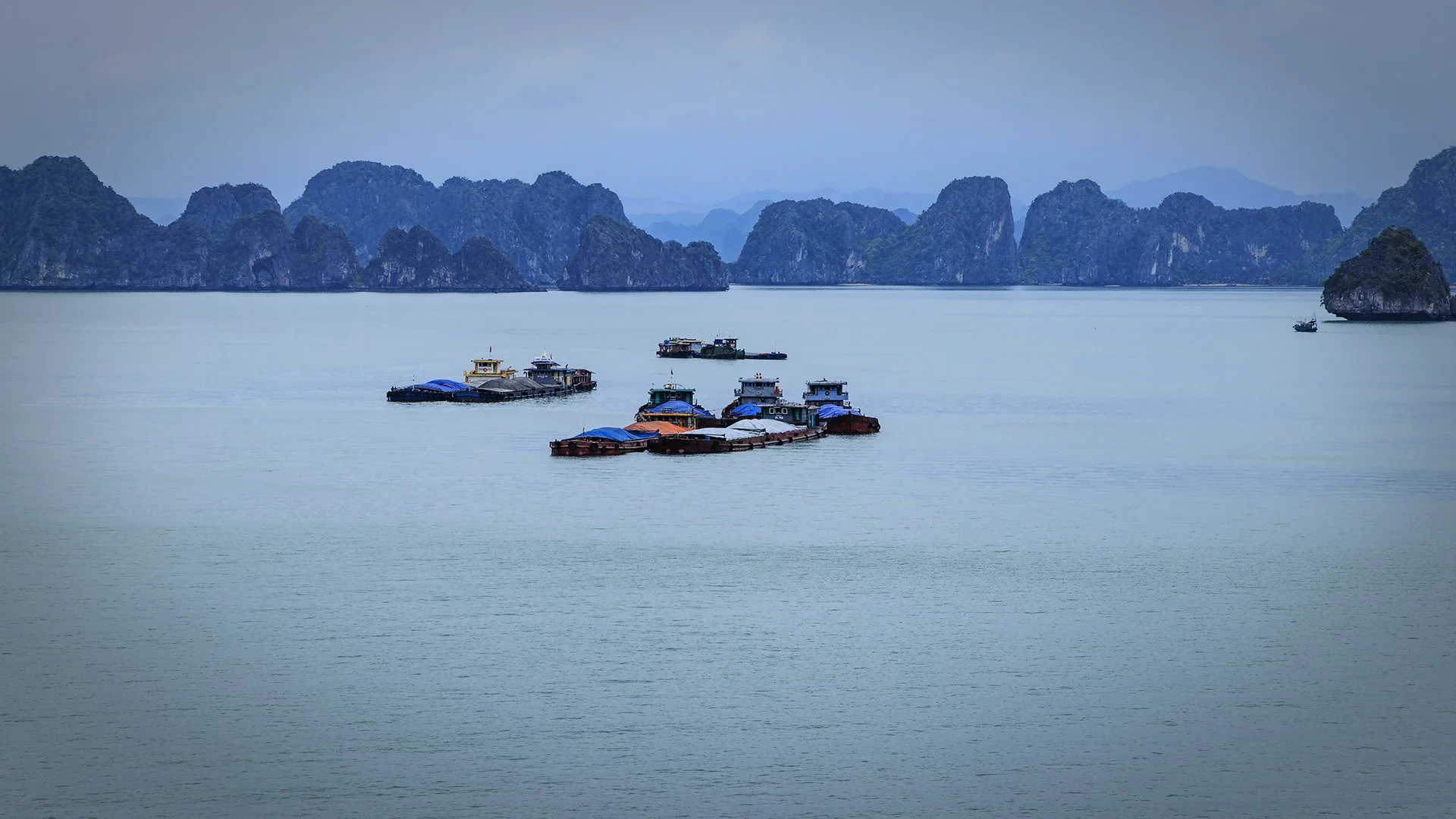
These river coal barges are waiting to transfer their cargo to ocean ships. Vietnam is still using coal as a significant part of their energy supply.
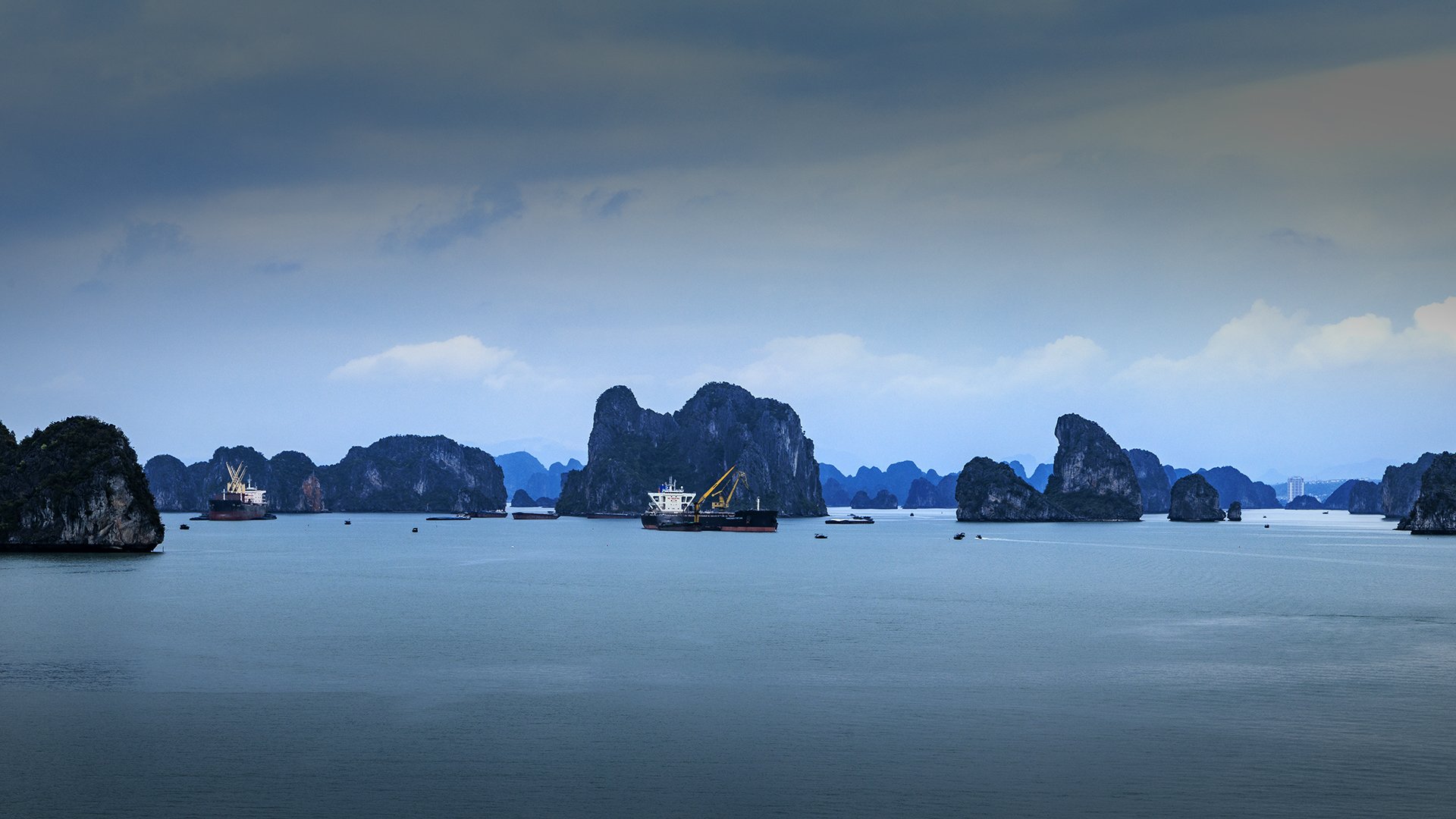
Another image of commercial shipping in the bay. This is a well sheltered bay but with all the karsk islands and the shallow water I wonder if storms cause a large disruptions when they come through.
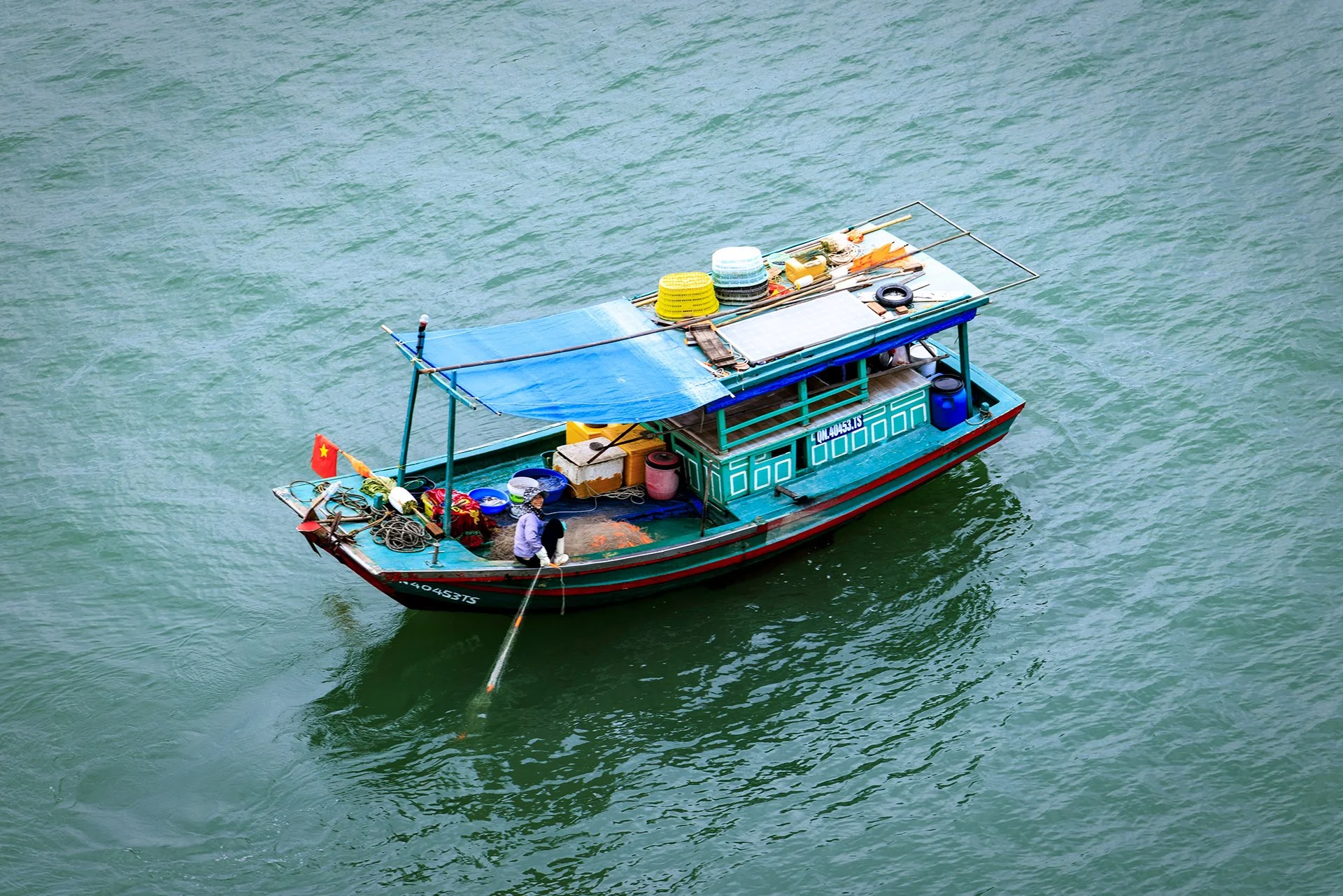
There were lots of fishermen (and fisherwomen) working in the bay as well.
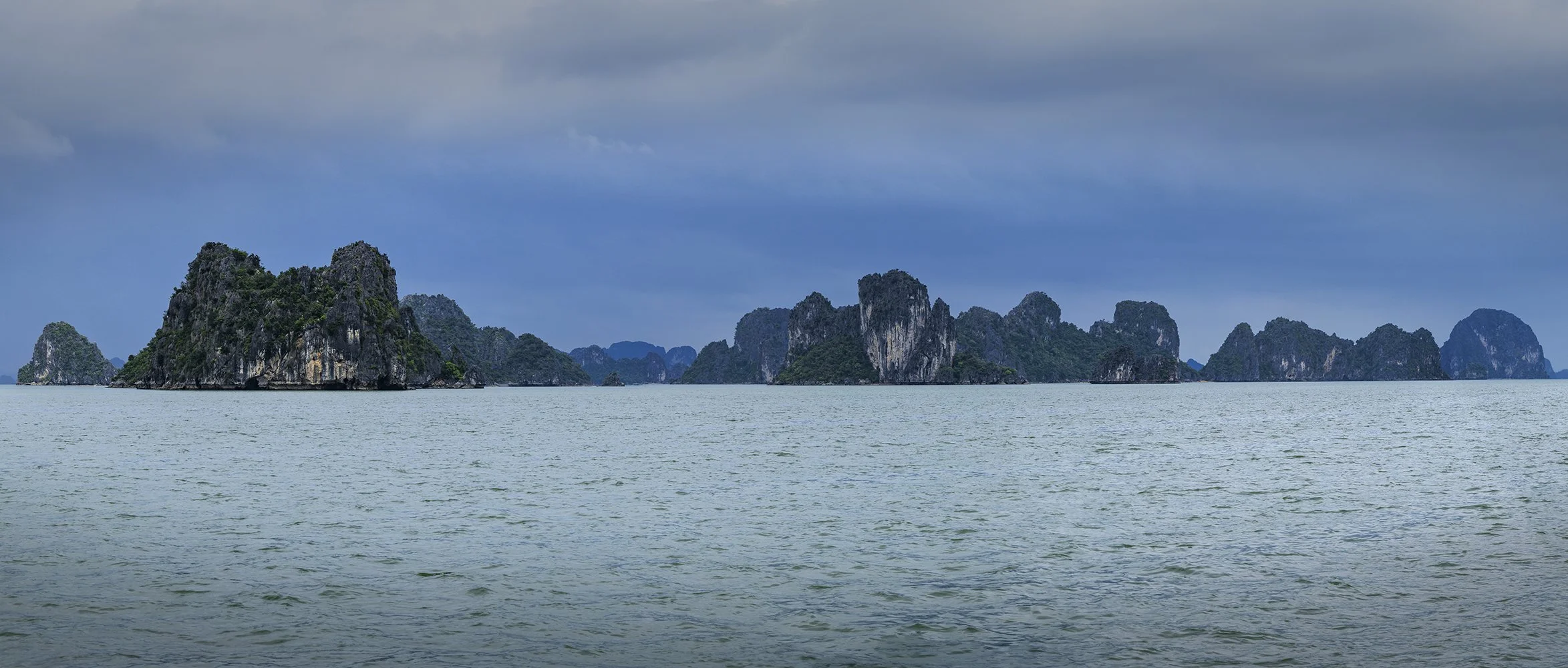
After docking we embarked a bay cruise where we were able to get away from the busy port and see some of the beautiful sights of the bay. This panoramic shows how the landscape inspiring the Descending Dragon name of the bay.
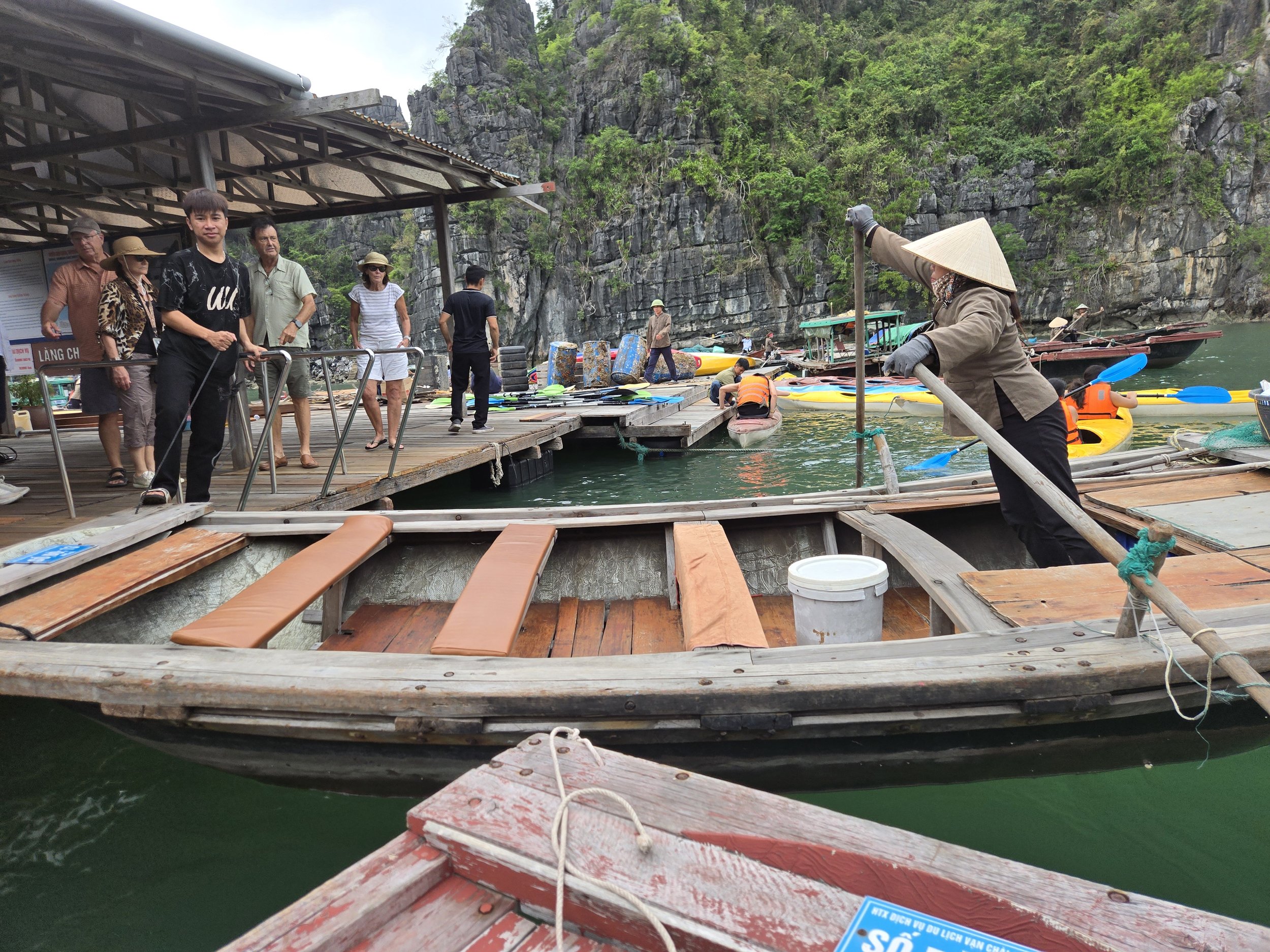
This is from the floating fishing village we visited. Now that the bay is a UNESCO protected site most of the local floating villages have been removed since they cause pollution and diminish the natural beauty of the preserve. This village is mostly maintained for educating visitors although people still live here and rely on fishing along with tourism for their livelihoods.
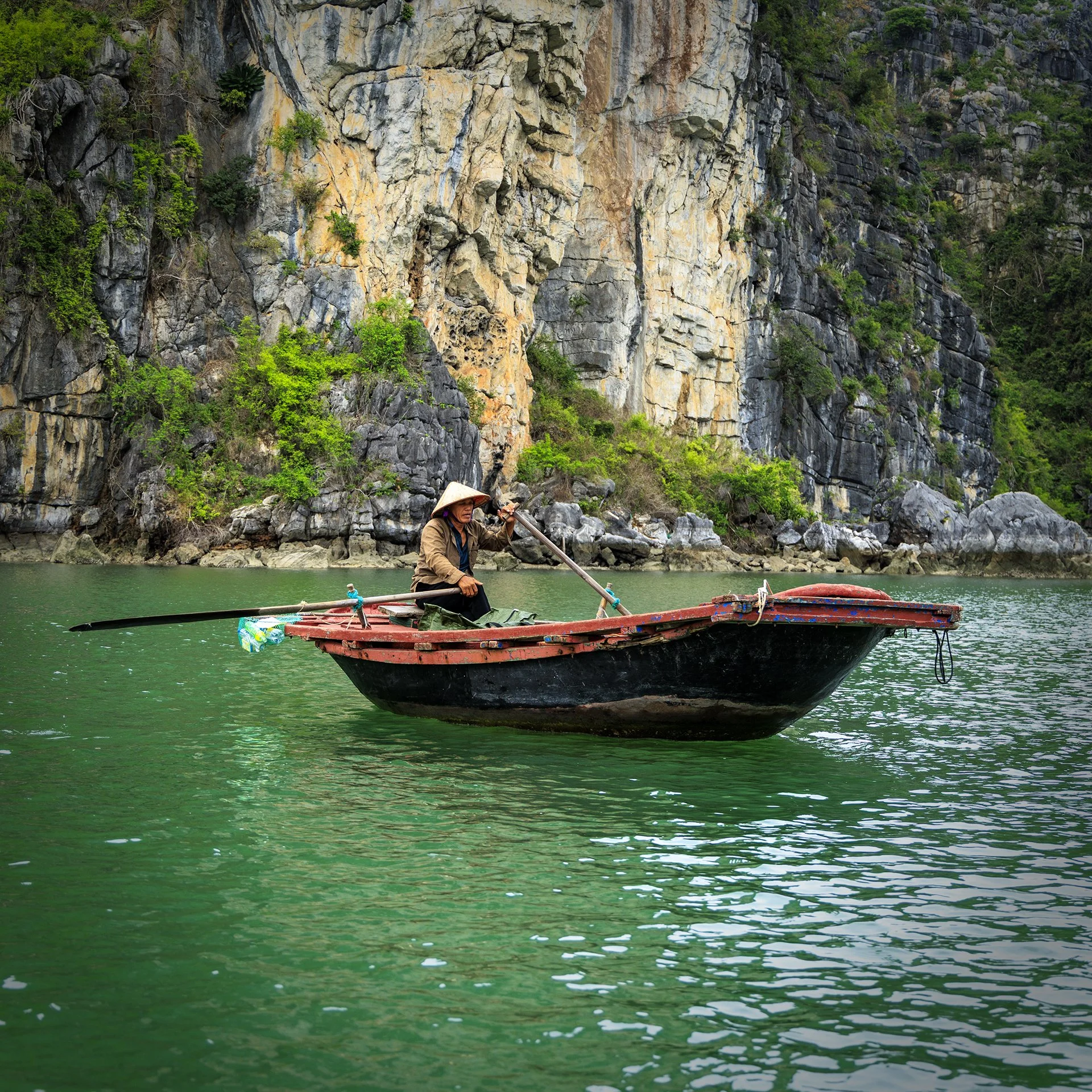
Our local boatman arrives.
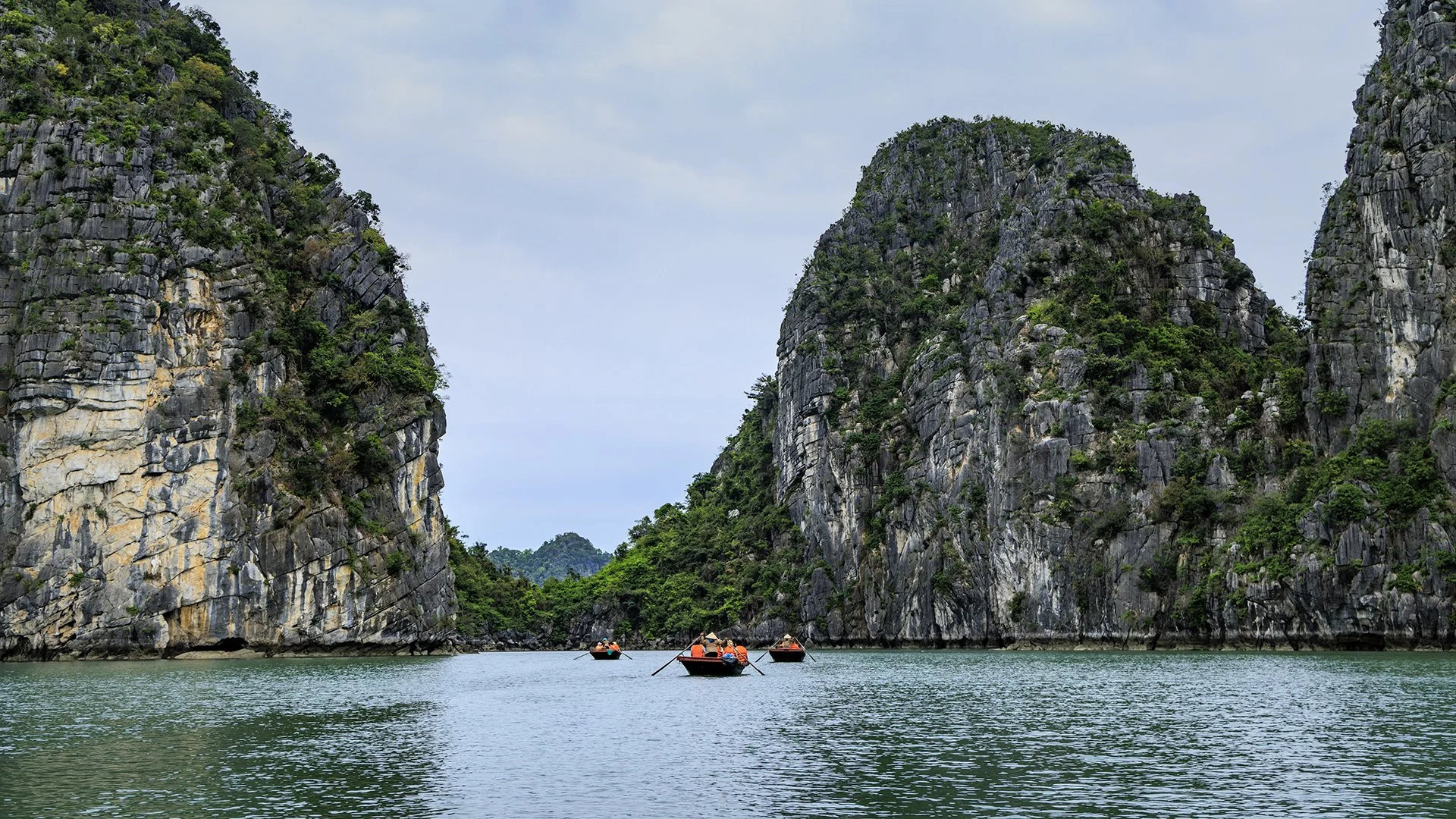
Sampans with their cargos of tourists exploring the beautiful bay.
Stopping to explore one of the many caves on islands in the bay. At this point the battery in my mirrorless camera was dead so the remaining images from the tour are from my phone.
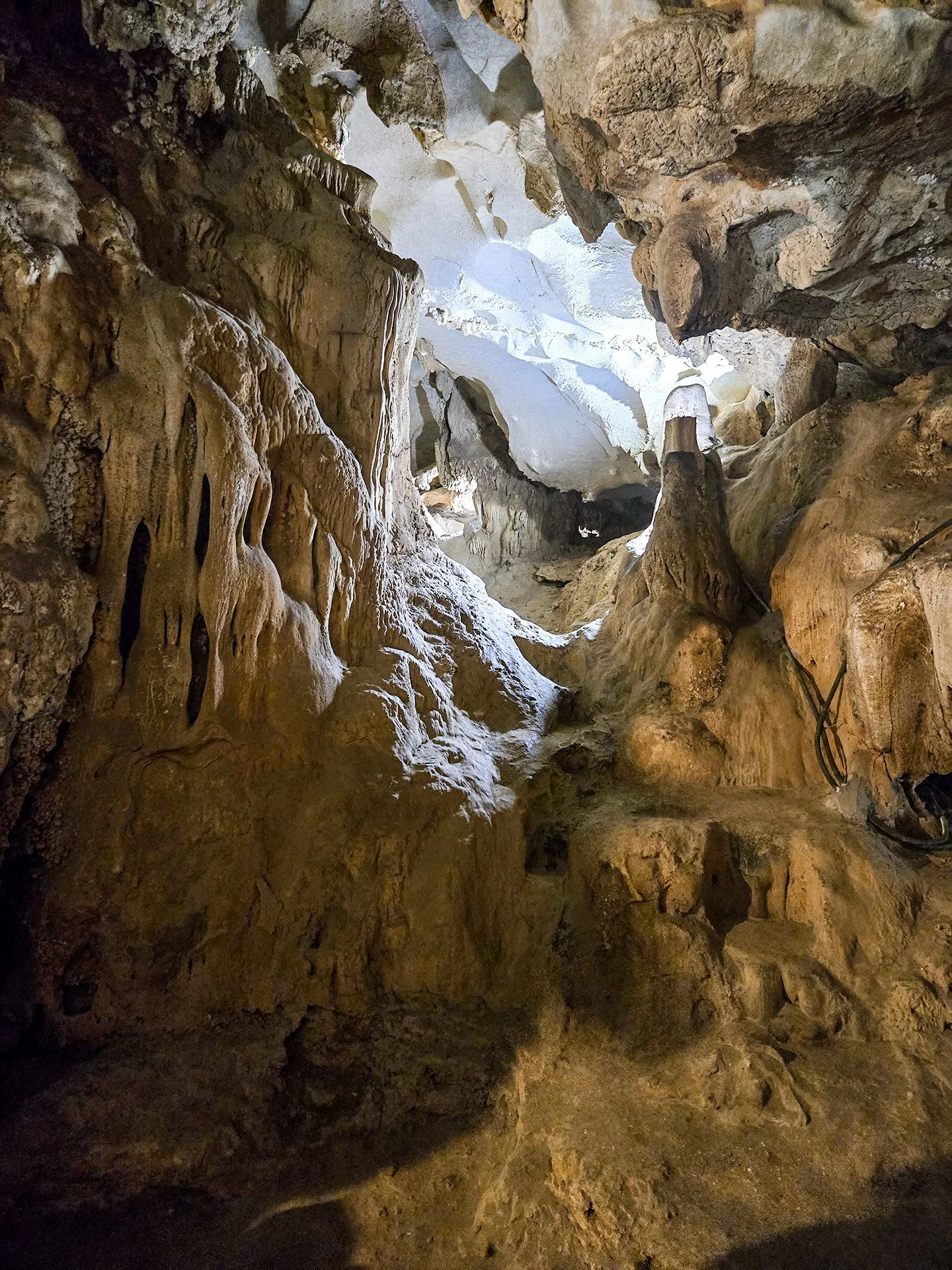
From inside the cave.
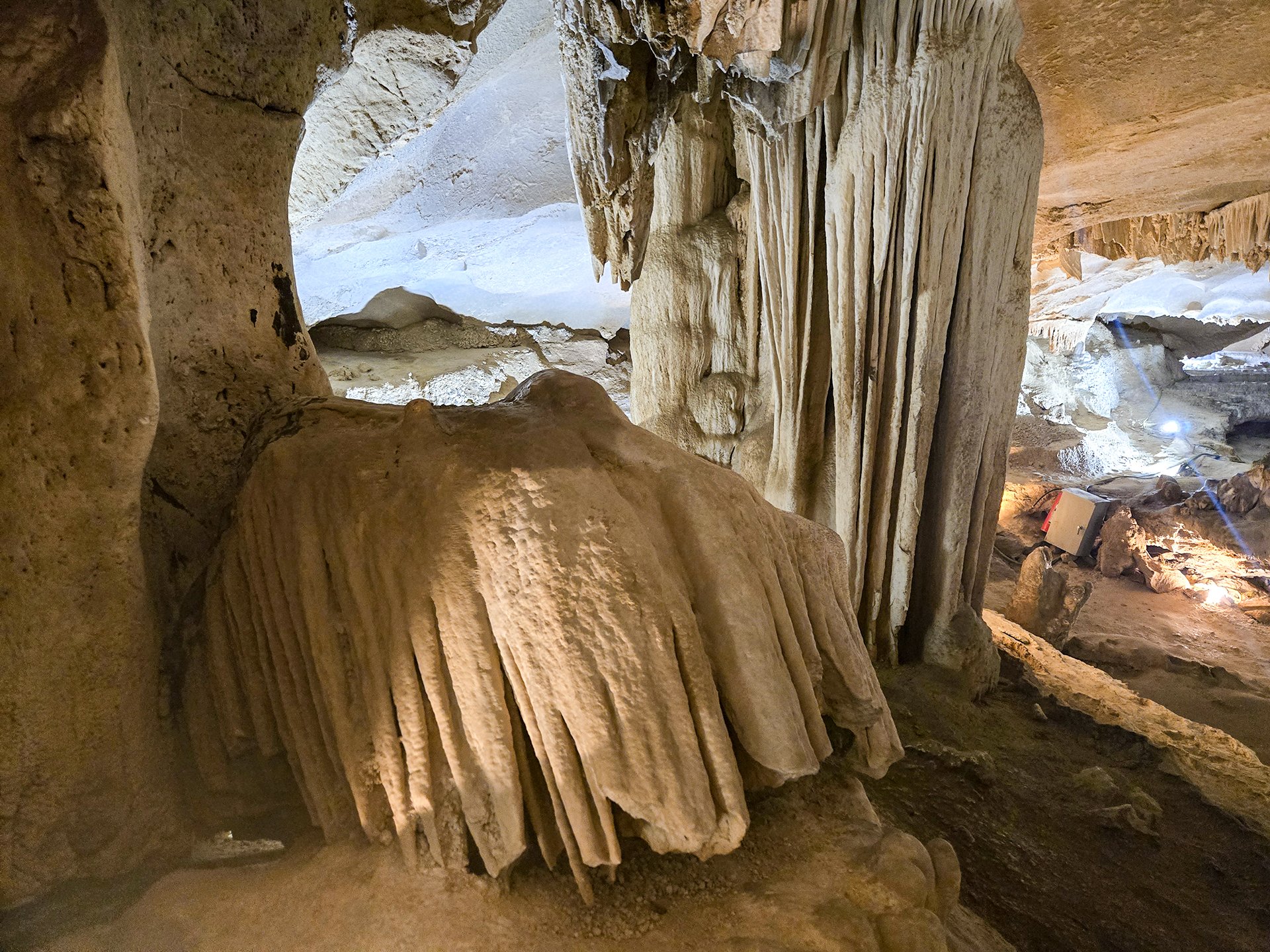
Cave formations.
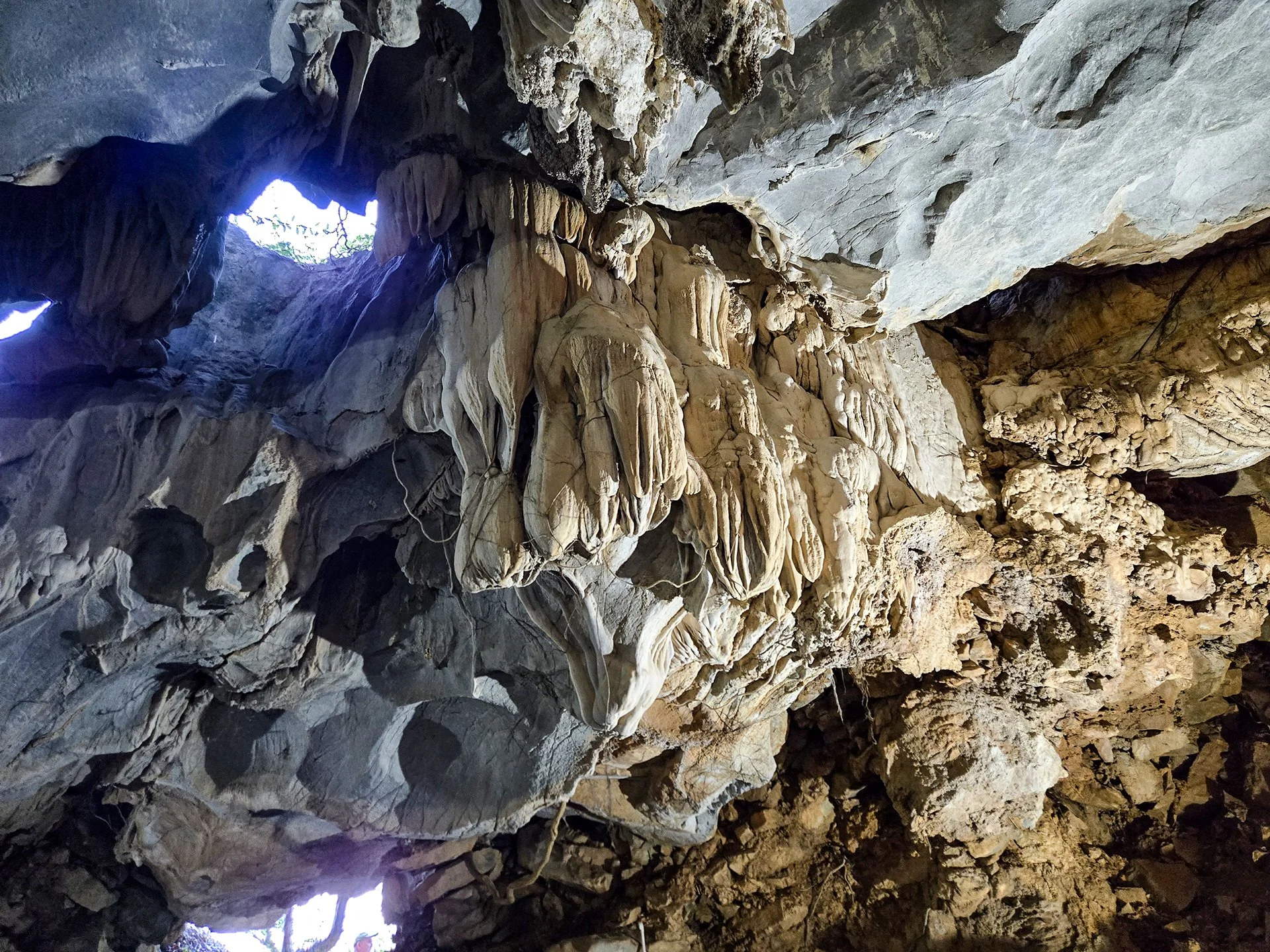
Cave formations.
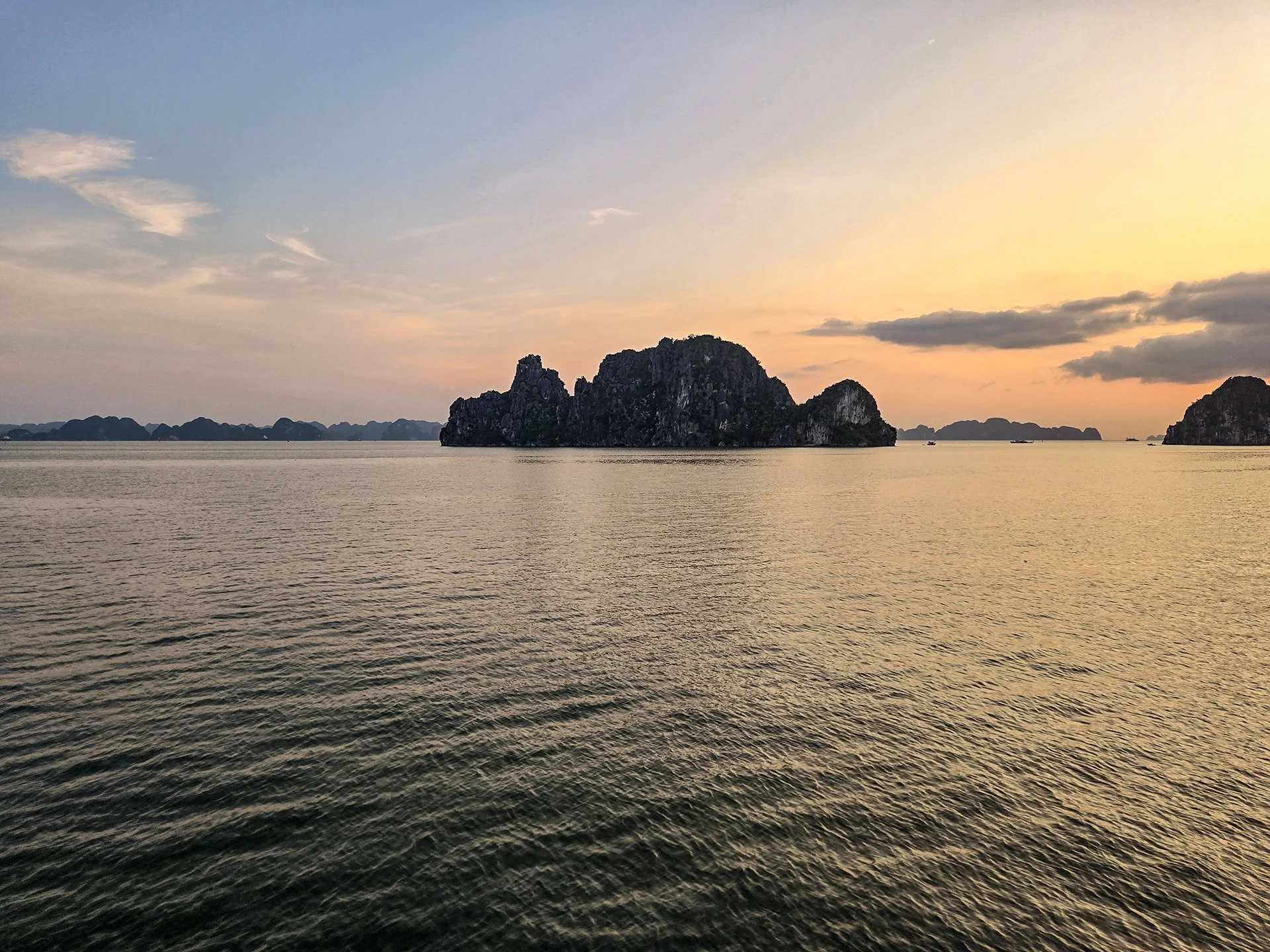
On our way back to the ship we had a nice sunset.
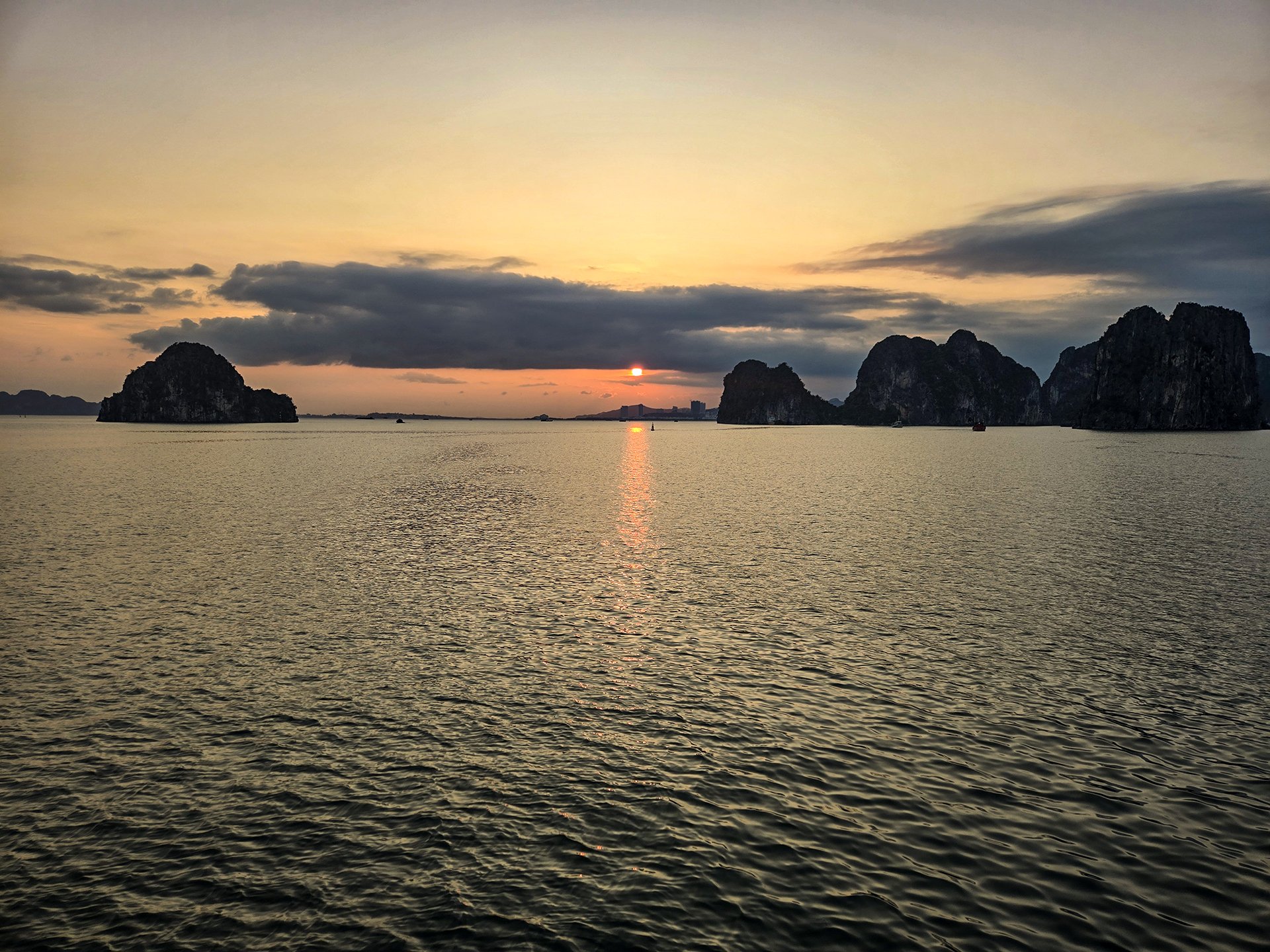
Sunset on Ha Long Bay.
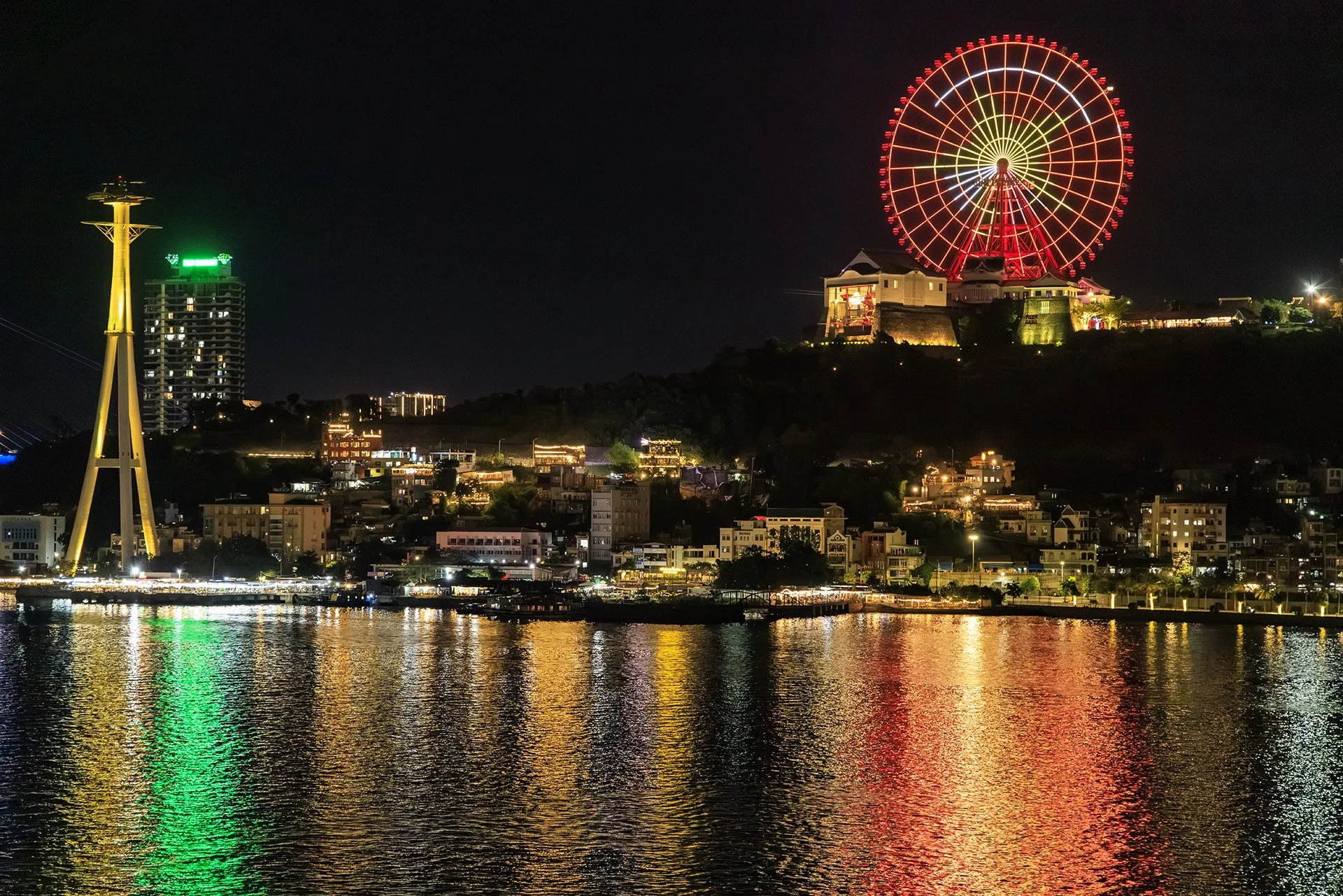
Ha Long Bay cityscape at night.
Ha Long Bay Day 2
We had a second day in Ha Long bay on which we took another bay cruise. This time our small bay tour boat took us up into the more remote part of the bay. This gave me an opportunity to photograph some of the most beautiful and unspoiled parts of the bay.
Although the conditions in terms of sky, clouds, etc. weren't great and, as always on this trip, I had to shoot hand held rather than being able to get long exposures on a tripod, these are still my favorite landscape photographs from the trip.
Ha Long bay is truly one of the most beautiful places on the planet (if you can get away from the commercial shipping zones).
After the tour we returned to the ship and set sail for Hong Kong after the sun set. As we left the bay we dodged a flotilla of shrimping boats that were all lit up like UFOs.
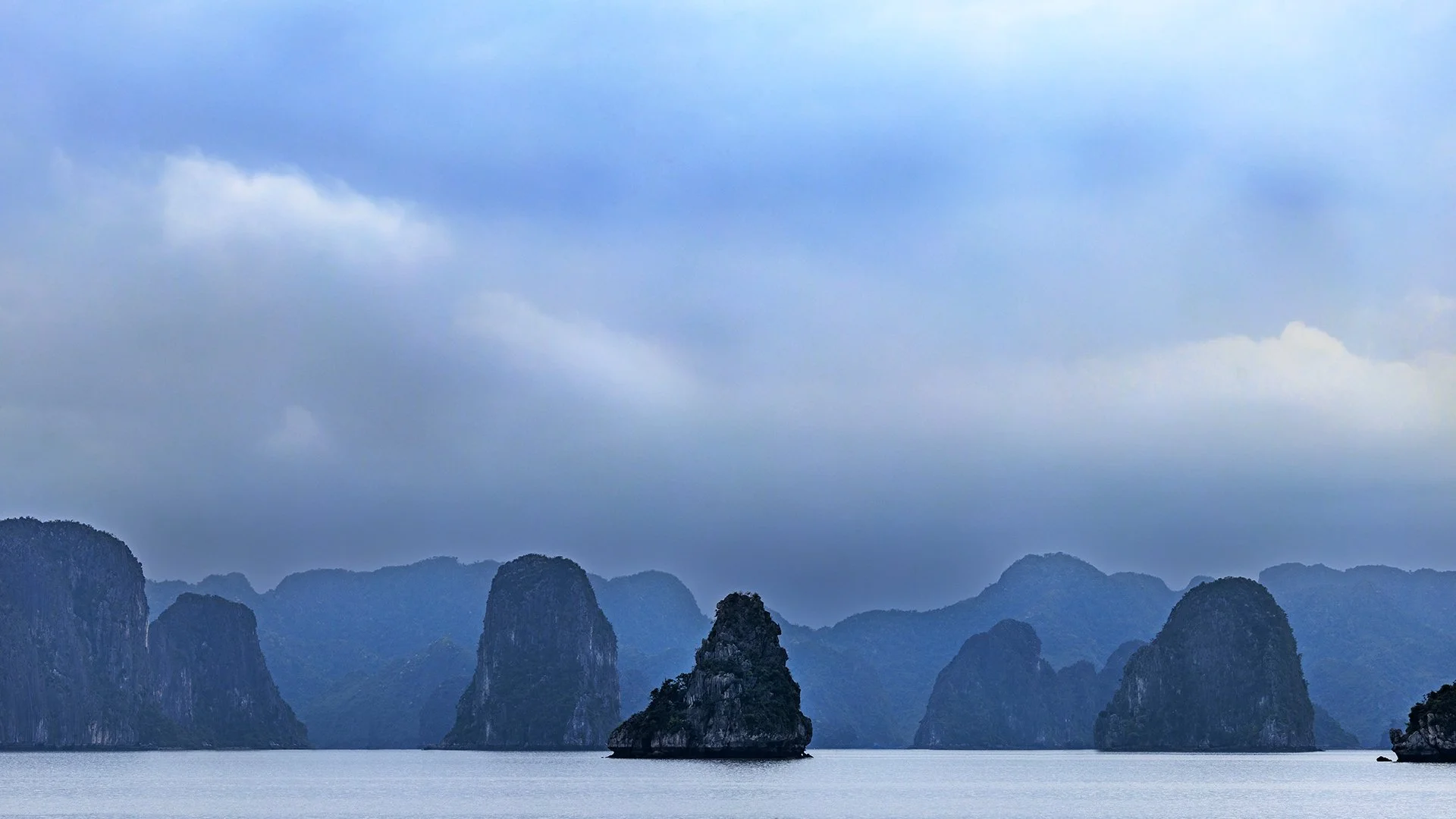
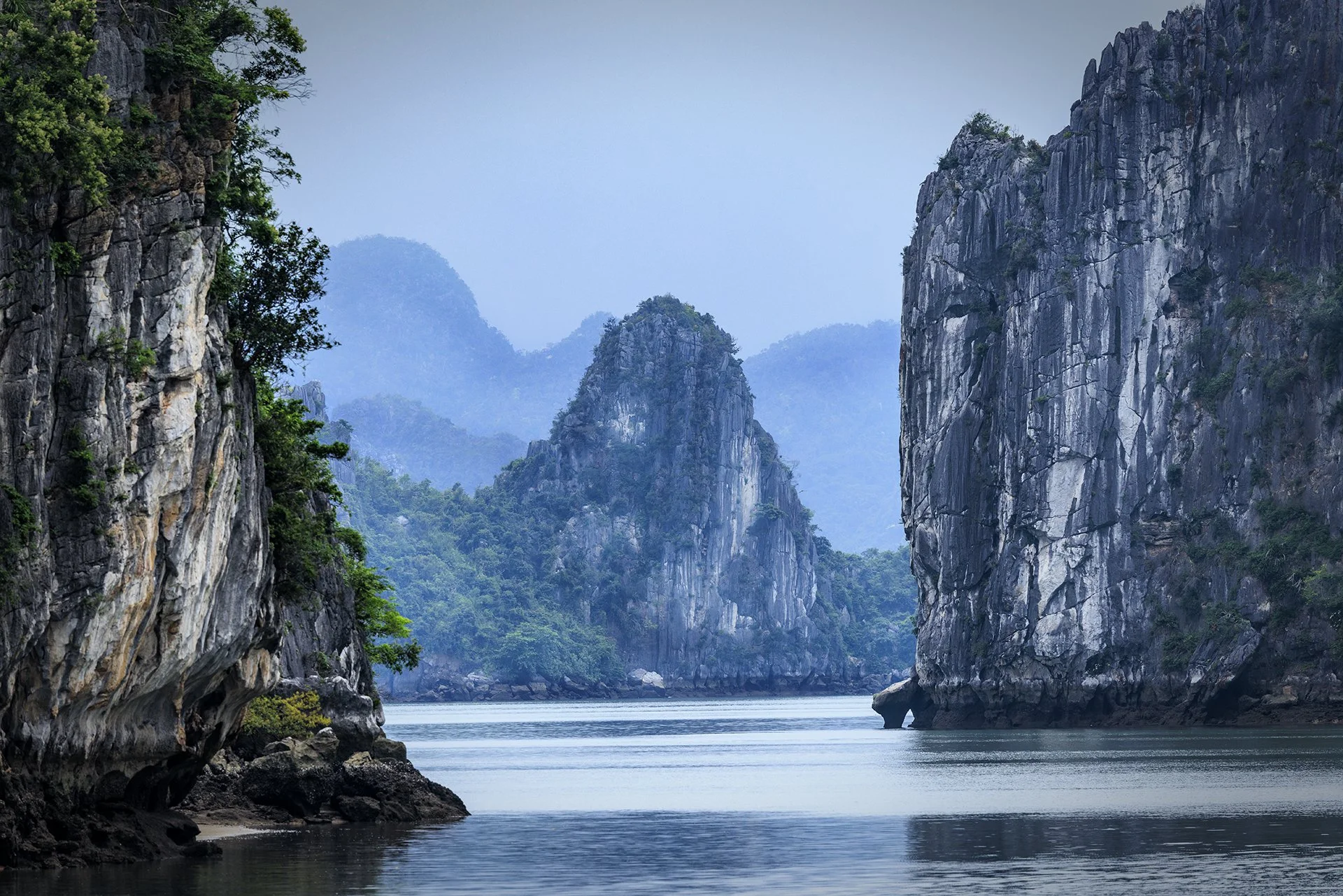
Winding through the maze of karsts.
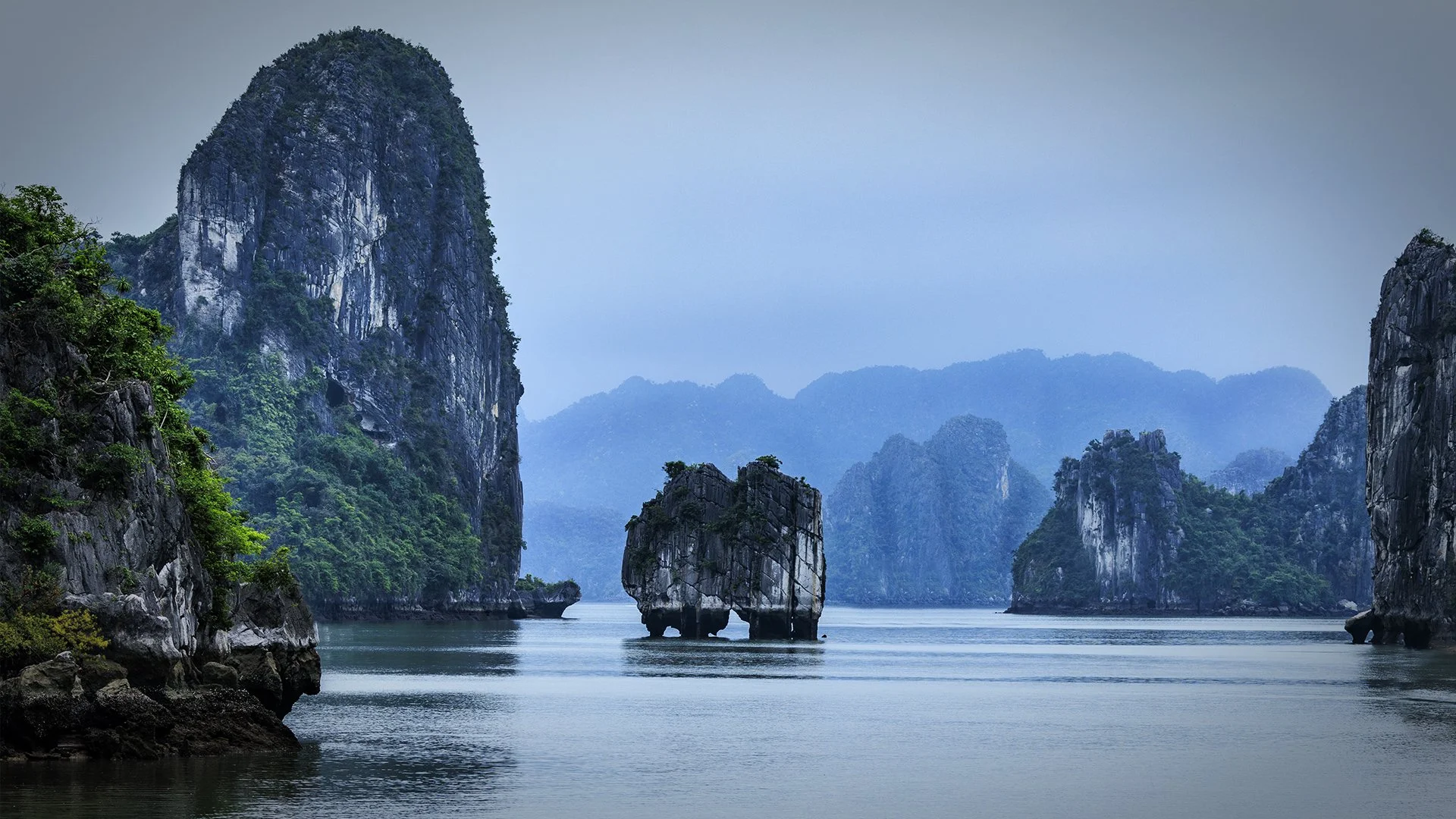
More winding through the karsts.
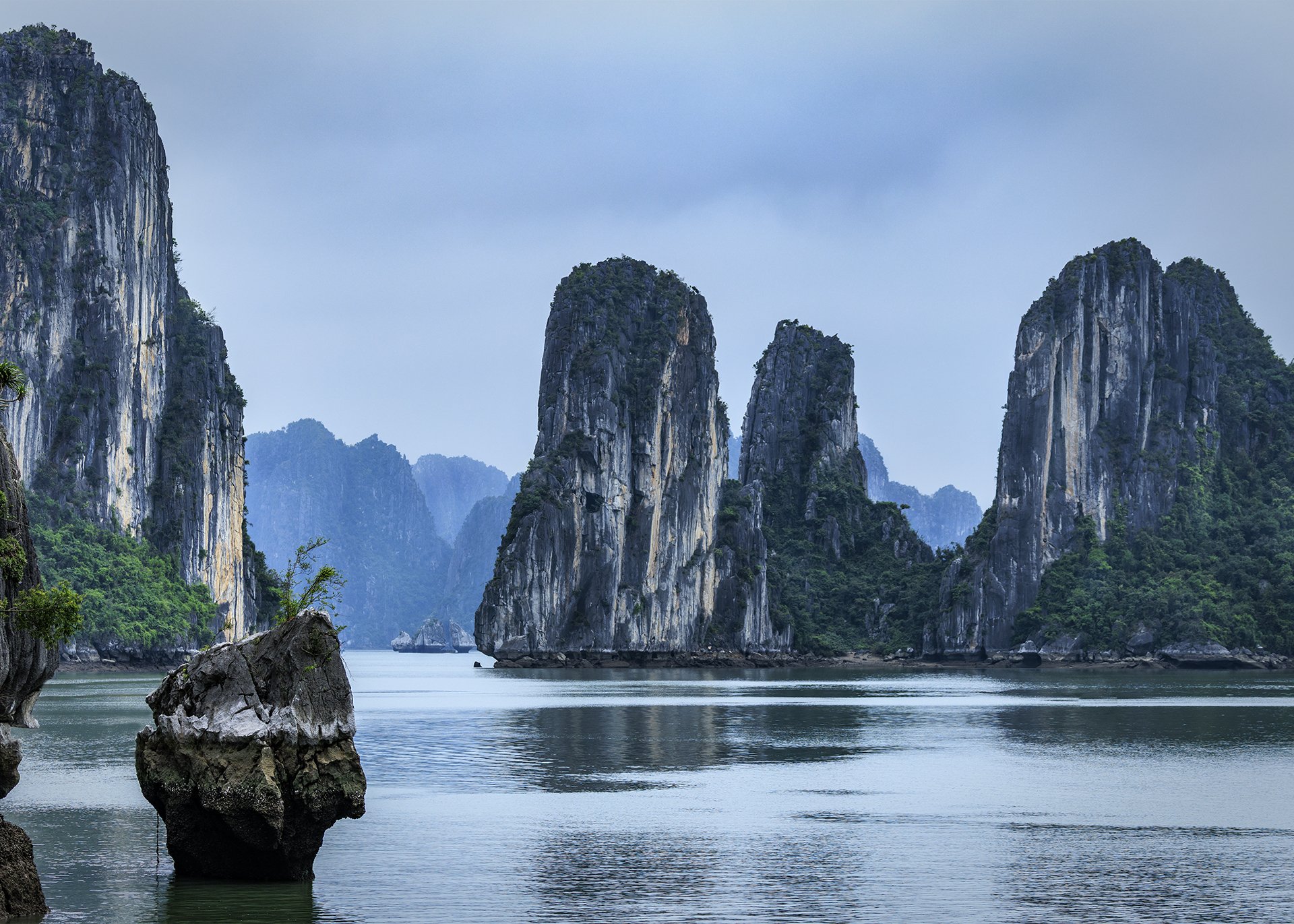
Every turn opened up to another beautiful view.
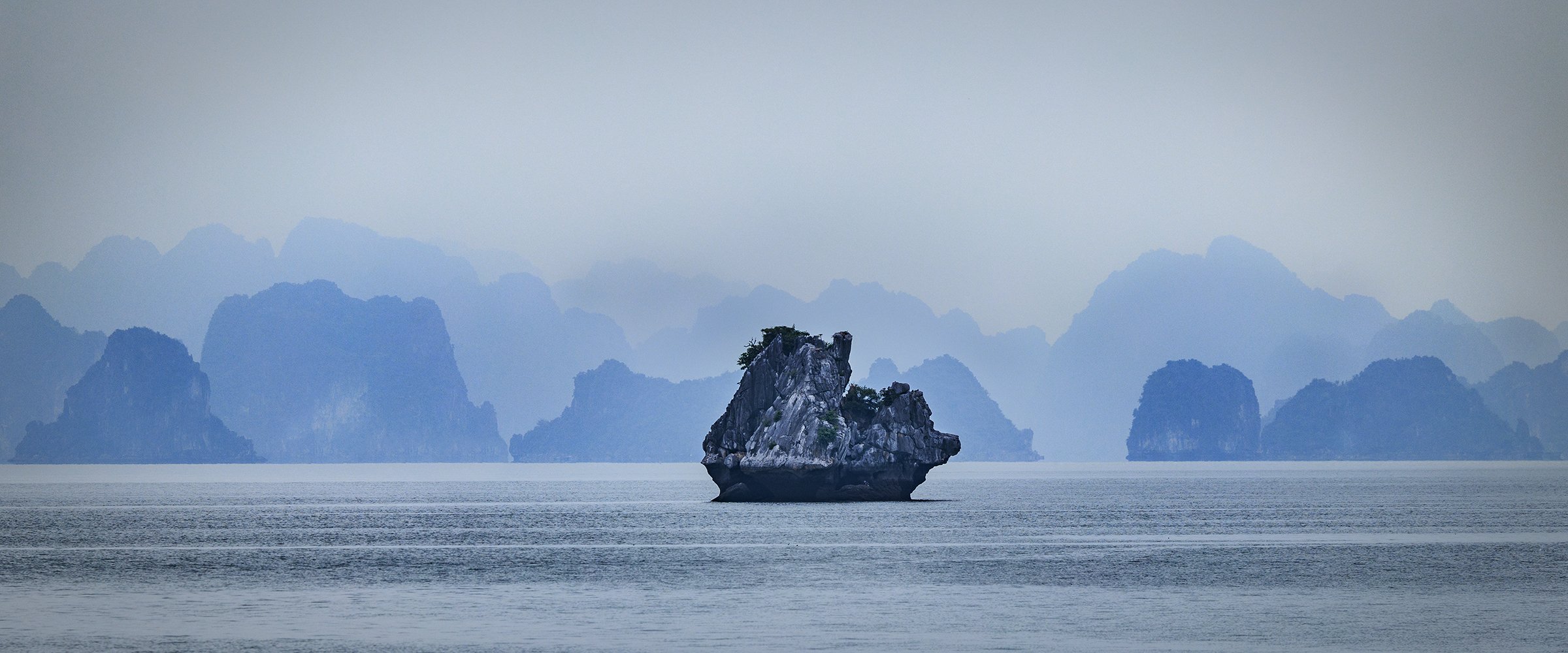
I think this one is my favorite from the Ha Long Bay images. This panoramic was hand photographed and stitched together from, I think, seven images.
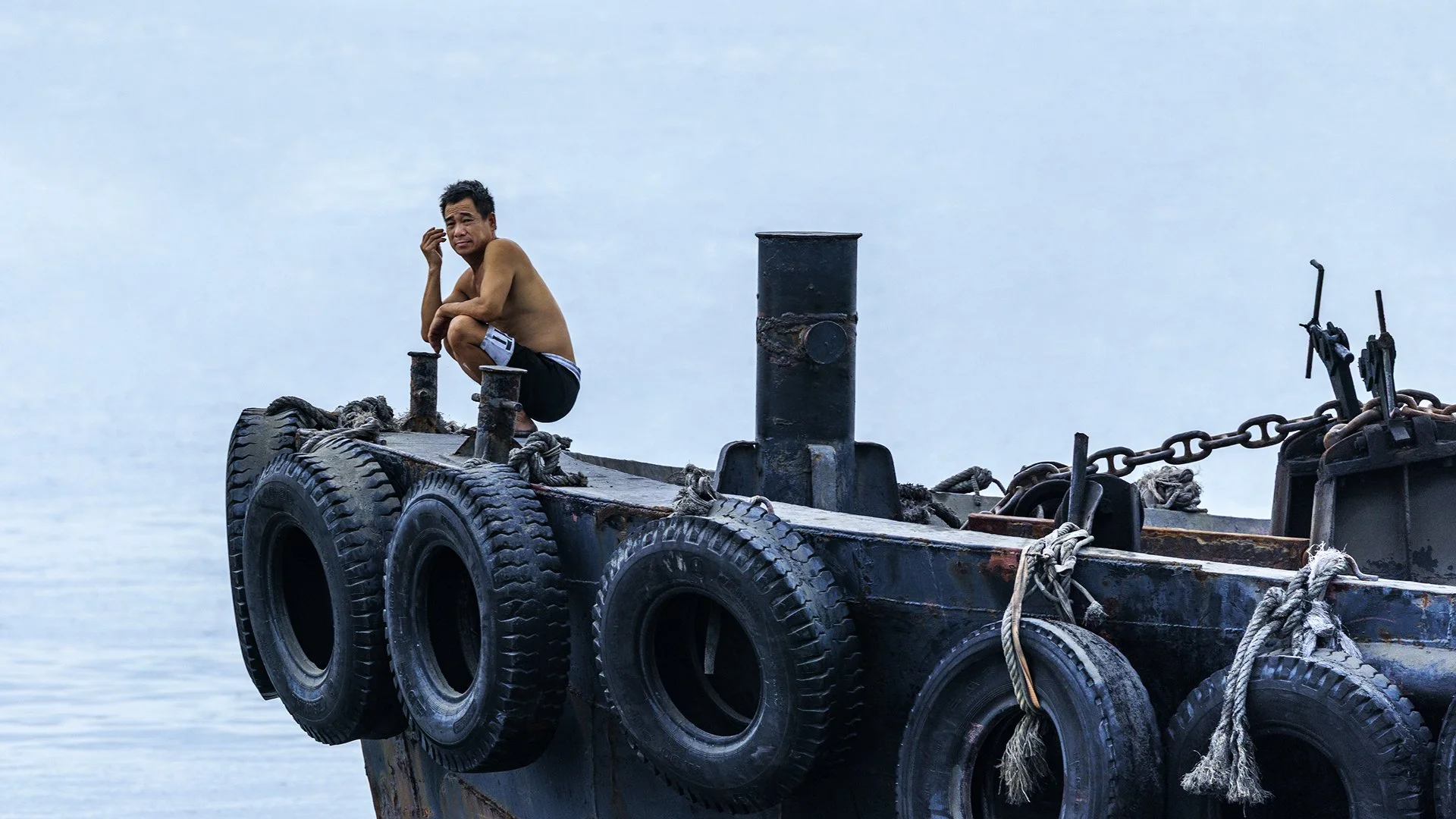
I like everything about this "street" photograph. The composition, texture, negative space all contribute placing the subject in his environment. His connection with me via looking directly at me and the camera makes the image. BTW he waved at me right after I snapped this photo. I didn't shoot that because I was waving back at him. Everyone on the bay was very friendly toward the tourist boats with frequent waves and smiles.
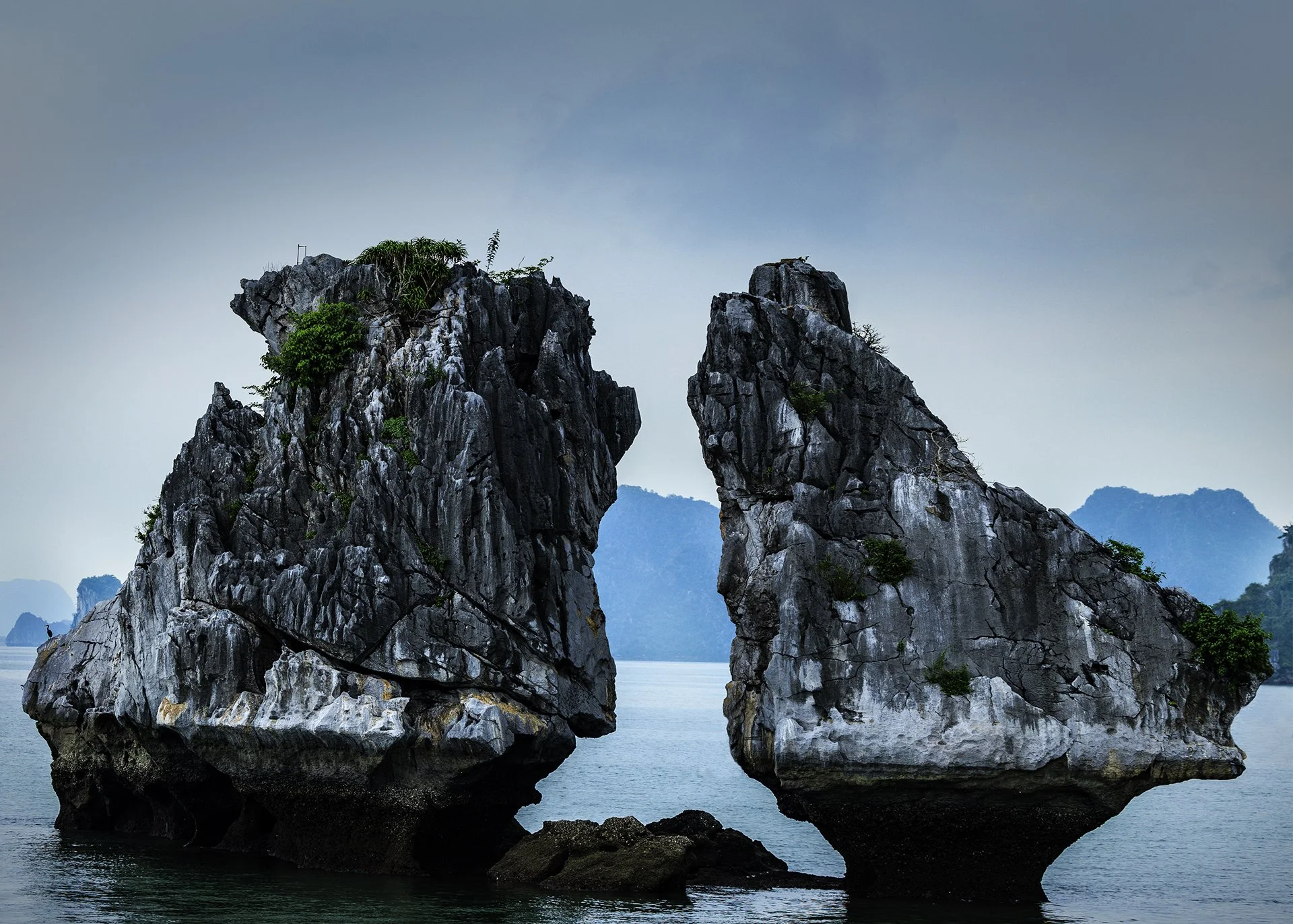
This is “Kissing Chicken Rock” and it’s the iconic symbol of Ha Long Bay. I was limited in what angle I could shoot it at but this image is OK. The boat captain did a good job of getting us close from a decent angle. Of course there were other boats all around so I was happy to get one shot where I could crop out the other boats even if it wasn’t a perfect spot.
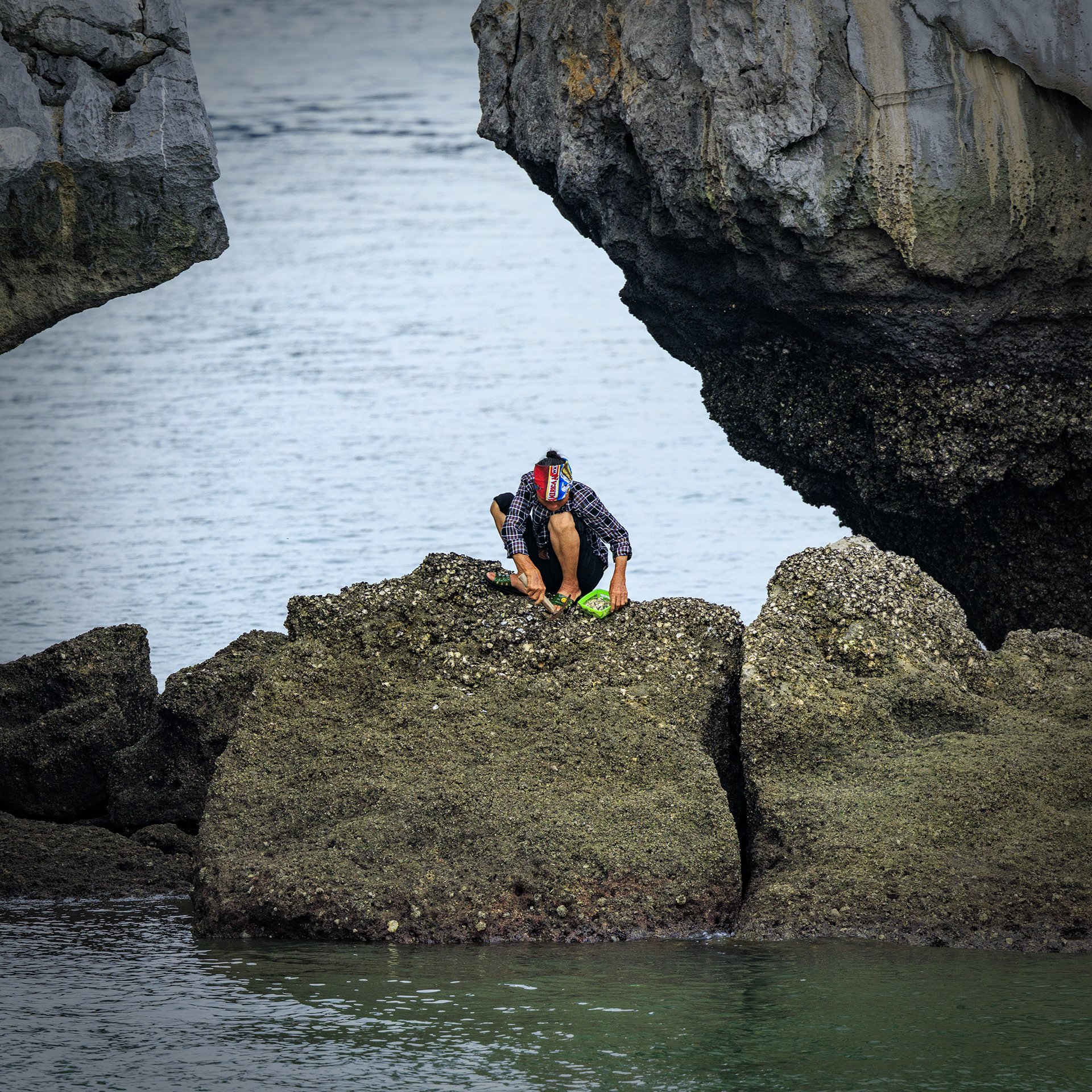
Gathering clams.
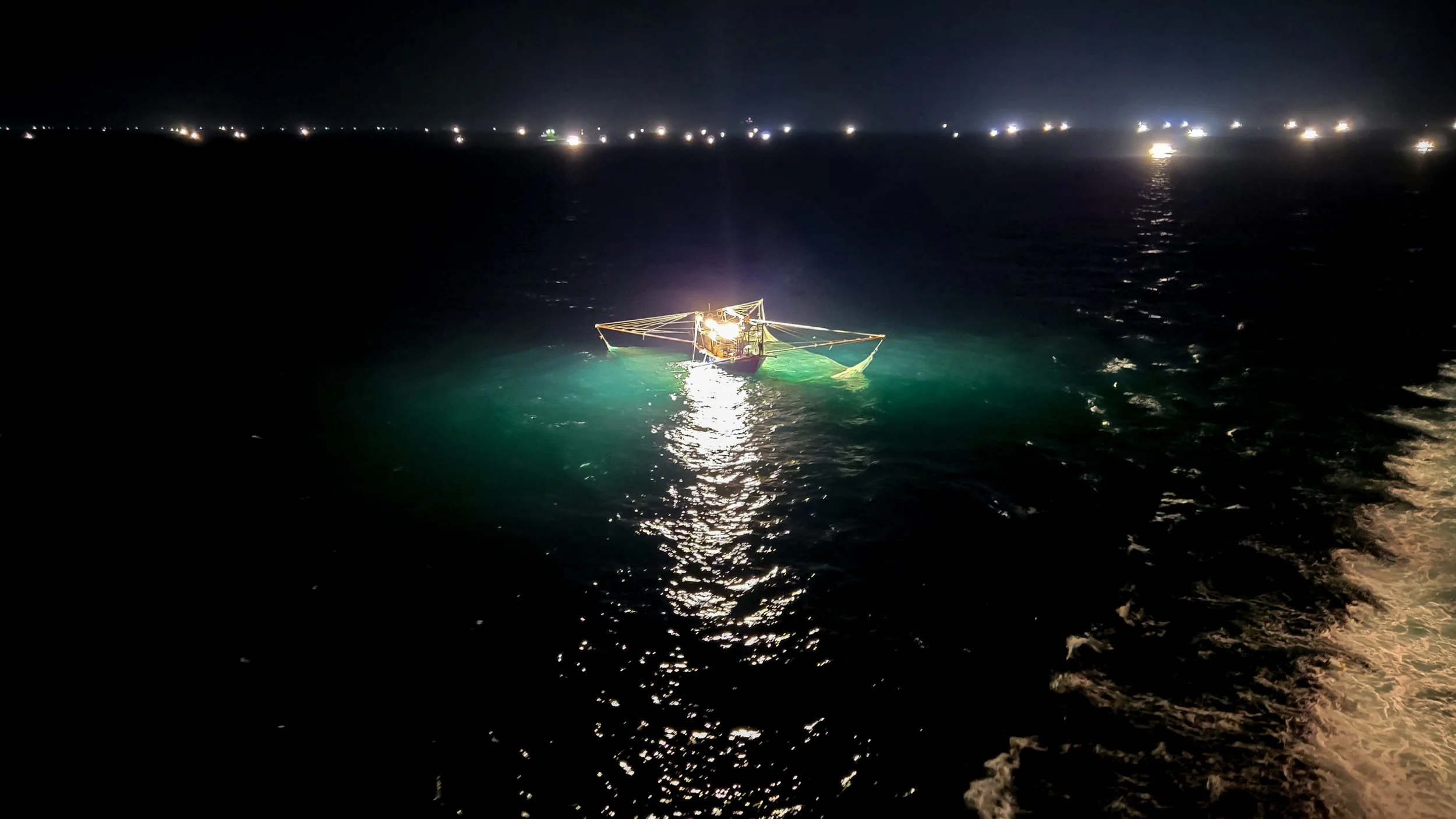
Shrimp boat at night on Ha Long Bay as we sailed away. I presume the lights attract the shrimp. I shot this with my cell phone.
I thought a lot about what we had seen in Vietnam and what we had learned from talking with the local people and seeing how they lived. Vietnam really challenged what I thought I knew about Vietnam.
Vietnam is a Communist country. It’s really one of only maybe two real Communist countries left in the world with Cuba being the other (China is arguably an authoritarian dictatorship and North Korea is clearly a hereditary authoritarian dictatorship).
The “American War” as they call it there still overshadows the country. They actually really like Americans in Vietnam today, in spite of the constant propaganda about the war (or maybe it’s just history from a different perspective than ours rather than actual propaganda). But they understand, as I think many Americans do not, that we killed hundreds of thousands of people (tens of thousands of ours and many times that many of theirs) to “save” them from Communism. Obviously we failed.
What were we saving them from, though? Today Vietnam is a power house. Yes, it is a Communist government. They have elections but people only get to vote for the Communist party candidates. Even so, people there don’t feel like their government is oppressive or unresponsive to their needs. Actually much less so than we Americans feel towards our government.
The government is in partnership with an almost completely free capitalist economy that has maintained excellent growth for a generation since the American War. The only control the government exercises over the economy is to prevent the worst, most toxic aspects of unbridled capitalism. With a prosperous economy taxes are low enough not to be a drain on business but high enough to make sure that the government can provide for the people what they cannot provide for themselves (or do so well for themselves).
As a result, this is a country where people feel free, where they have virtually free universal health care, where no one is unemployed or homeless and everyone has access to an excellent public education and very attainable and affordable higher education.
Saigon (Ho Chi Minh City) rivals New York, Tokyo, or London in growth, vitality and prosperity. Vietnam could grow even faster than it does but they refuse to borrow money from the Chinese or allow them to build developments in the country (as Cambodia does for example).
After visiting Vietnam, and the other Asian countries, it feels like the American Century is over. These countries are providing for their people what they can’t provide for themselves individually, protecting liberties and creating the opportunity for advancement that it seems the American dream promised us but no longer can provide.
I wouldn’t necessarily want to live under their systems. They are fundamentally different from us culturally but their systems work for them. It was folly to try to impose our system or one like it on these people and it remains folly to continue to do it today.
We should learn from these countries and use that knowledge to solve our problems before it’s too late.
Sailing the South China Sea
After leaving Ha Long Bay we had a day at sea on the way to Hong Kong. I thought I’d share a few cell phone photos to give an idea of what a sea day is like for us. Usually there is little more relaxing way to spend a day than at sea.
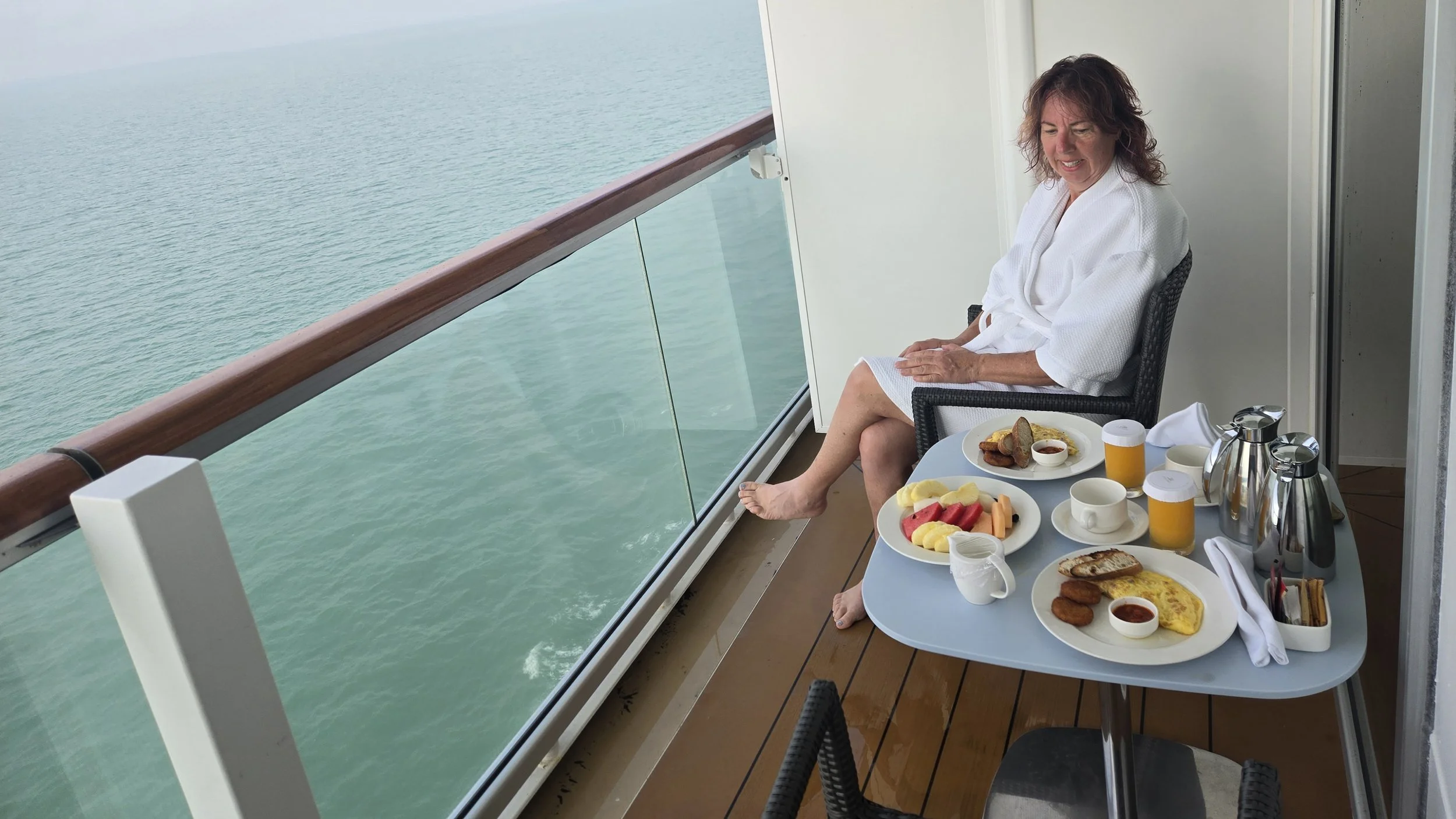
A sea day usually starts with sleeping in followed by a room service breakfast on the balcony. Viking provides complementary 24 hour room service and it’s really good.
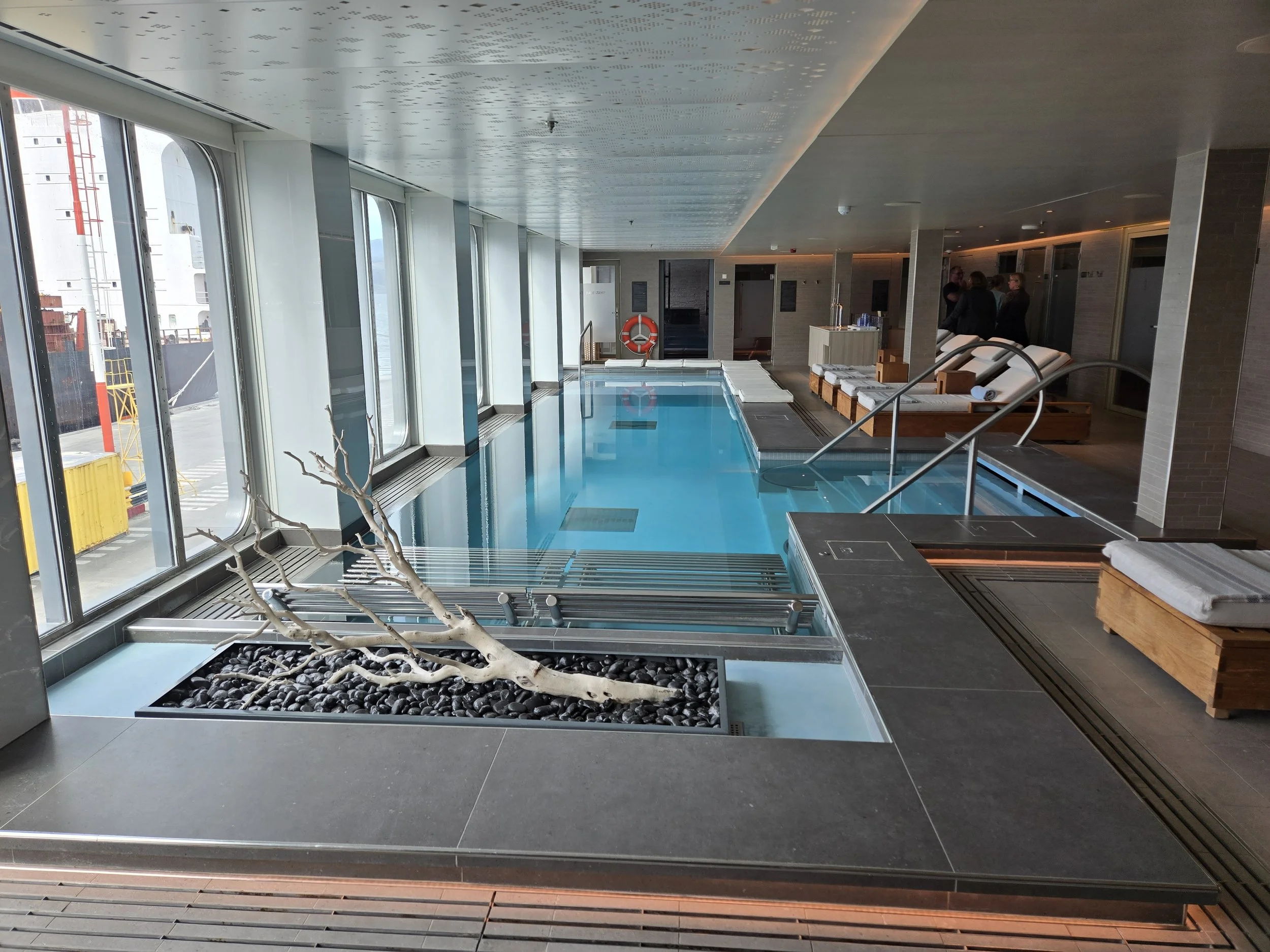
Followed by some time in the spa. This is actually from our expedition ship the previous trip — I never got a chance to take a photo of the spa on Orion when there wasn’t a person or two that would be in the photo. I didn’t want to invade their privacy so this image will give you an idea. The spa on Orion was very similar except that it was a little larger and didn’t have outside windows.
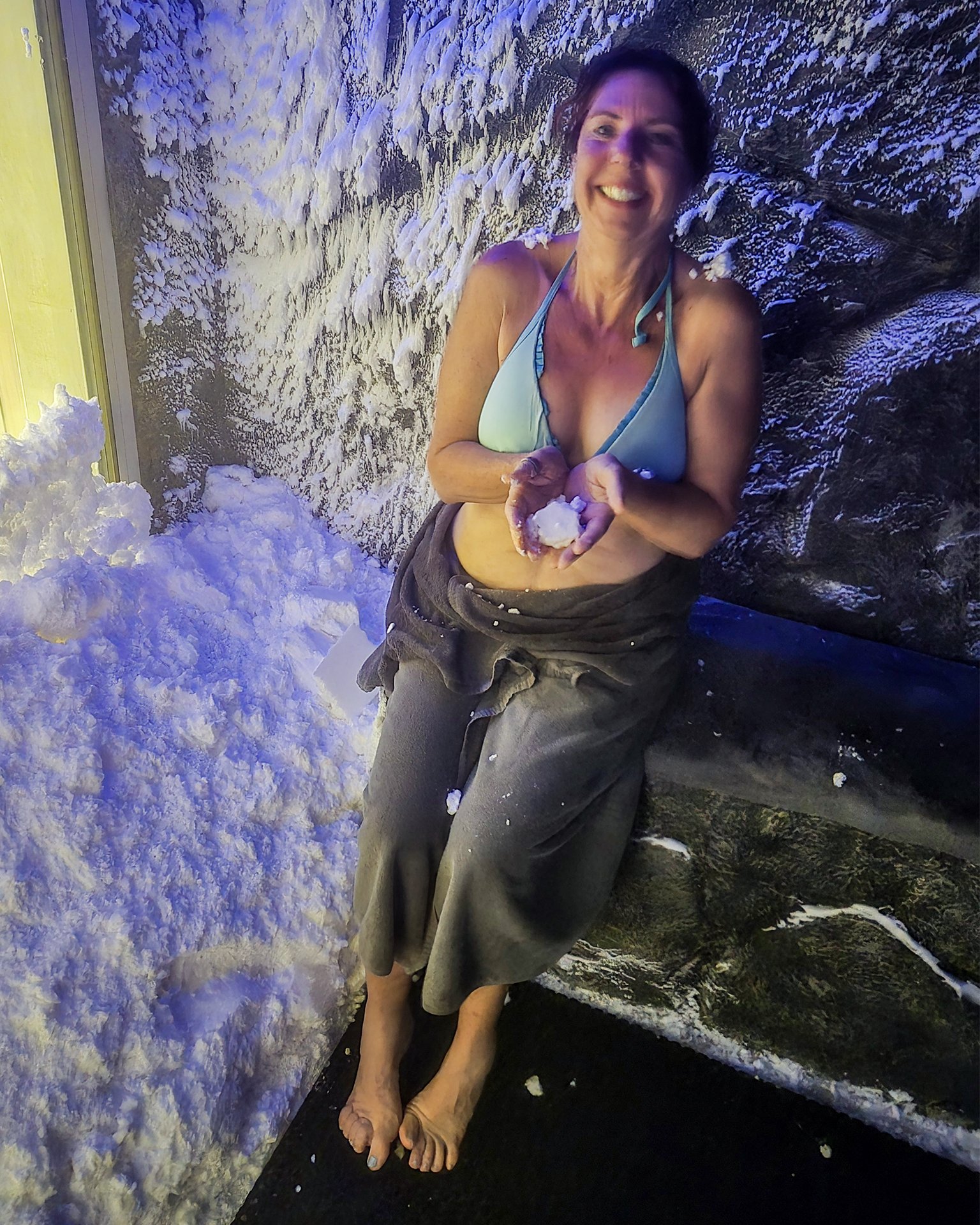
I did take the opportunity to photograph Marla in the snow room in the spa. It’s really full of snow. That probably seems normal to the Norwegian president of Viking Cruise Lines.
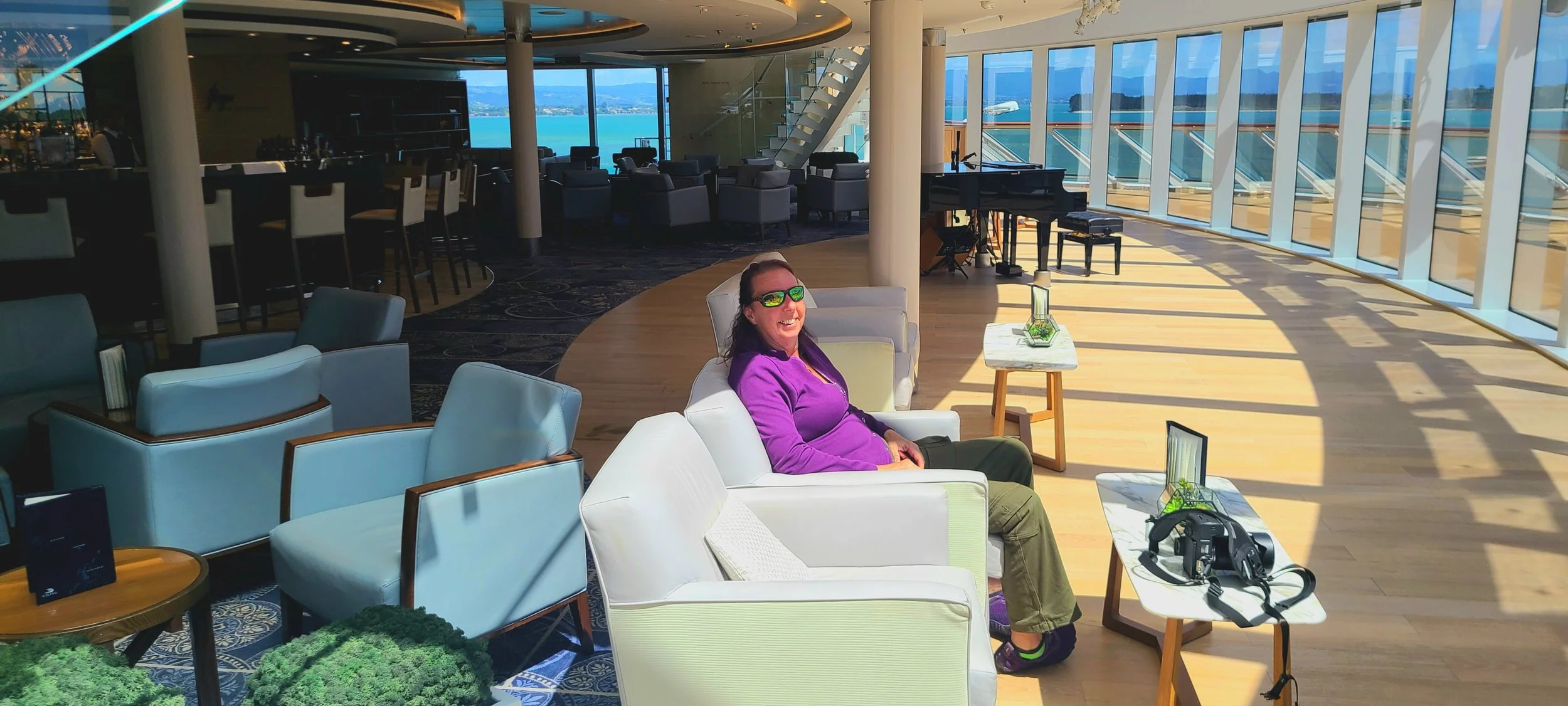
Then maybe some quiet time and a cocktail in the explorer’s lounge as the ocean goes by.
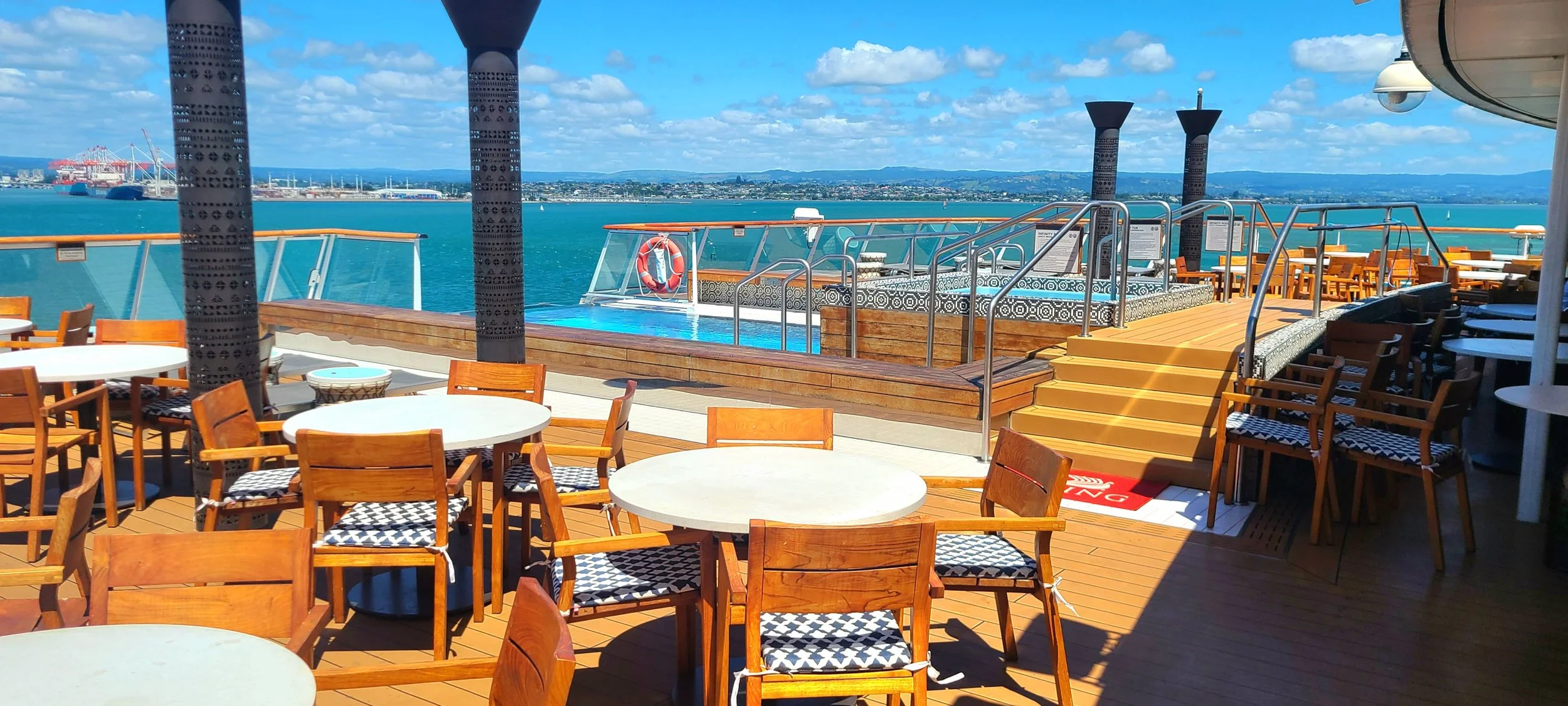
A light lunch on the terrace.
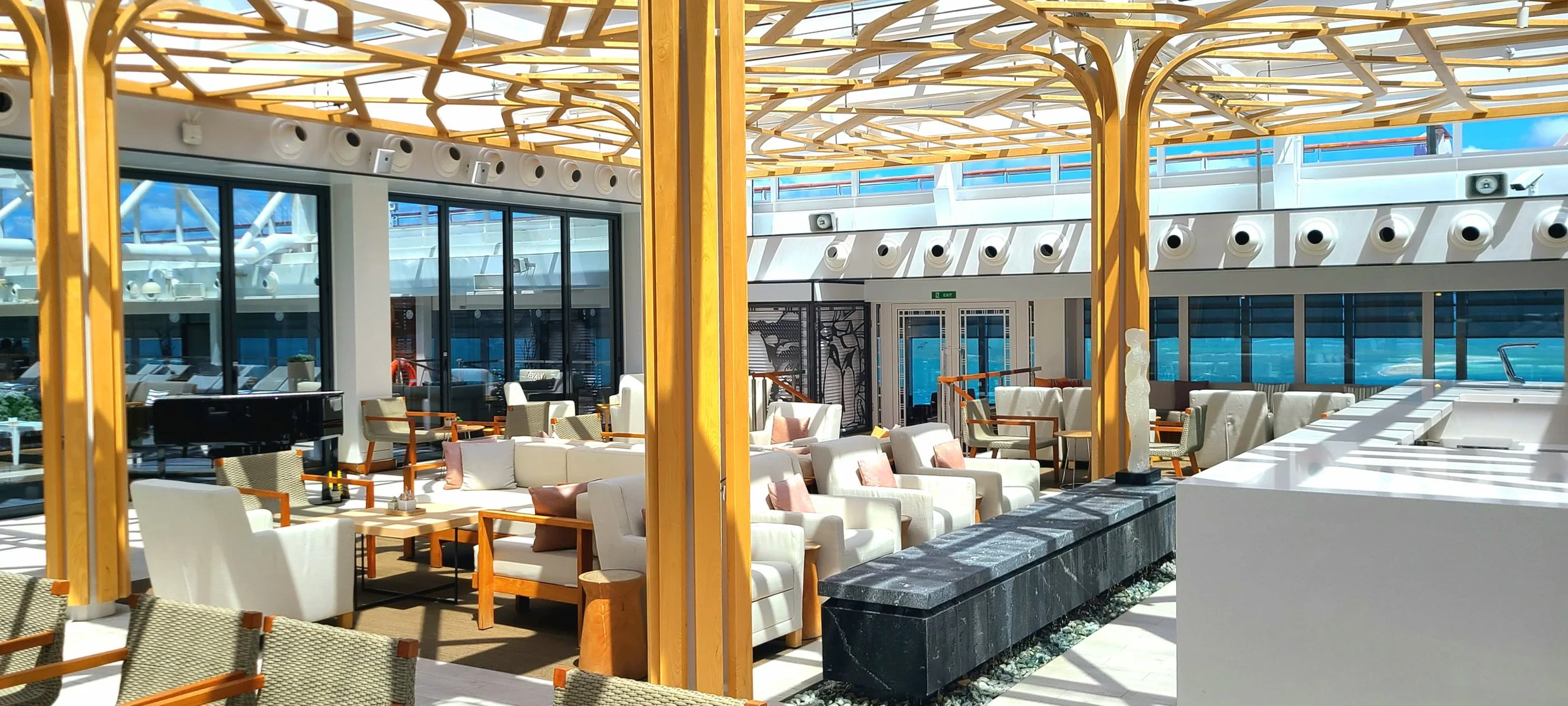
Tea is served at 4pm in the Winter Garden terrace. Again I didn’t photograph the event so as to not invade anyone’s privacy. The tea service is complementary and outstanding with a varied selection of small treats and a huge selections of tea all served at your seat while a string combo plays classical music. It’s feels so damn British.
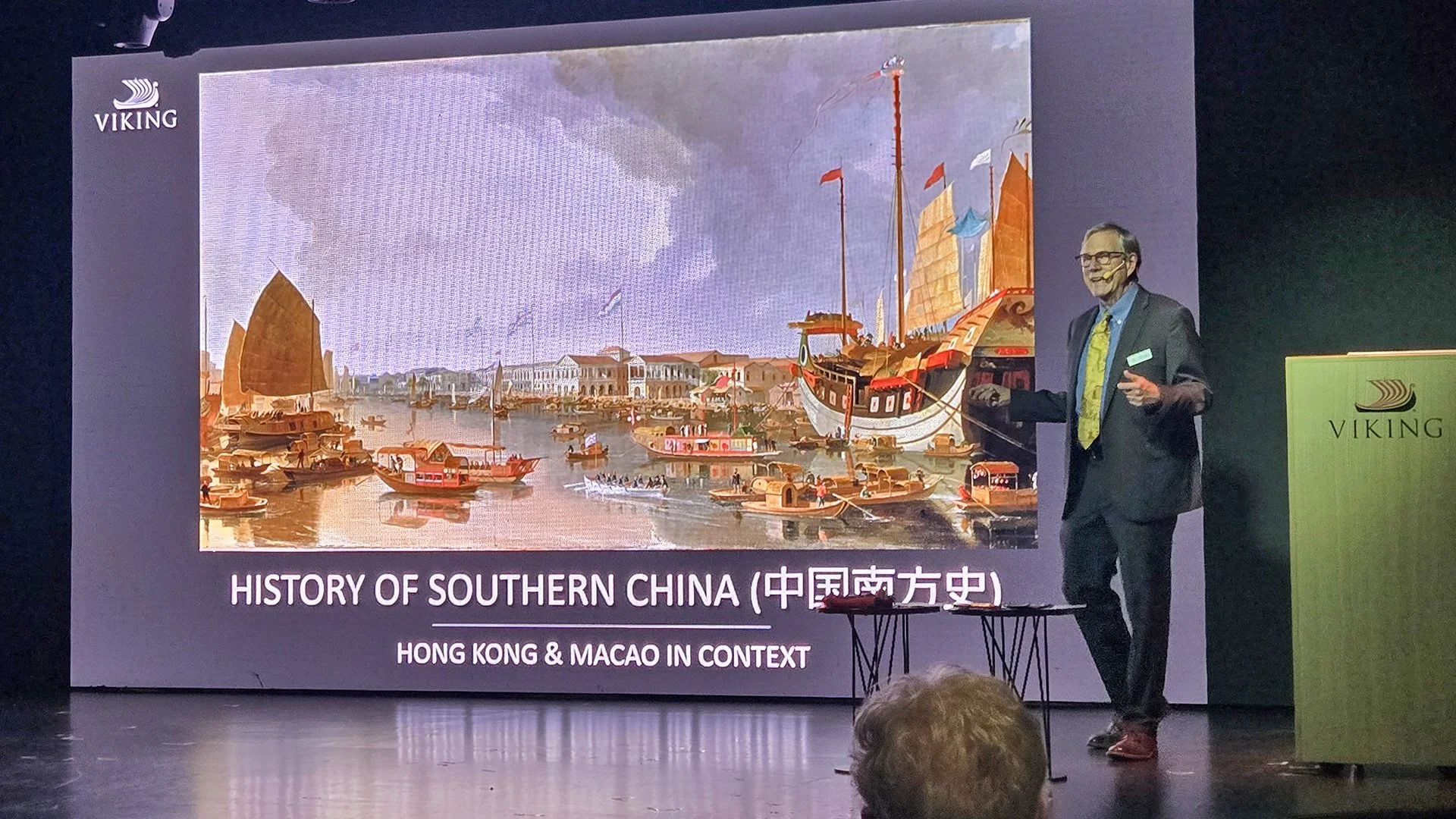
Next, an enrichment lecture from the on board historian. I think Viking is the single largest employer of semi-retired college professors. Seriously, the on board enrichment lecturers are always very entertaining and informative.
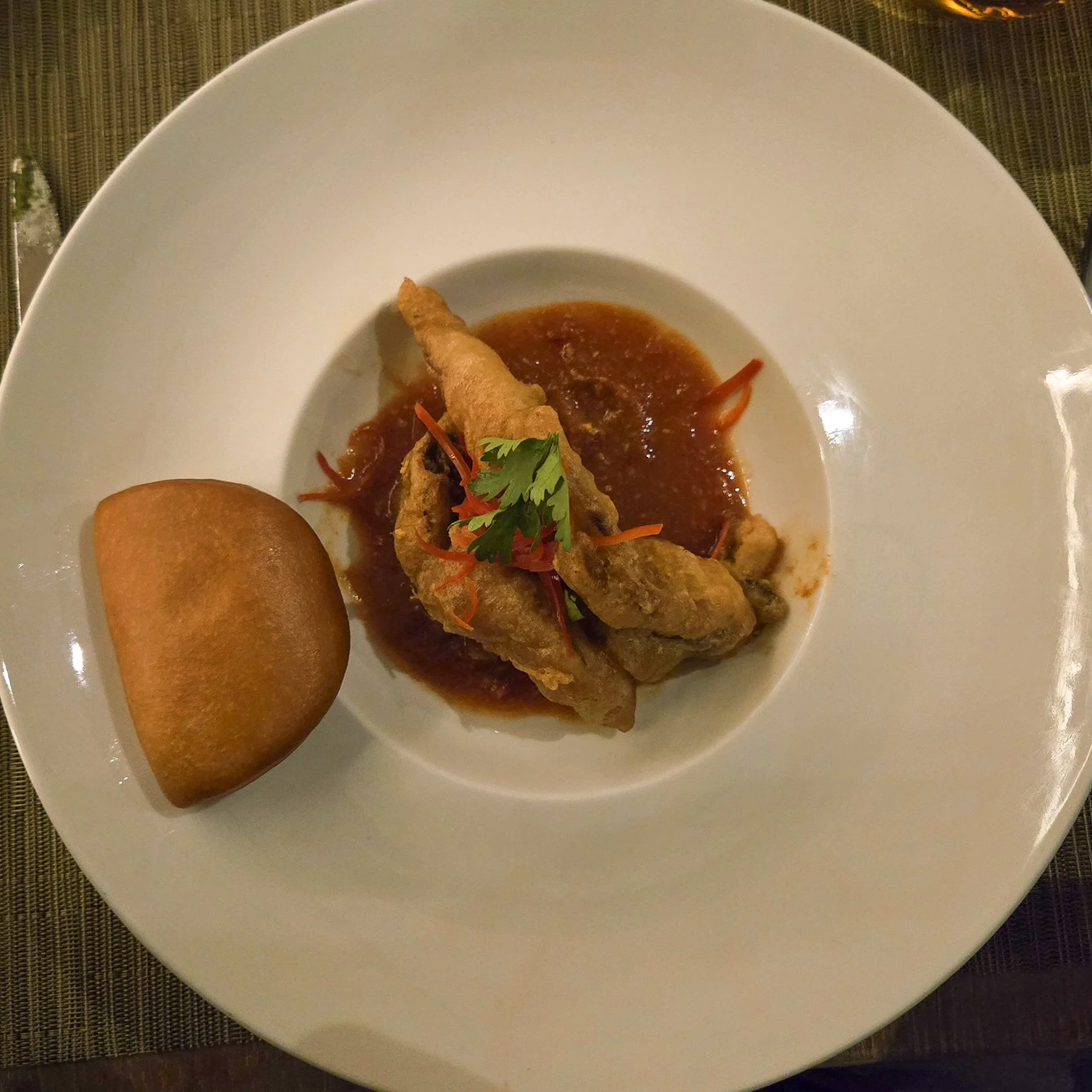
After being fully enriched we moved on to dinner at The Chef’s Table, one of the specialty restaurants on board. This was my first course. It think I forgot to photograph the next two courses.
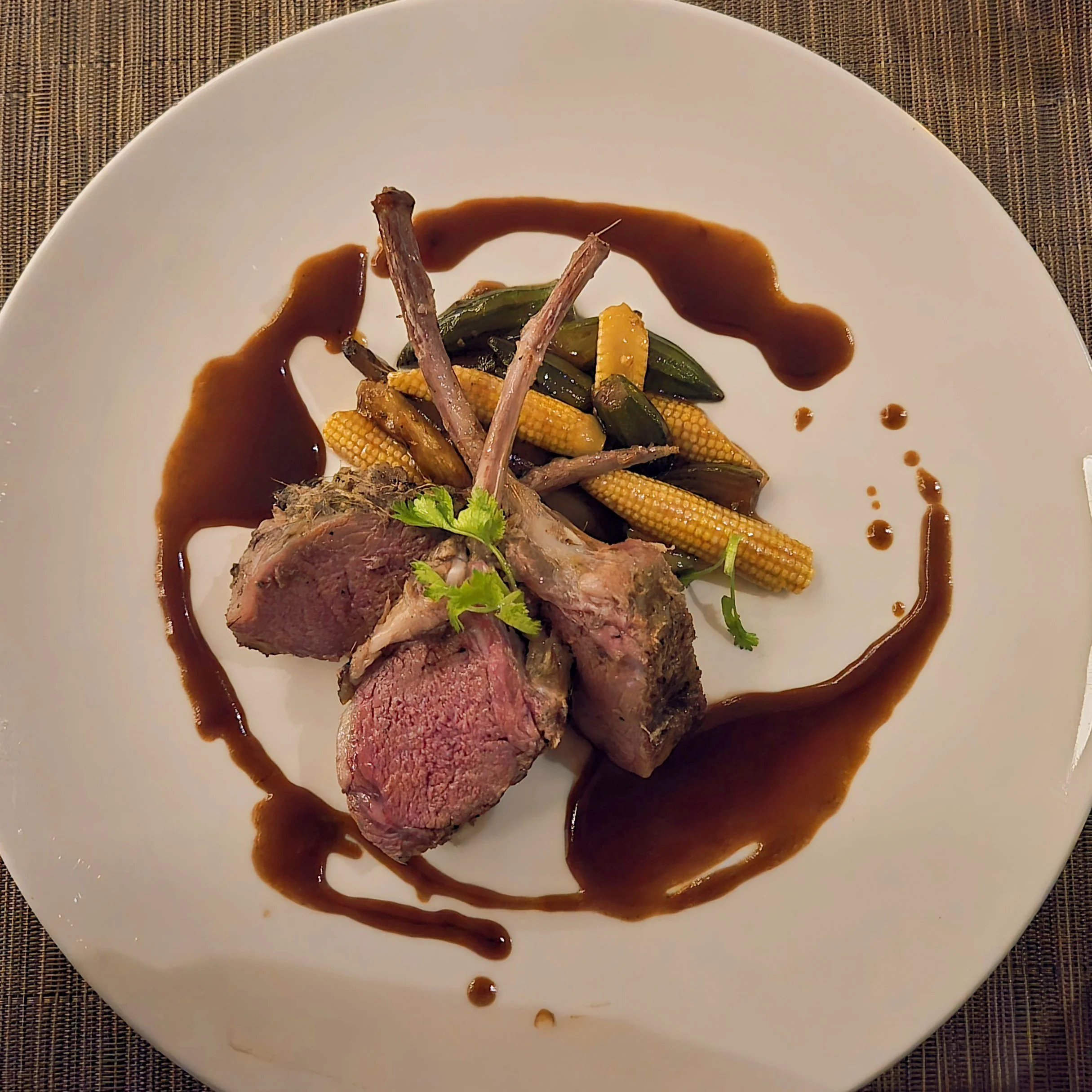
My main course.
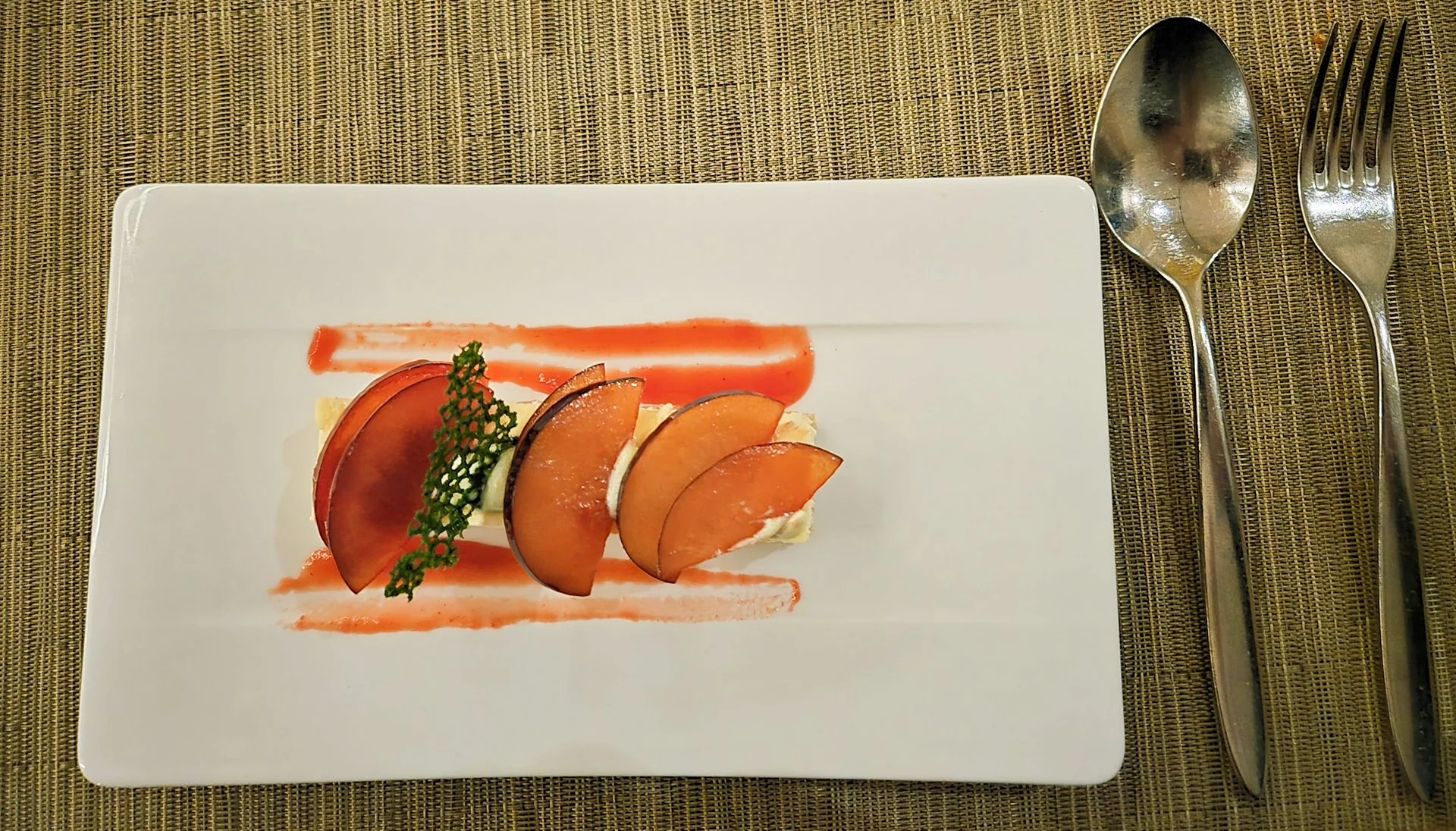
My dessert.
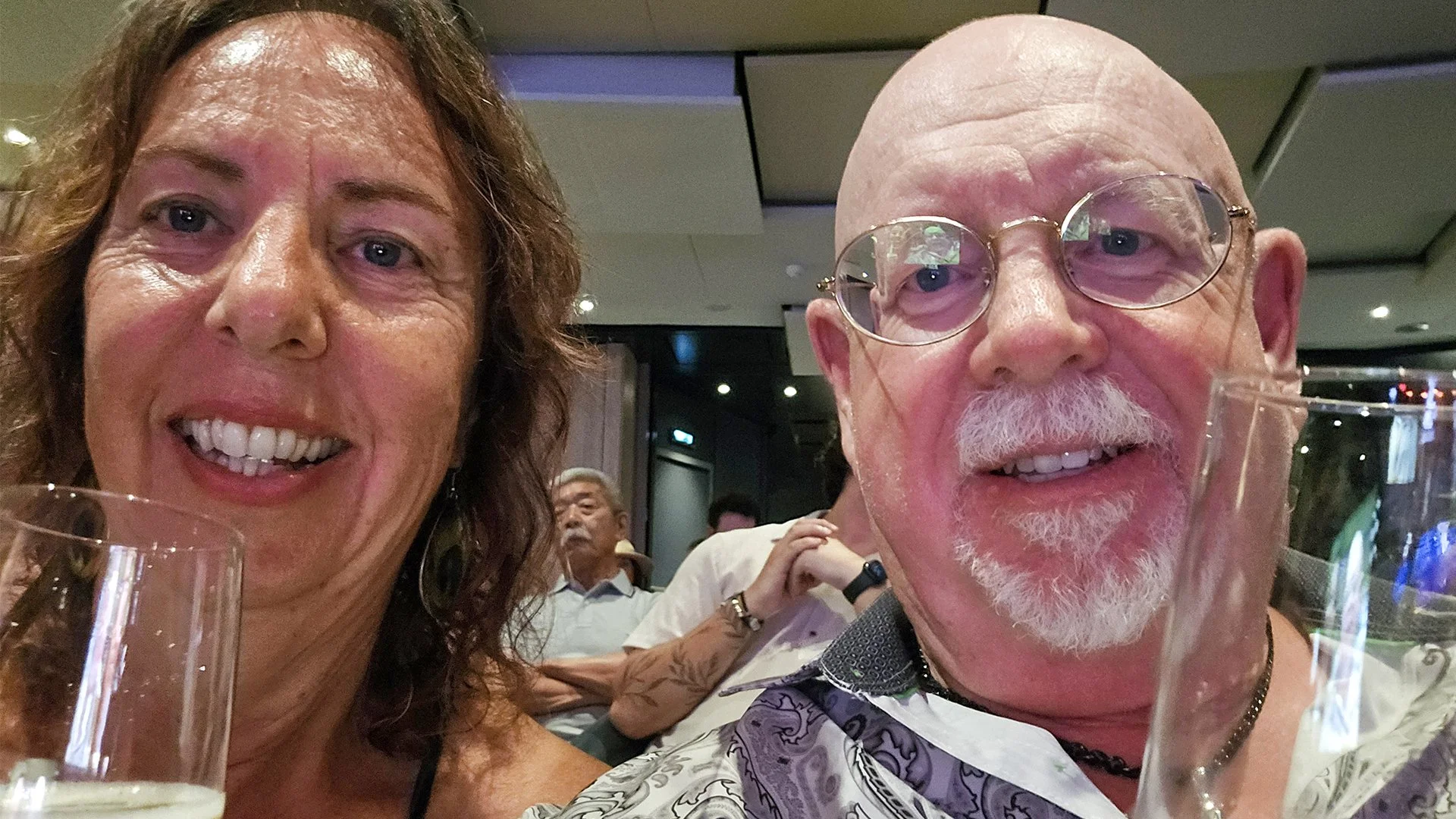
Then back to the theater where champagne cocktails were waiting for us (they even had a non-alcoholic version for me).
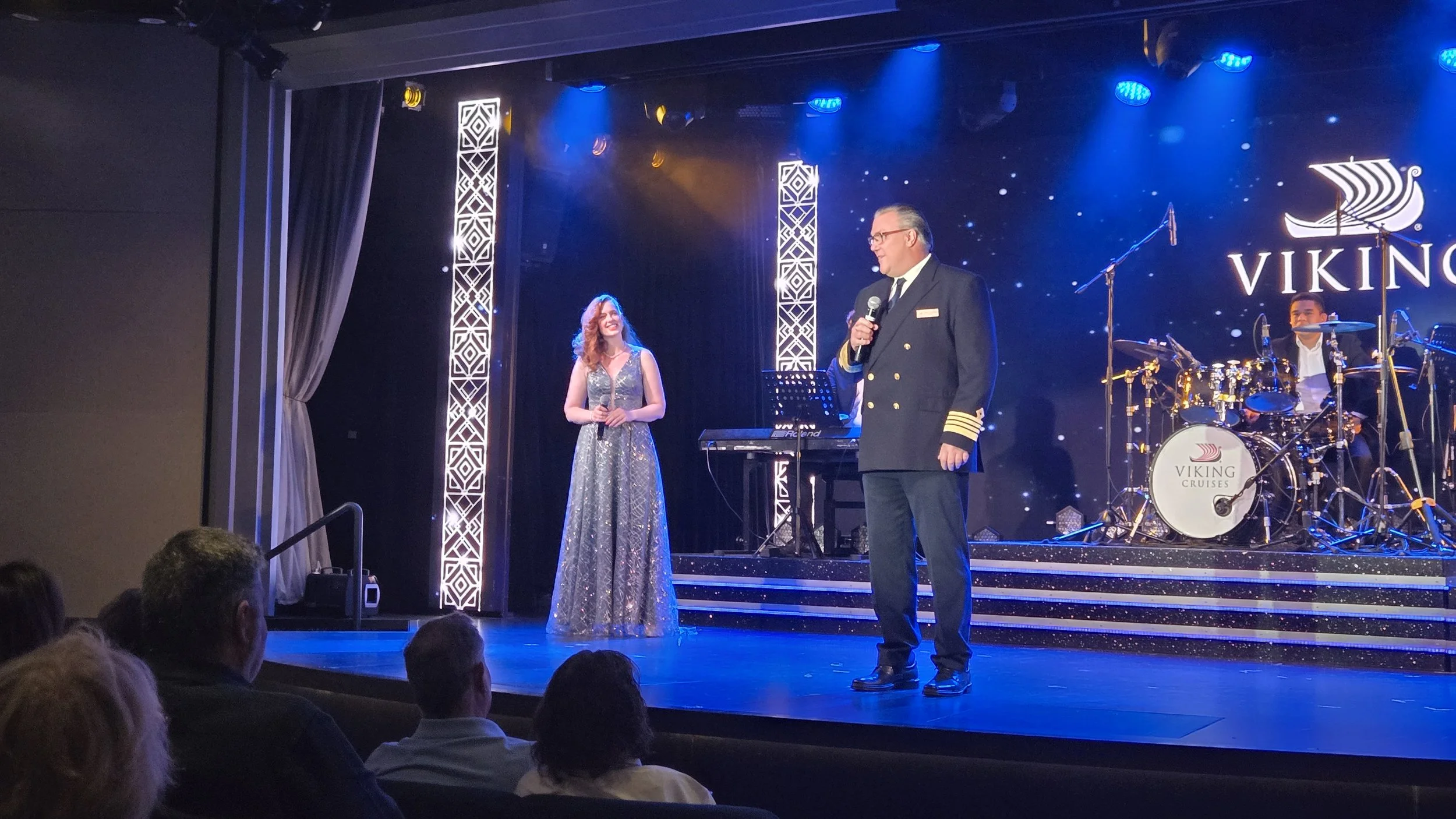
As this was the last sea day the traditional crew appreciation event was first starting with an entertaining talk from the captain.
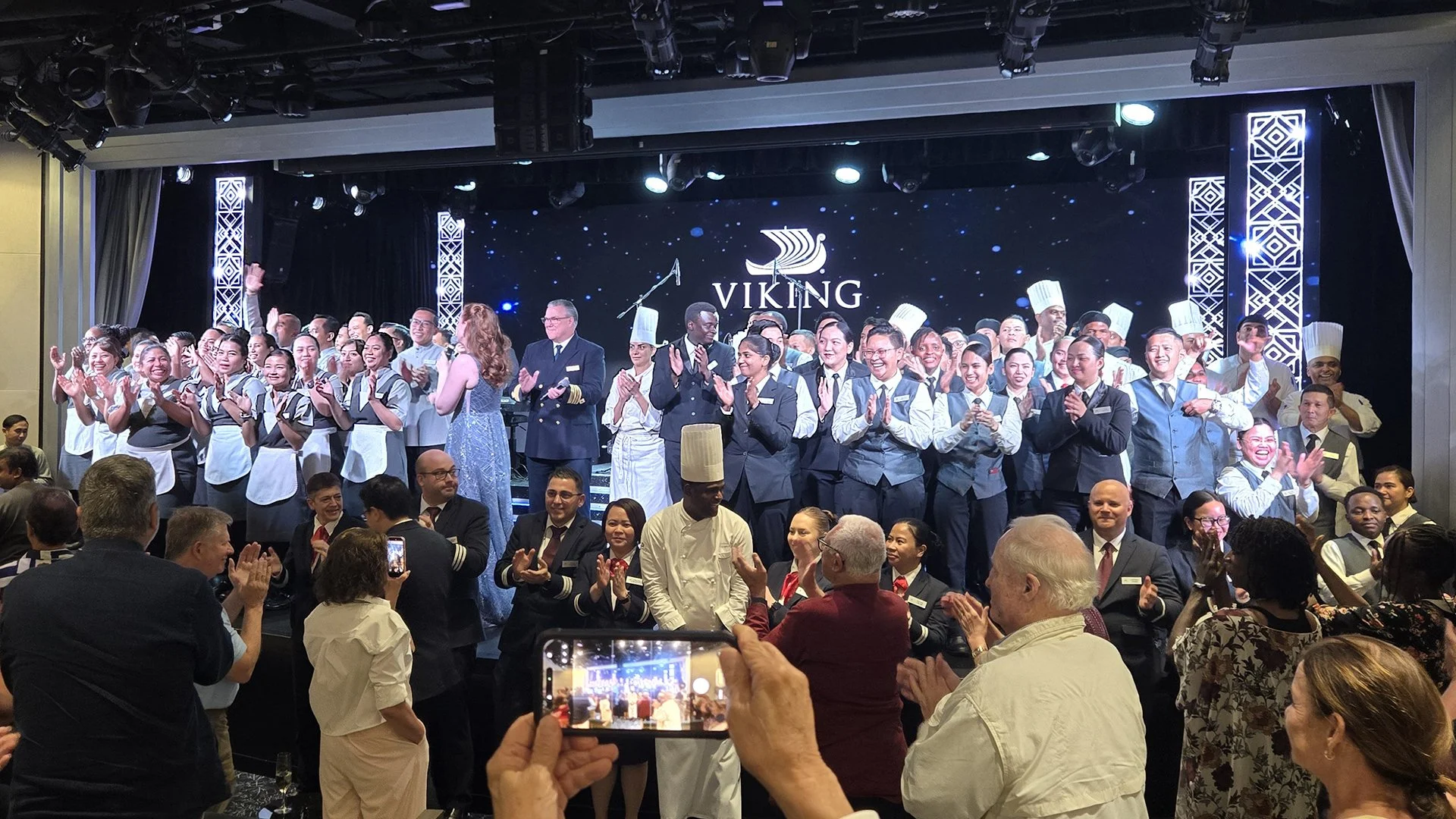
The crews on Viking really are outstanding and fully deserve the standing ovation.
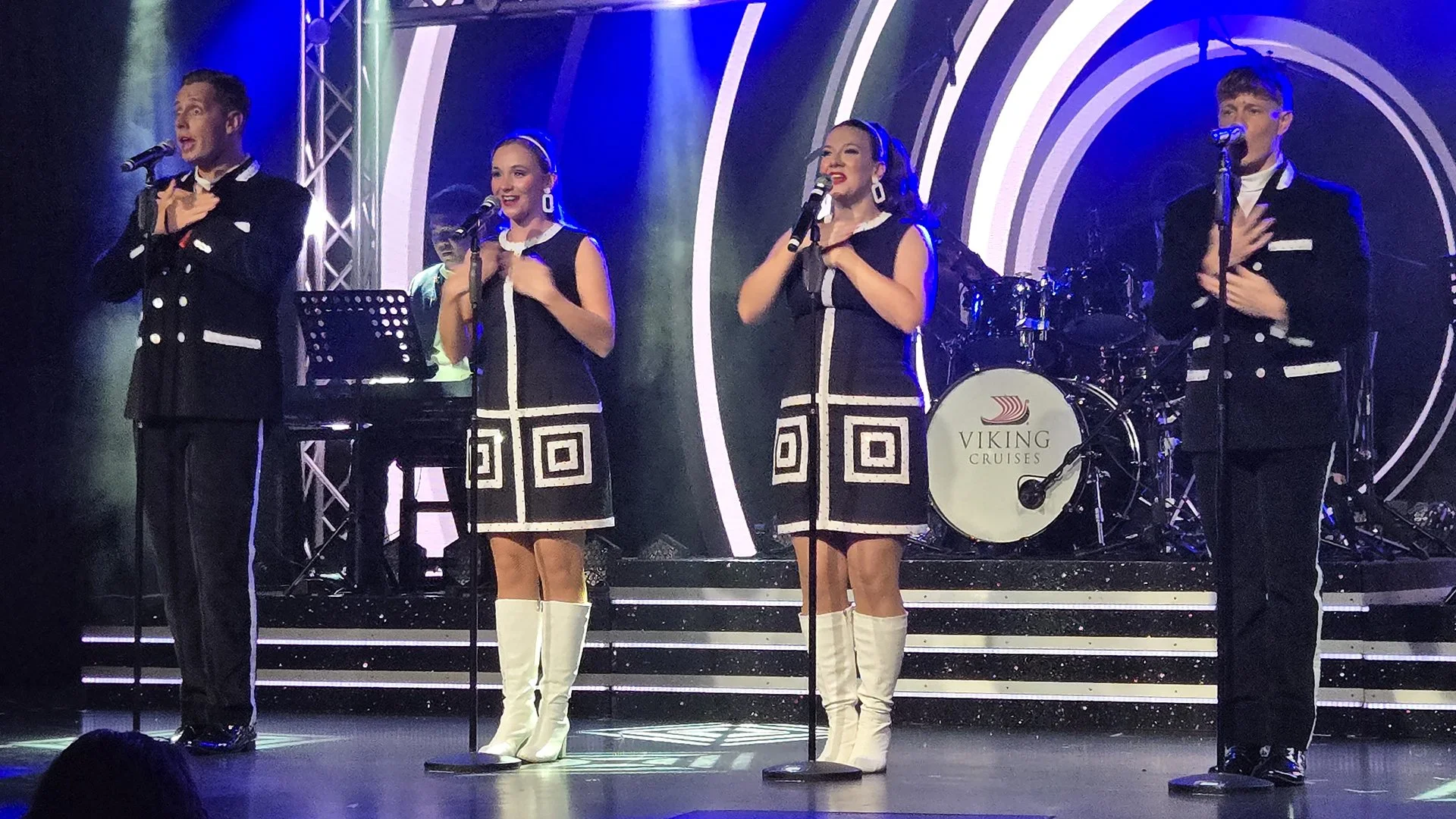
Then the performance team takes over with a Beatle’s retrospective.
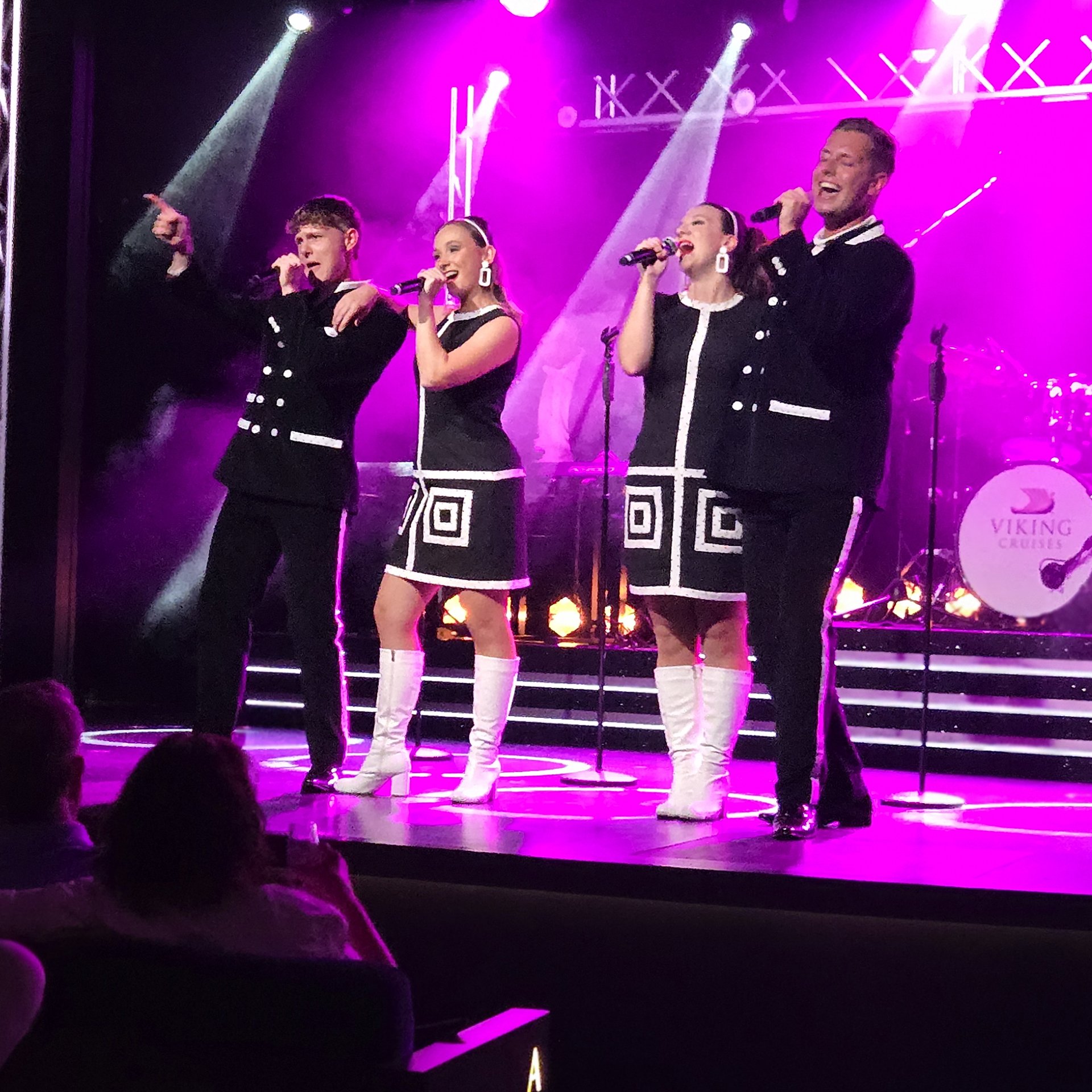
Fun show — talented performers.
After the stage show we went over to the nightclub Torshaven for drinks and dancing with live music by the Viking Orion band but I didn’t take any photos from there.
As you can probably tell, it was an epic sea day and we went to bed and slept very well.
Hong Kong China
After a pleasant day at sea we sailed into Hong Kong early in the morning.
We had a city tour in Hong Kong later that day. The city tour included a trip by funicular railway to the top of Victoria Peak for views of the city, then a cruise around part of the bay and a short stop in a local market for shopping. In the evening we had a entertaining traditional stage show by local performers in the ship's auditorium.
Early the next morning we had a quick breakfast and then we transferred to the airport for our flight home. As a result we didn't get any time to explore Hong Kong on our own or at our own pace.
If I had it again we would have extended our stay in HK after the cruise because what we saw of HK was impressive. Someday perhaps we will return and stay for a while.
Anyway, here are photos from our visit starting with sailing into HK harbor, visiting Victoria Peak and then a stop in a local market for shopping.
Photographically, some of these are the same as all the others from this trip — hand held, fast shutter speads,high ISOs taken on the run during tours. However, for the first time on this trip, I had the opportunity at Victoria Peak to actually get out my tripod and take some serious cityscapes. It was a nice change of space even though it was only a couple images.
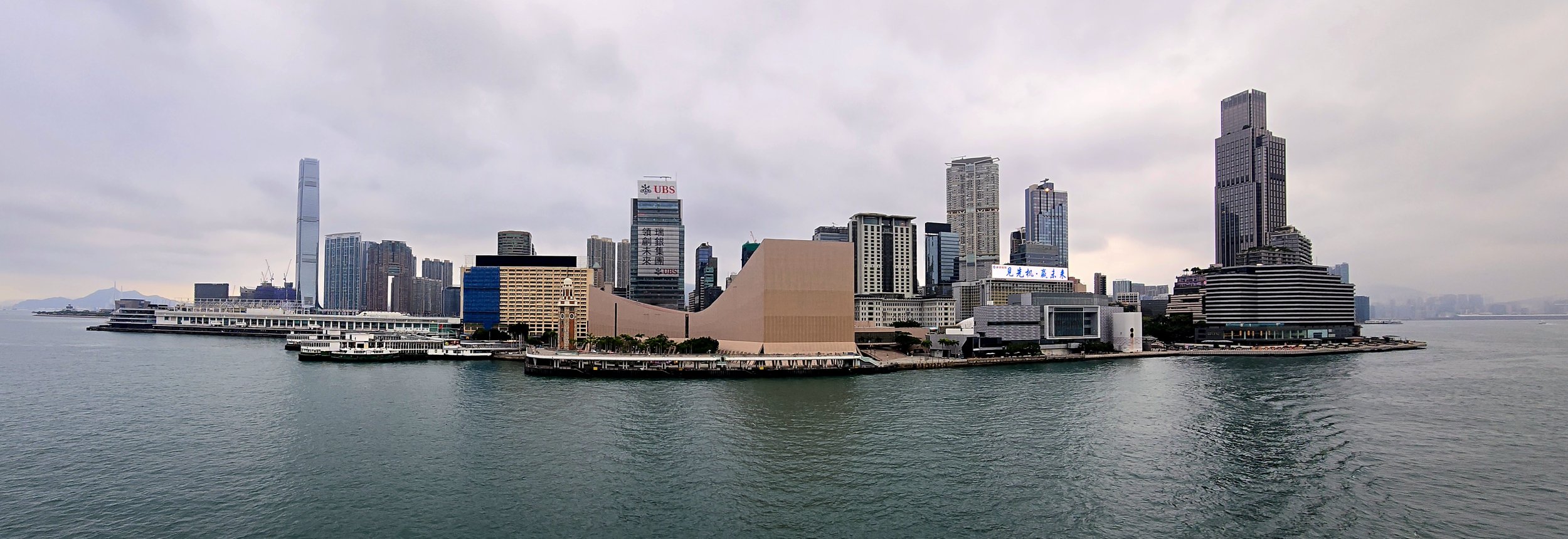
Hong Kong rises from the mist.
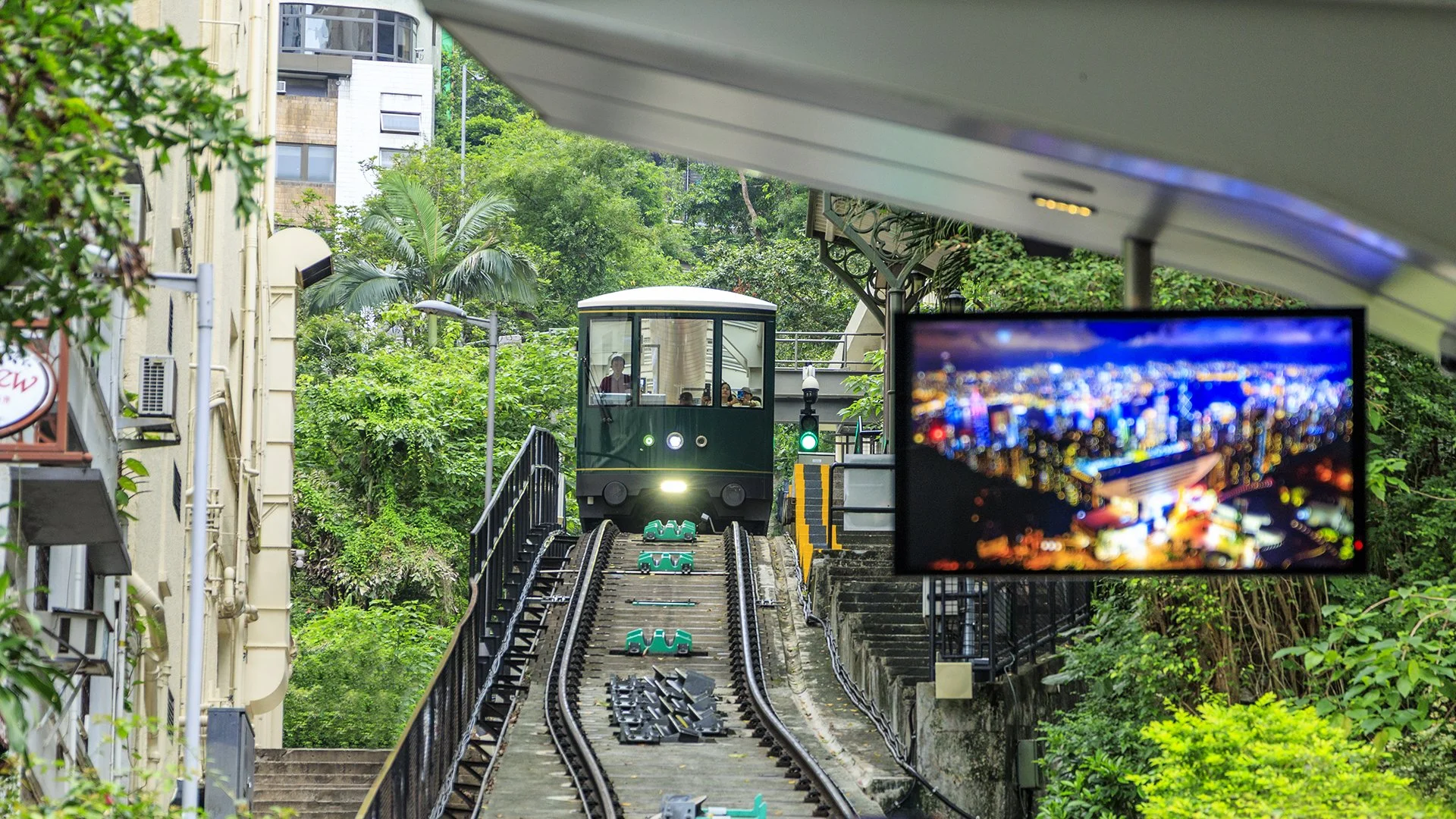
Funicular railroad to Victoria Peak.
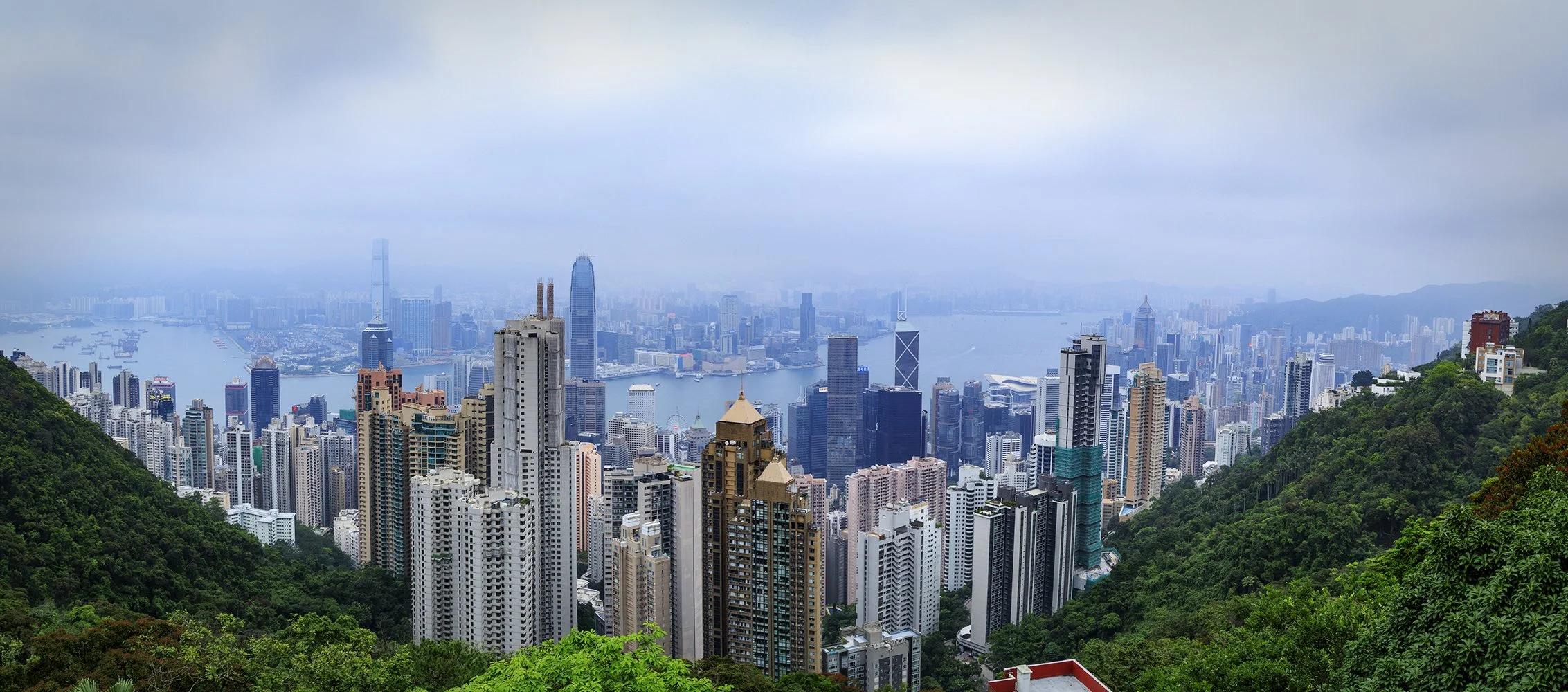
Hong Kong from Victoria Peak. This panoramic is stitched together from six images taken on a tripod.
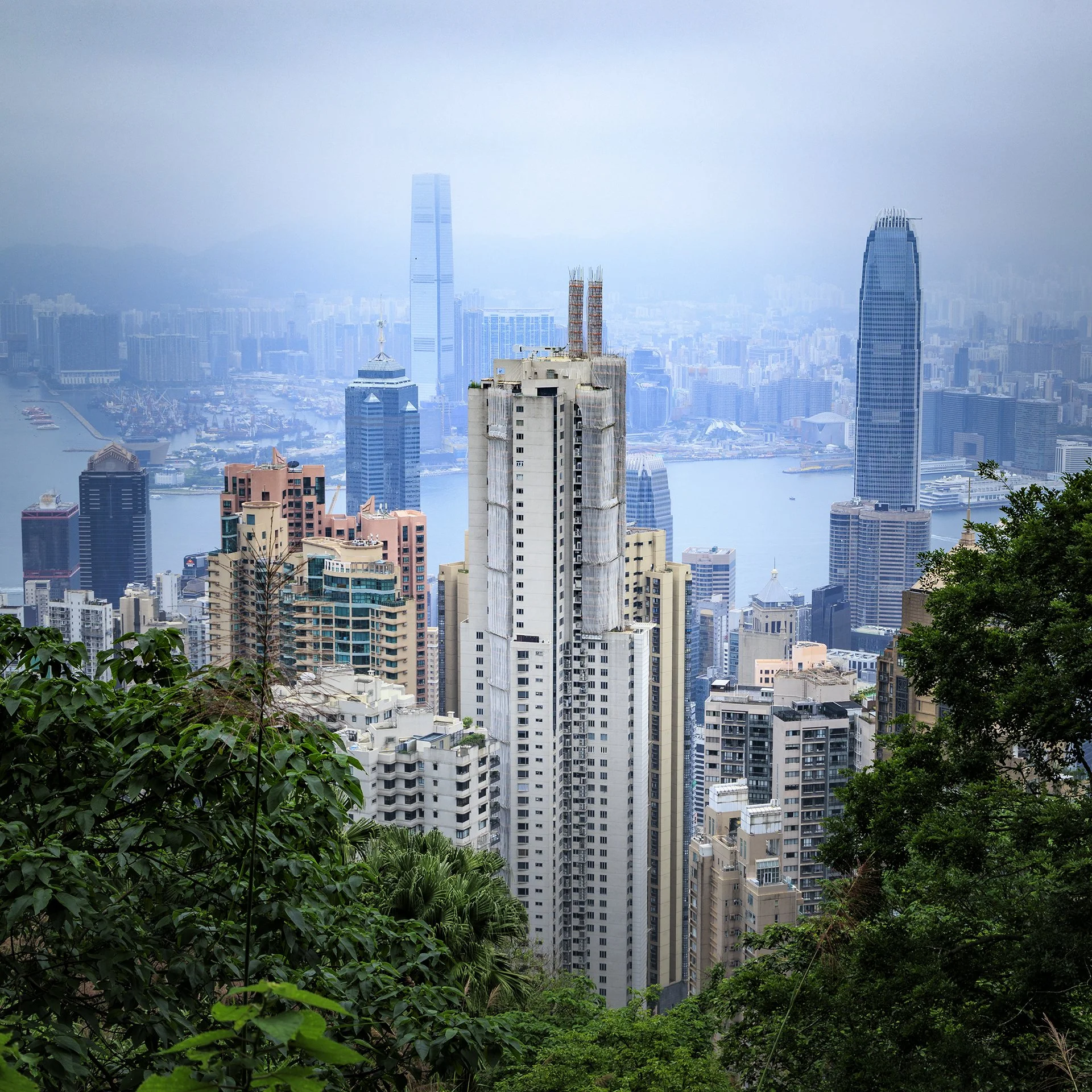
Another perspective on Hong Kong from Victoria Peak.
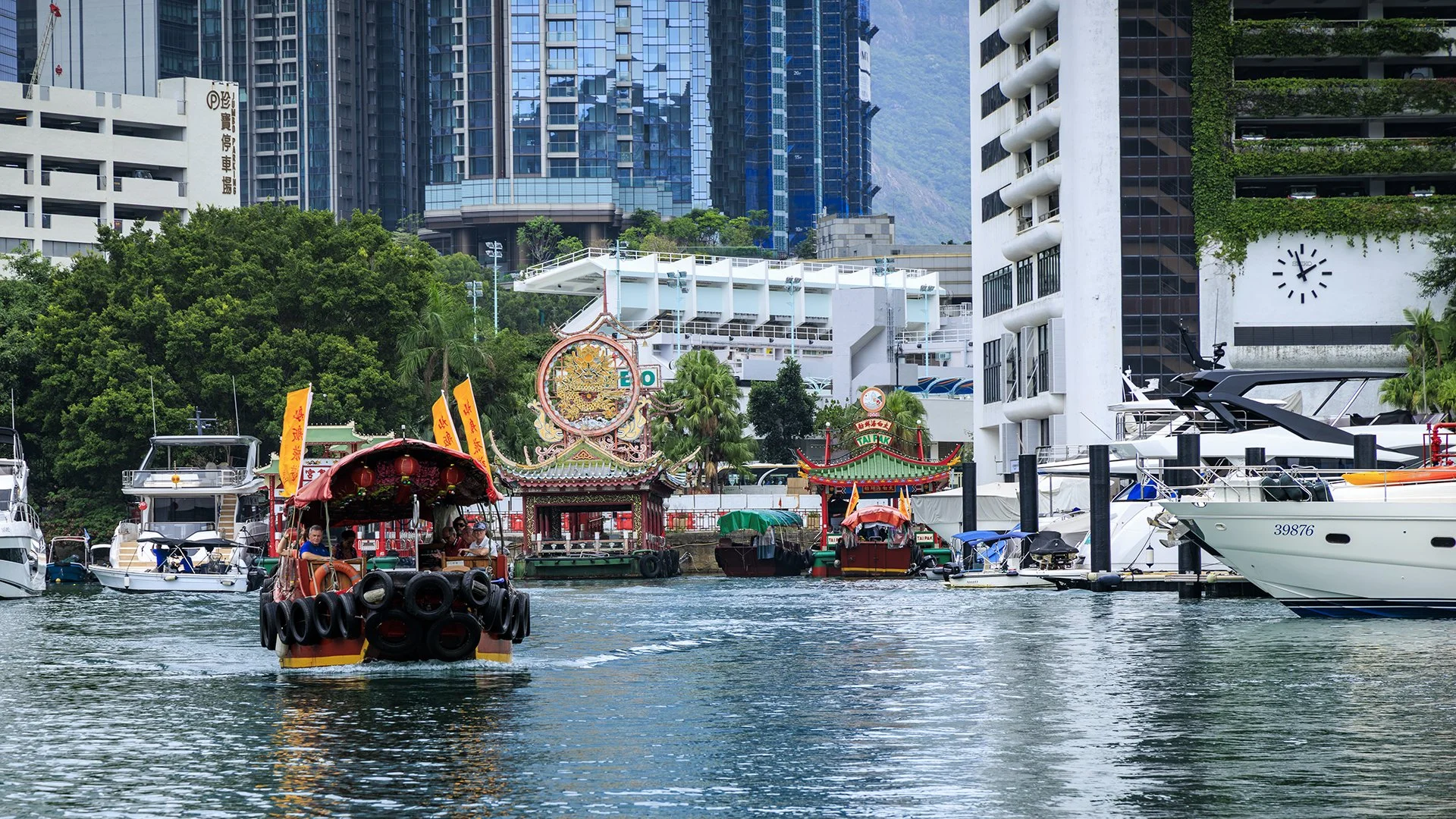
Back to handheld photography. Tourist boat tour of Hong Kong Harbor.
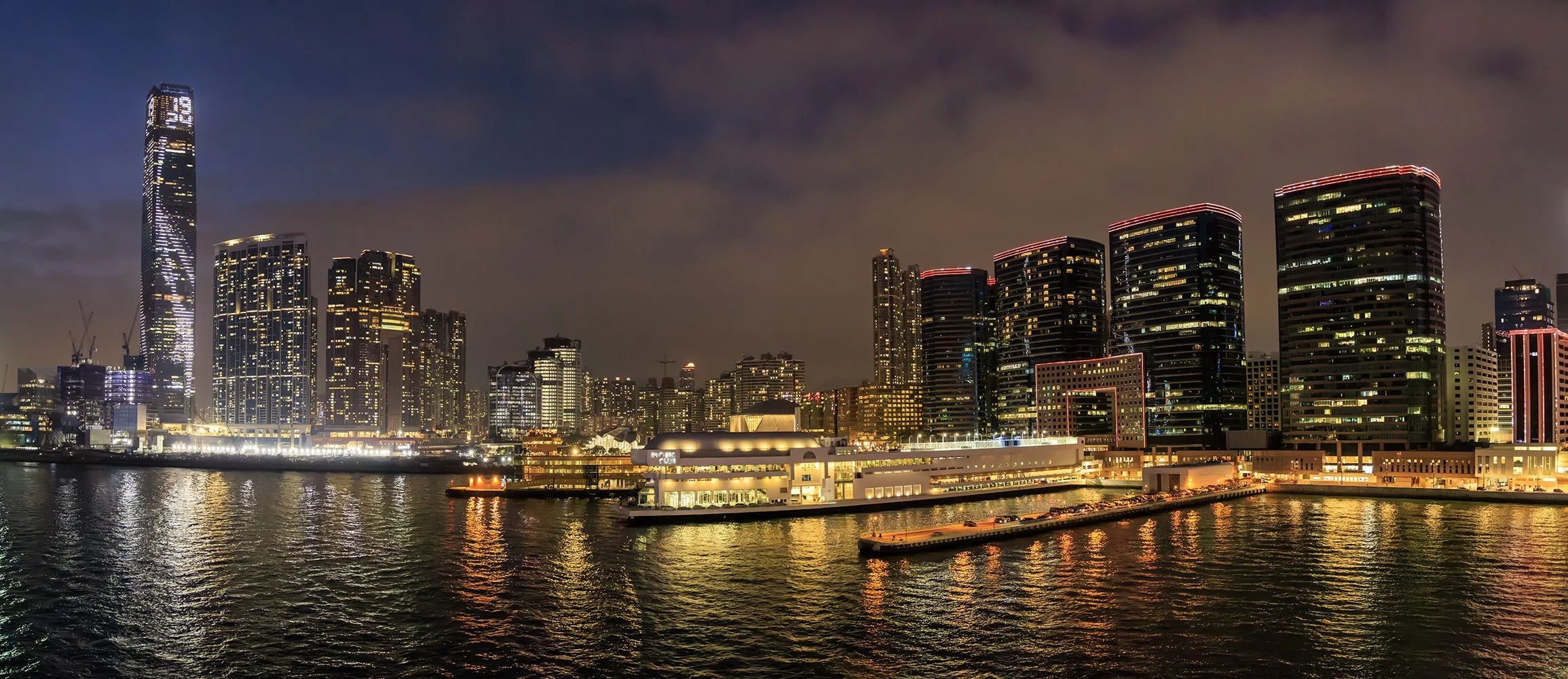
That evening I took this image from the ship (so with the drawbacks of handheld night photos again). This is only a tiny part of Hong Kong. The cruise terminal building blocked the view of the main part of the city that I really wanted to shoot.
I thought about going ashore to get some good tripod mounted images of the rest of the city but I wasn't sure how late the cruise terminal stayed open. Since we had to clear customs and security to go ashore I was worried to take the risk. Also, it had been a long day and we were really too tired to deal with the complexity.
That's OK. It means there will still be cool images to take the next time I visit Hong Kong (and I hope that I will do that someday).